
During a failover test, engineers pull the fiber that carries the state link of an active/standby FTD pair and wait for a transition. The dedicated failover link stays healthy, heartbeats continue, and the active unit never changes. Which statement about the failover link, the state link, and failover triggers explains the outcome?
Select an answer to reveal the explanation.
Short Explanation
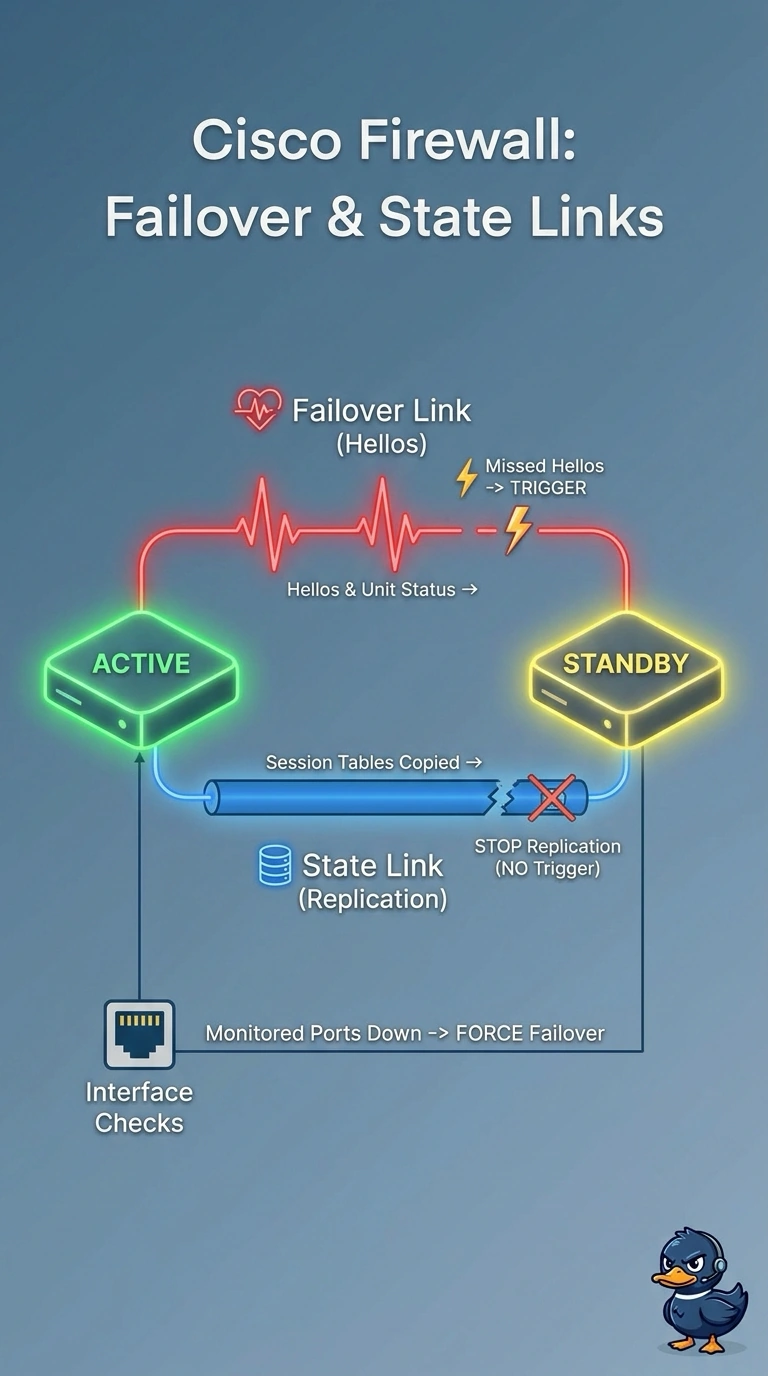
You keep failover triggers on the failover link, where the hellos live, while the state link mirrors sessions for a later takeover. It's like a heart monitor beside a shared notebook: only the monitor tells you the unit is alive.
Full Explanation
The failover link is the pair's lifeline: the units exchange hello messages and unit status across it, and missed hellos can make a unit decide its peer is gone and take over as active. The stateful link does a different job: it replicates connection and session tables so that a surviving unit can pick up existing flows. Losing it degrades that replication but does not, by itself, trigger failover. Because the hello path stayed healthy, the units kept confirming each other, no trigger fired, and the active unit stayed in charge for the whole test. Treating the state link as a second heartbeat path fails because hellos are not sent on it, so losing it cannot slow unit detection. Treating it as a monitored interface fails because interface monitoring watches configured data interfaces, not the state link. Claiming the standby took over fails because it contradicts the observed behavior that the active unit kept forwarding. One caveat is that a state link outage can leave the standby with incomplete session tables if a real failover occurs. A practical check is to confirm that hellos increment on the failover interface while state replication status is reported separately.