
A lead is standardizing definitions across several FTD devices so that shared policies behave predictably while each device still classifies its own internal network correctly. Considering the FMC object types network, port, URL and variable set, which pairing of object type and everyday use is correct?
Select an answer to reveal the explanation.
Short Explanation
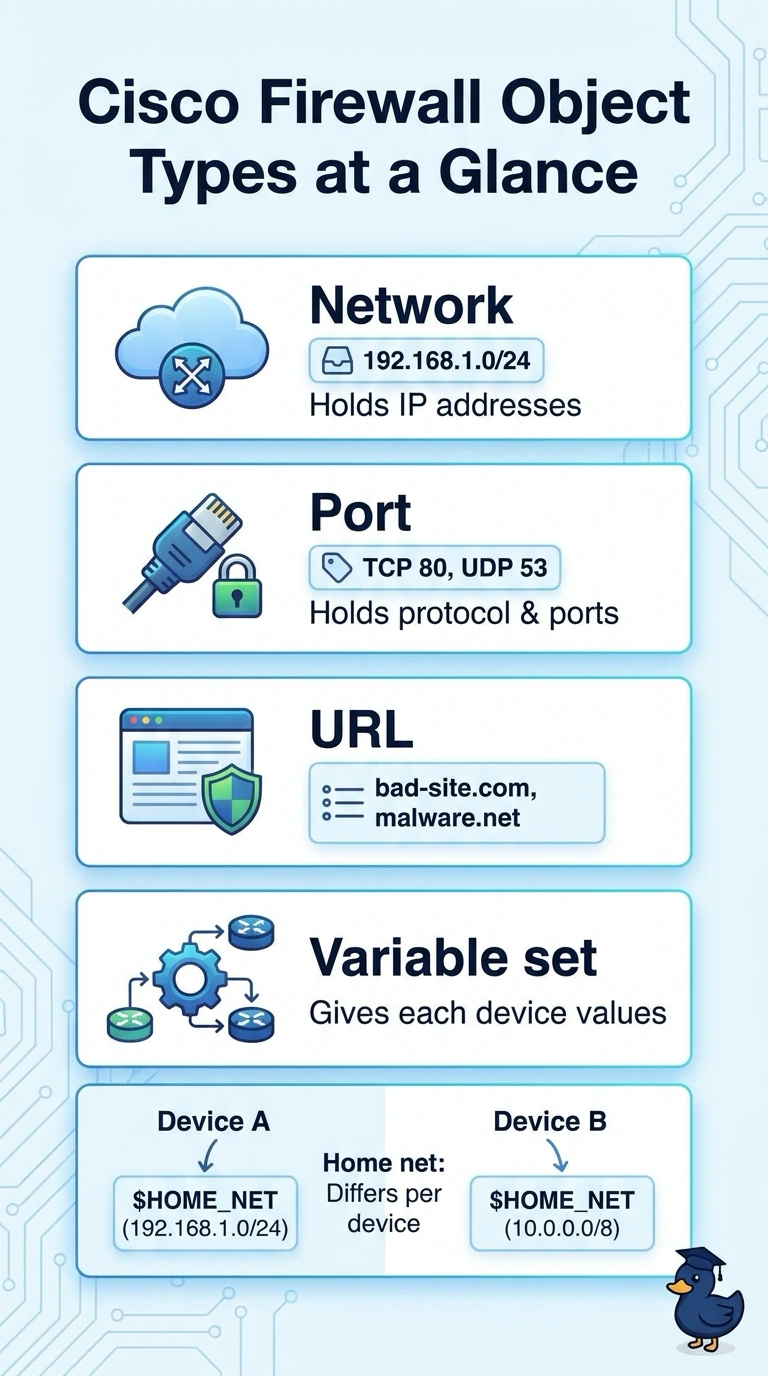
Nice work keeping the two jobs apart. Variable sets are what let one shared policy read $HOME_NET differently on each box, like identical labels on boxes that each hold a different address. Port objects, by contrast, keep a service definition in one spot, so you'll only edit one place when the port changes.
Full Explanation
Variable sets are what make one shared policy reusable: $HOME_NET is a variable that intrusion policies reference, and when it is built from network objects with per-device overrides it resolves to each device's internal ranges at deployment, so the datacenter and the branch can share identical rules yet match different addresses. A port object is the reusable home for a protocol and a port number, so writing TCP 8443 once means every rule that references it picks up a future change on the next deployment. Pairing a port object with a network object for ports fails because network objects store addresses rather than services, so no rule could ever match that value as a service definition. Using a network group in place of per-device variables fails because a group is shared and resolves to the same addresses on every device, which cannot express a different value per box. Using a network object to supply per-device $HOME_NET values fails for the same reason, it is one fixed definition deployed everywhere, even though the URL half of that pairing is correct. Exam caveat: object edits reach a device only when you deploy to it. Practical check: change the port number in the object once, redeploy, and confirm every rule that uses it now matches the new service.