
A branch office has two 1-Gigabit copper links from a collapsed-core switch to an FTD appliance in routed mode. The network standard requires the pair to present as one logical interface, to detect a failed or mispatched member through negotiation rather than by traffic loss, and to be built with LACP on the switch side. Which port-channel design on the FTD meets the branch standard?
Select an answer to reveal the explanation.
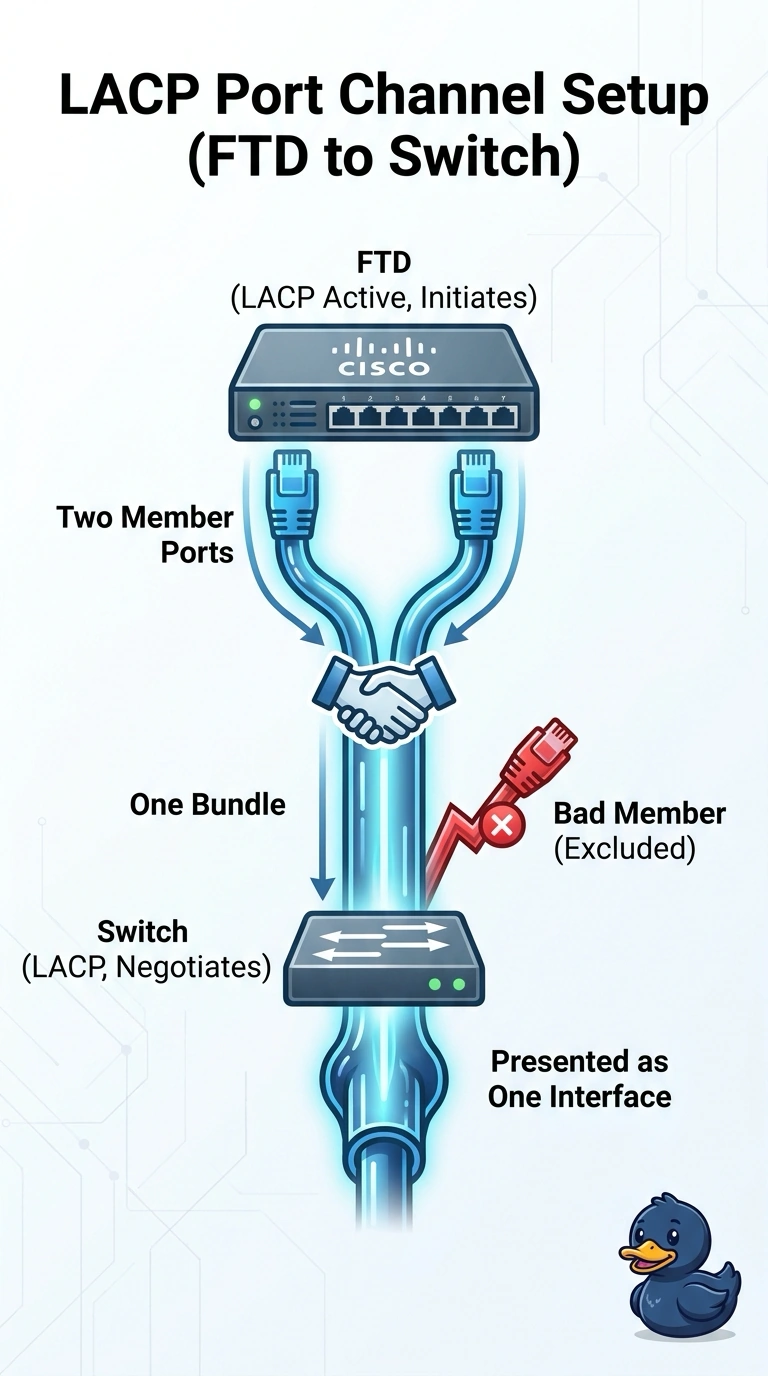
Short Explanation
You configure the FTD’s two interfaces in one port channel with LACP active, while the switch also negotiates the bundle. It’s like a two-lane bridge with a check-in: both ends confirm each link is compatible and remove one that stops participating.
Full Explanation
An FTD EtherChannel becomes an LACP bundle only when both ends speak LACP: the firewall and the switch exchange LACP frames on each member, and the links form one logical port channel. In routed mode, the port-channel interface carries the Layer 3 configuration rather than each member having a separate address. LACP can prevent an incompatible or mispatched member from joining the bundle, and peers can remove a member when LACP communication is lost. A static EtherChannel does not use LACP negotiation to verify members, so it cannot meet the requirement to detect a mispatch through negotiation. Keeping two separate routed interfaces fails the single logical interface requirement, even though equal-cost routing can use both paths. Setting LACP on the FTD side only fails because negotiation requires both ends to participate. Configure the port channel as a routed interface in the intended zone, and verify that its members are active before moving the address onto it.