
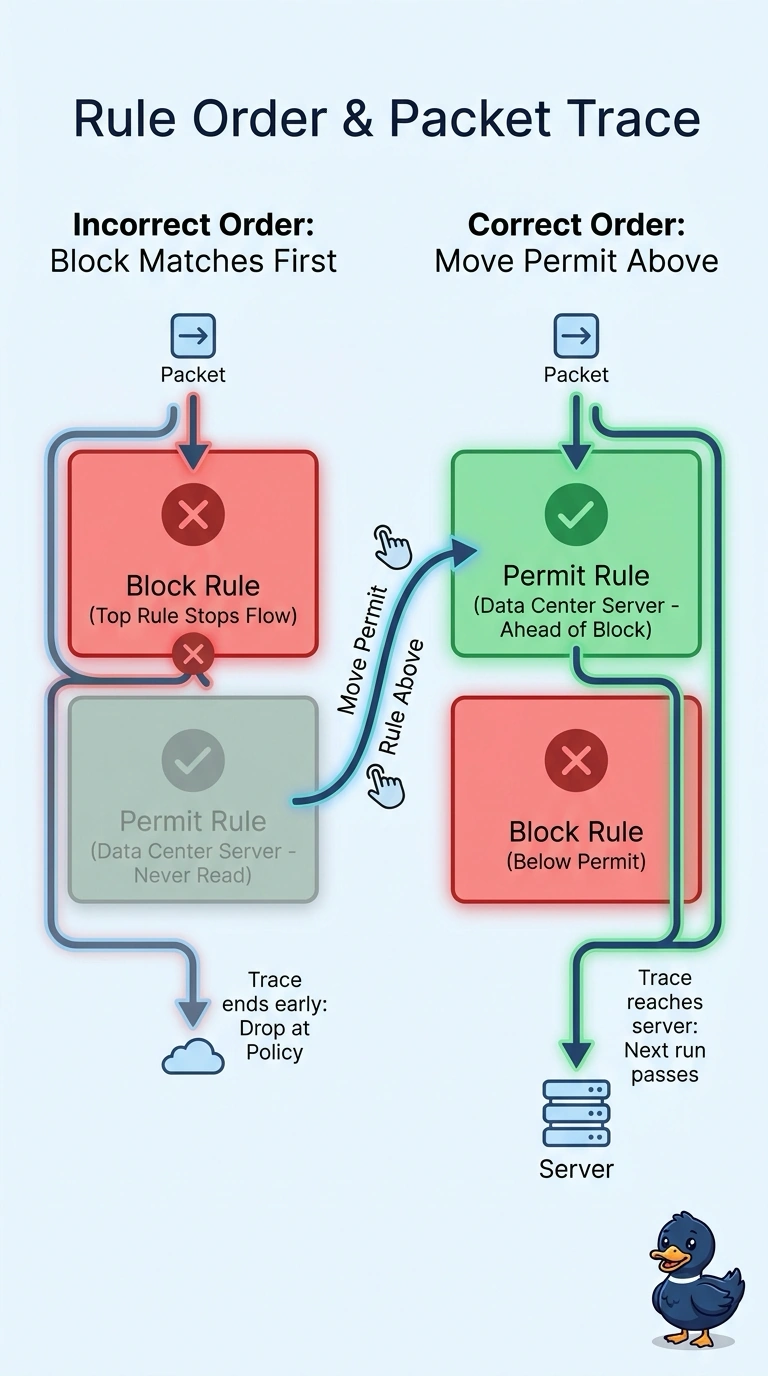
A security engineer traces a flow in Secure Firewall Management Center from a workstation in the Users zone to an application server in the data center zone. Each phase before policy evaluation reports success, but the trace ends there with a drop caused by a block action, while the permit rule for that server sits lower in the rule list. Which rule placement change will clear the drop at policy evaluation for this traced flow?
Select an answer to reveal the explanation.
Short Explanation
You've nailed the real cause, because the trace stopped at policy evaluation and never reached routing or inspection. Reordering the rules puts the permit in front of the block, like moving your name tag to the front of the queue. The detail that matters is rule order, since the engine stops at the first matching rule.
Full Explanation
Access control evaluation in Threat Defense walks the rule list from the top down and stops at the first rule whose conditions match the packet, so an earlier block action always beats a later permit no matter how specific that permit is. Moving the permit above the block changes the evaluation order, and the trace then reports a permit match so the flow continues into the next phase. The static route approach fails because routing already completed successfully in this trace, so a route lookup problem never existed. Turning on application inspection fails because inspection only runs after policy evaluation lets the packet through, so it cannot rescue a flow that was already dropped. The identity rule approach fails because the block matched on network conditions before any directory lookup happens, so user identity never gets a chance to influence the result. Exam caveat: the phase summary in a trace can look different from the per-hop detail, so trust the phase that actually shows the drop. Practical check: re-run the packet trace after the change and confirm a permit match at policy evaluation before touching production traffic.