
During an outage, an engineer traces a test packet on the FTD from a client to a new reporting server. The output returns a drop reason showing that the route lookup failed for the destination, and the trace ends right there before any NAT or inspection section is printed. Which reading of the packet tracer output is correct?
Select an answer to reveal the explanation.
Short Explanation
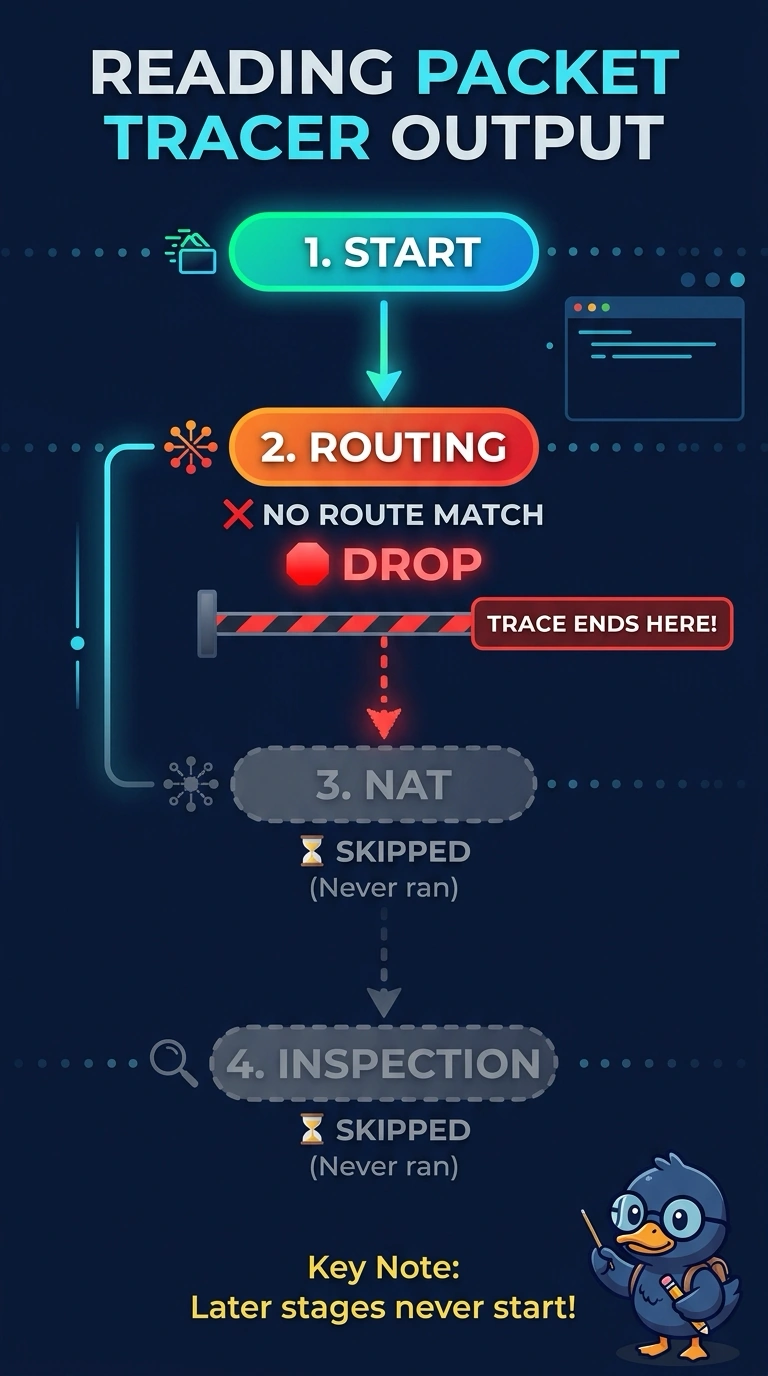
The drop reason tells you the routing stage ended the run, so everything after it never executed. It's like a relay race where the baton drops and the later runners never get to start.
Full Explanation
Packet tracer walks a synthetic packet through the device's stages in order and stops at the first stage that drops it, so the drop reason printed in the output is the stage where the trace ended. A route lookup failure means the device had no usable route for the destination at that point, and because the trace stops there, a NAT section and an inspection section cannot appear after it. Reading the result as an access control rejection ignores that the printed drop reason names routing rather than a policy decision, and an access rule is blamed only when the policy stage prints the drop. Reading it as a NAT failure assumes translation was evaluated even though the output ended at routing. Reading it as a successful trace with an upstream drop contradicts the drop reason the tool reported for the firewall itself. Exam caveat: packet tracer simulates the flow and never puts traffic on the wire, so it complements a real capture rather than replacing it. Practical check: confirm the route exists, add it if it is missing, then rerun the trace and watch the drop reason change.