
A credit union must manage 12 Secure Firewall Threat Defense appliances from one place: the management plane must stay inside its data center, one shared access-control policy has to reach every device, and engineers must be able to review connection and intrusion events after an incident. Which management tool fits all three requirements?
Select an answer to reveal the explanation.
Short Explanation
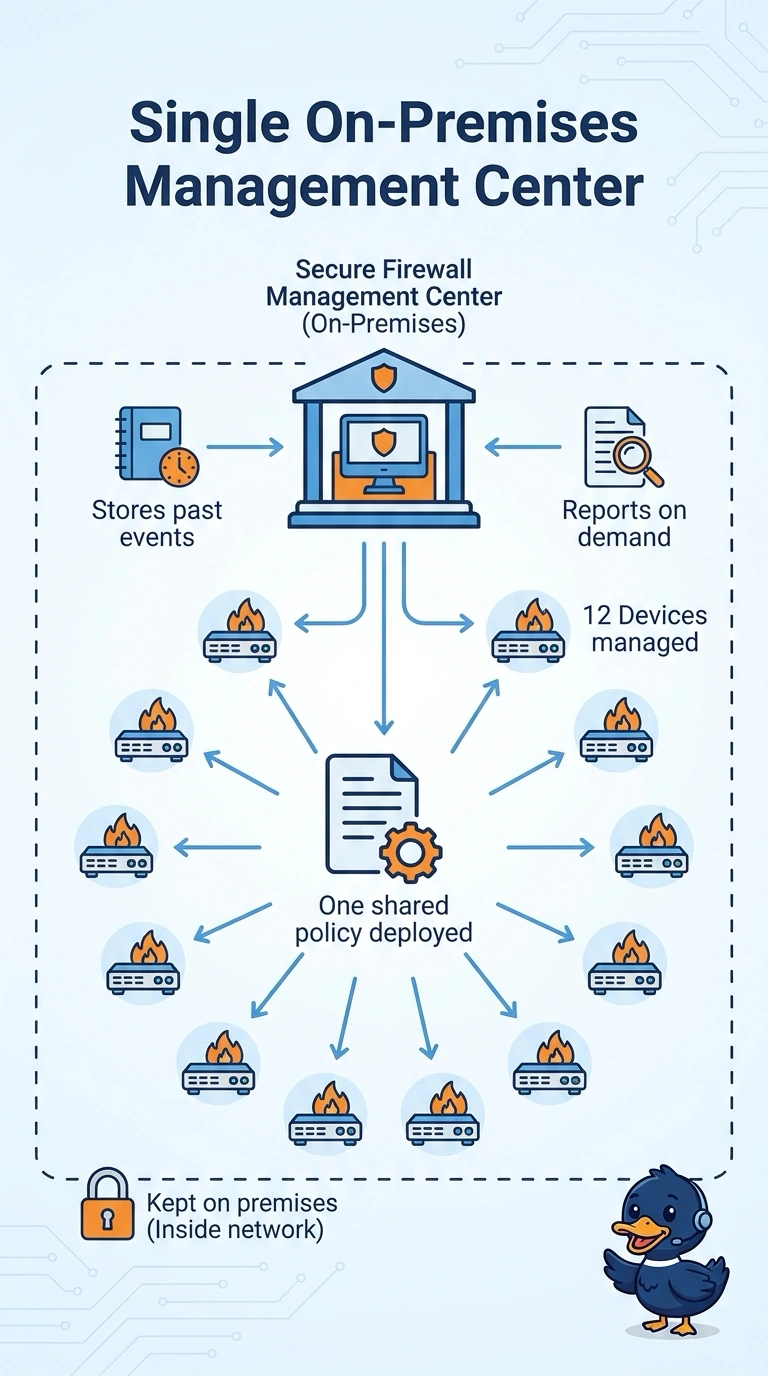
You can keep the management plane in your data center and centrally apply one shared policy and review events with an on-premises Secure Firewall Management Center. Firewall Device Manager manages appliances individually, while a cloud-hosted Management Center does not meet your location requirement.
Full Explanation
An on-premises Secure Firewall Management Center fits because it keeps the management plane in the credit union’s data center, lets you deploy one shared access-control policy across the appliances, and provides centralized connection and intrusion event management for incident review. A cloud-hosted Secure Firewall Management Center can provide centralized policy deployment and event visibility, but its management plane is outside the data center, contrary to the stated requirement. Firewall Device Manager can configure and inspect an individual appliance, and reusing a standard policy template can help keep configurations consistent; however, each appliance is managed through its own interface, so this approach does not provide one place to manage the fleet. An on-premises Secure Firewall Management Center with a separate access-control policy for each appliance can centralize device management and event review, but separate policies do not meet the requirement for one shared policy to reach every device. Exam caveat: centralized management does not automatically mean a single policy is applied to every managed device. Practical check: before deployment, confirm that all 12 appliances are registered to the on-premises manager, included in the shared policy’s deployment scope, and configured to retain the connection and intrusion events needed for post-incident review.