
A retail chain is inserting an FTD appliance between its access switch and distribution router so the point-of-sale servers keep their current addresses. The appliance must filter at Layer 2 while routing stays elsewhere, keep both segments in one broadcast domain, and hold its management address on one virtual interface in the production subnet. Which FTD deployment mode and interface design satisfies every requirement?
Select an answer to reveal the explanation.
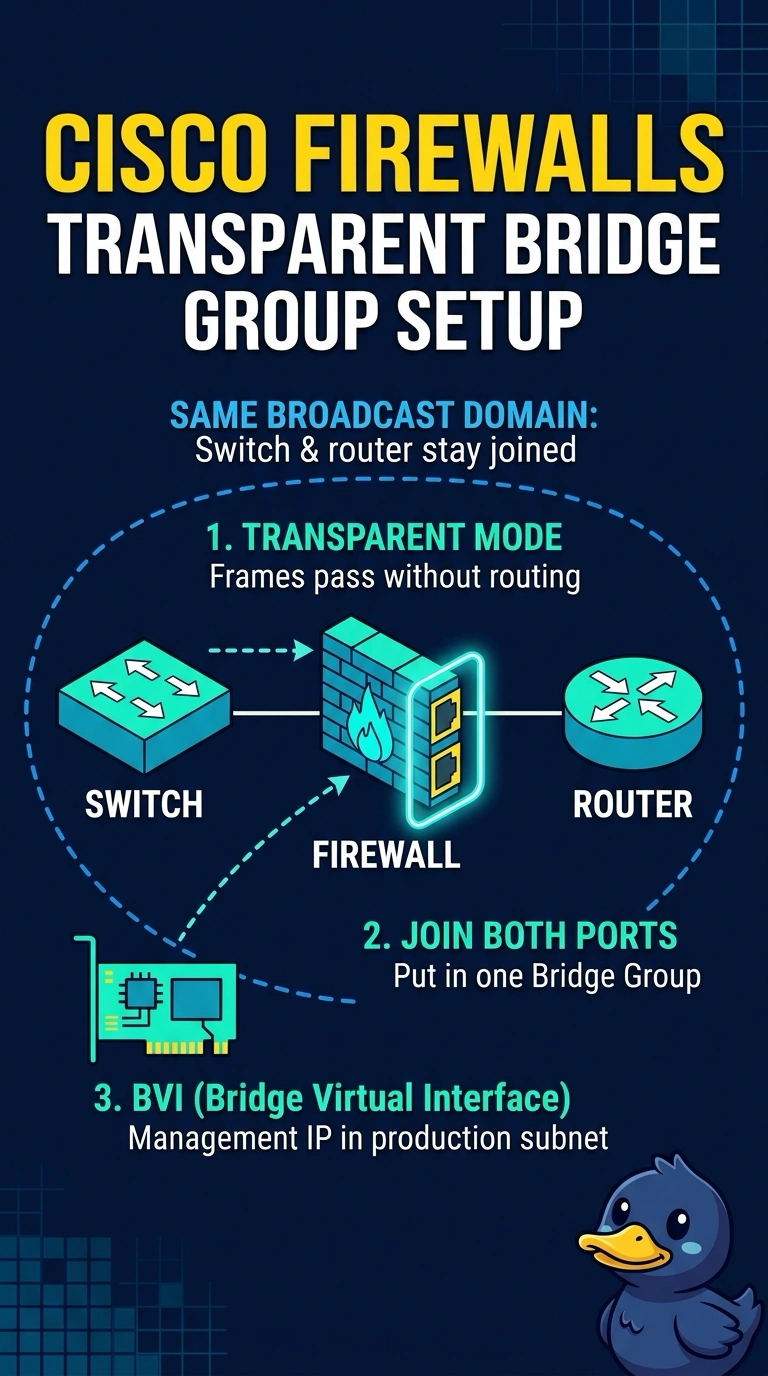
Short Explanation
You've got it: transparent mode turns the appliance into a bridge, so the switch and router still behave as one segment, just like a patch cable with a security guard on it. The bridge group virtual interface (BVI) carries the appliance's management address, which must be in the bridged network's subnet. Two groups would split the segment, and routed mode would not meet the Layer 2 requirement.
Full Explanation
In transparent mode the appliance forwards Ethernet frames instead of routing packets, so both data interfaces belong to a single bridge group and the unit bridges them like a switch, leaving host addresses and gateways unchanged. The bridge group virtual interface (BVI) provides an IP address for device management; that address must be in the subnet of the bridged network. A routed-mode design fails the Layer 2 requirement because the appliance routes between Layer 3 interfaces. Placing the management address on a physical interface fails the requirement for a virtual interface, while two separate bridge groups form distinct Layer 2 domains. A bridge group requires at least two member interfaces. Practical check: after cutover, confirm in the Management Center interface panel that both interfaces show the same bridge group ID and that the BVI holds the management address before testing access.