
A hospital must insert an FTD between two switches carrying 192.168.10.0/24; every host keeps its current address and default gateway, and broadcasts must still cross the link. Management access from the data center has to work as well. Which transparent-mode design should the engineers deploy?
Select an answer to reveal the explanation.
Short Explanation
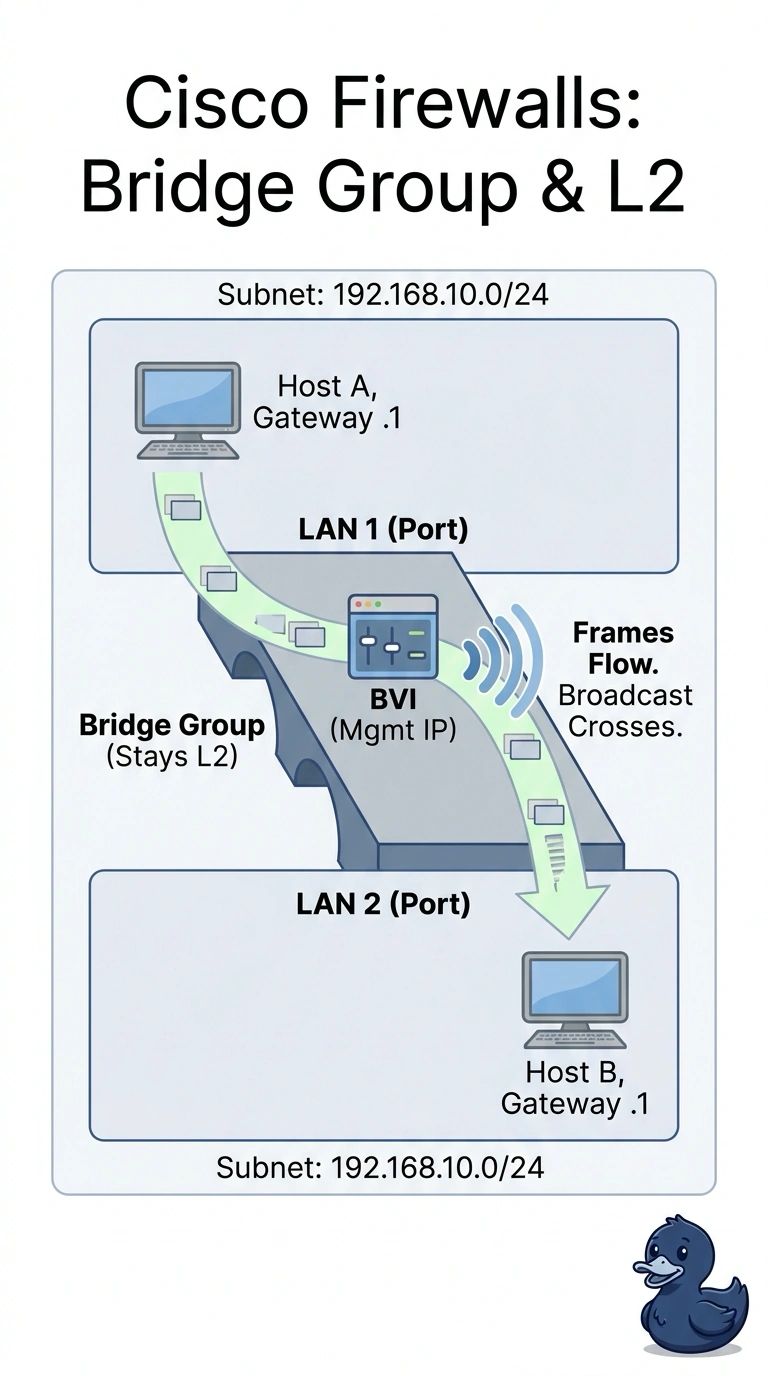
Bridge both LAN interfaces in one bridge group so broadcasts can pass and hosts keep their current addresses and gateways—like a clear walkway between two rooms. Give the BVI a management address so the data center can reach the FTD.
Full Explanation
In transparent mode, bridge-group member interfaces carry no IP addresses and forward frames at layer 2. Grouping the ports creates a logical segment, and the BVI can have an address for management; configure the appropriate management access and routing so the data center can reach it. Routed mode makes the appliance a layer 3 hop, conflicting with the requirement to keep the hosts' existing gateway. A physical bridge-group member interface cannot have its own address, and the BVI address is not a replacement default gateway for the hosts. The BVI address must be in the connected subnet. Broadcast traffic is subject to the applicable forwarding and access-control behavior, so verify the required traffic is allowed.