
A retailer wants to add threat inspection between a pair of Layer 2 switches at a store while host addresses and the default gateway stay exactly as they are. The engineer plans to deploy Secure Firewall Threat Defense in transparent mode. Which configuration detail describes how the appliance joins that Layer 2 segment in transparent mode?
Select an answer to reveal the explanation.
Short Explanation
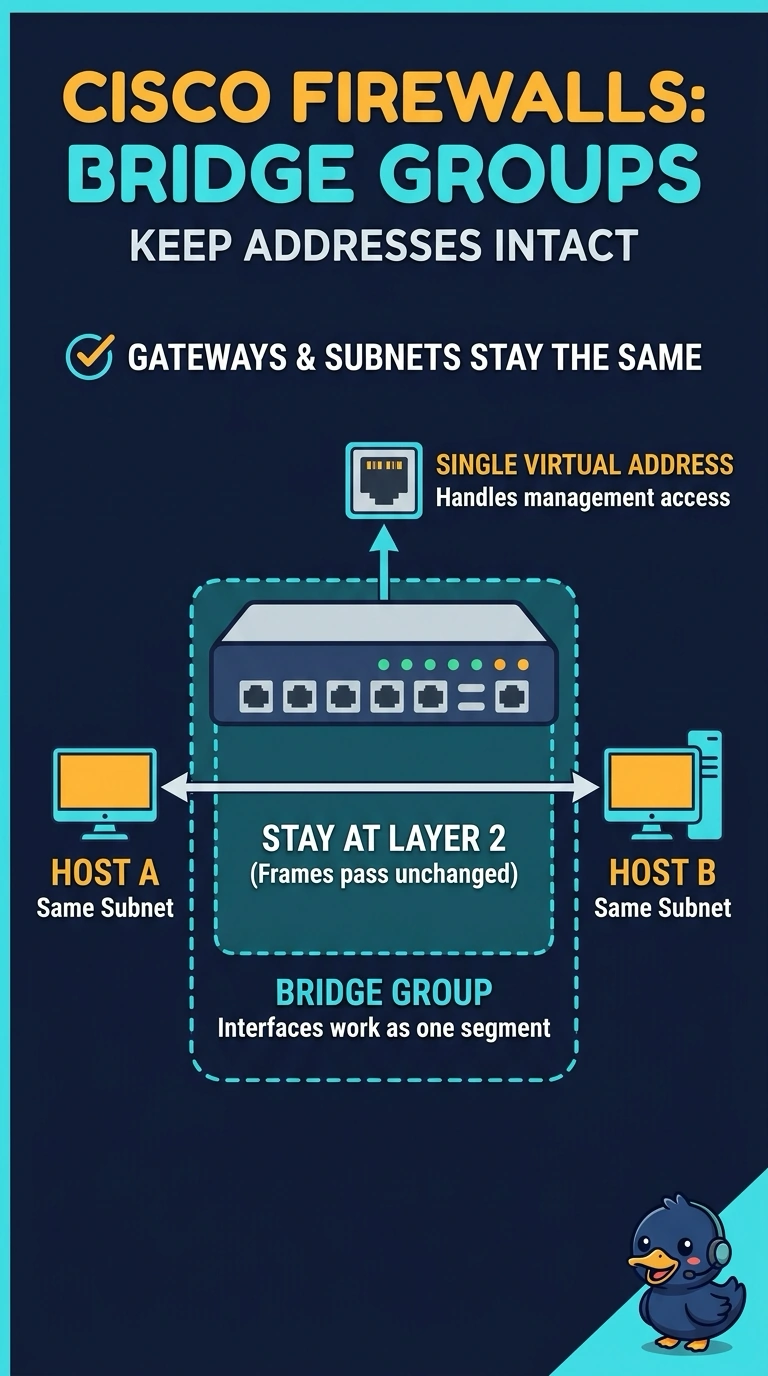
You put the interfaces in one bridge group, so your hosts and default gateway don't need to change in transparent mode. One bridge group virtual interface (BVI) address handles management access and appliance-originated traffic, like several doors opening into one room with a single mailbox.
Full Explanation
Transparent mode places the appliance into an existing segment at Layer 2, so participating interfaces are collected in a bridge group. That group presents one bridge group virtual interface (BVI), which carries the IP address used for management access and appliance-originated traffic. Hosts keep their addresses and gateway, so deployment does not disturb the segment. Giving every interface its own subnet is a routed-mode design and would require the addressing changes the scenario forbids. Assigning an address per interface inside the group misunderstands bridging, because the group behaves as one broadcast domain behind a single BVI. An unaddressed BVI would prevent access to the appliance through that interface and prevent it from originating traffic using that address; it does not mean all management must use a console. A bridge group can hold several interfaces, but only its BVI carries the group’s IP address, so expect one address per group rather than per port.