
A branch office replaces its router with an FTD appliance in routed mode. The inside interface faces the core switch, the outside interface faces the ISP router, and the core switch already uses the appliance as its default gateway. The ISP forwards traffic for one public address only. Which configuration completes the routed-mode path for outbound traffic?
Select an answer to reveal the explanation.
Short Explanation
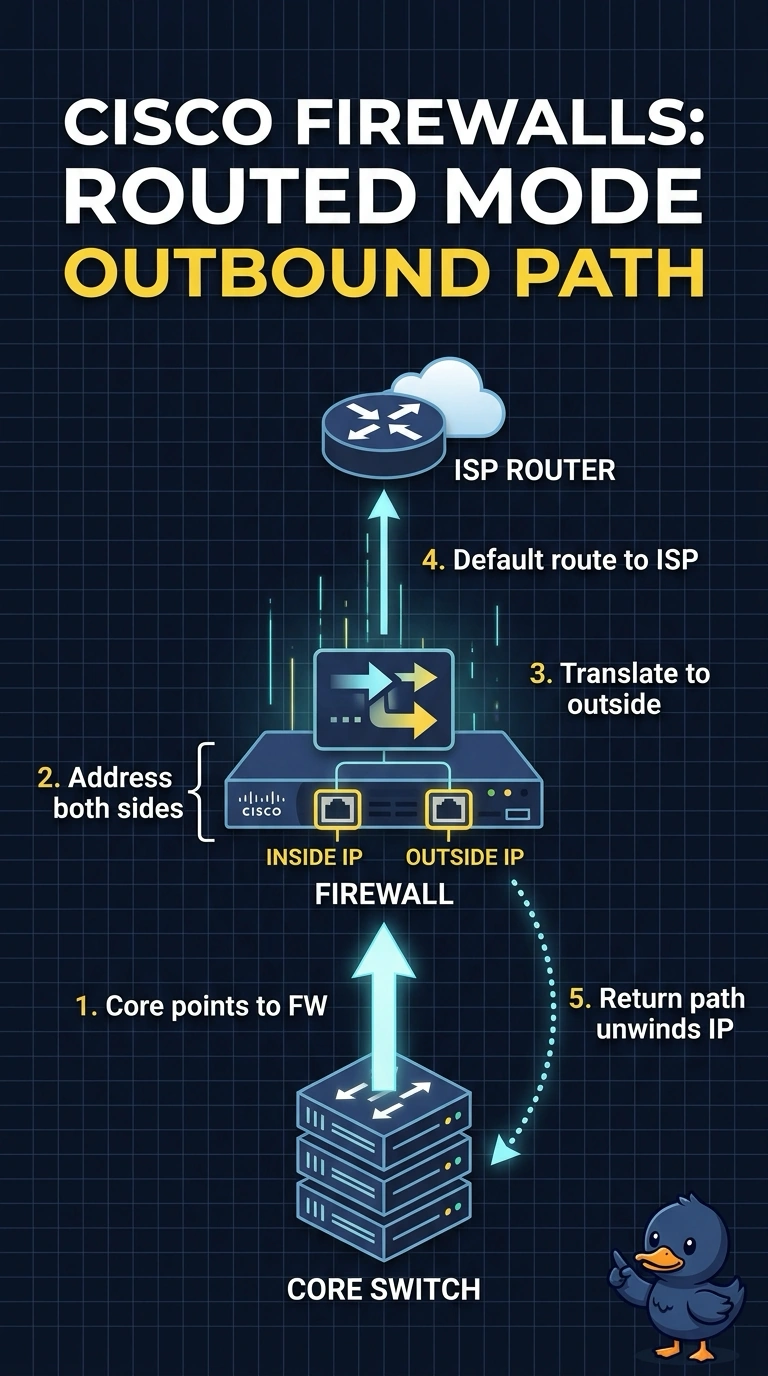
You’re on the right track: routed mode makes the FTD act like a router that also inspects, so it needs addresses on both interfaces and a route onward. Think of it as a postal hub that needs an address, an exit road, and a return-address swap; leave out any one and outbound traffic cannot complete its trip.
Full Explanation
The configuration that completes the path addresses the FTD’s inside and outside interfaces, points its default route toward the ISP router, and translates inside traffic to the outside address. The core switch already sends traffic to the FTD as its default gateway, so packets can enter the appliance; the ISP-facing route provides the onward path, and translation lets private hosts share the single public address the ISP forwards. A dynamic NAT pool is suited to a set of usable public addresses, but translations to other pool addresses would lack a working return path here. An OSPF-learned default route assumes an OSPF adjacency and route advertisement from the ISP, neither of which the scenario provides; the specified path needs a route to the ISP router. A default route toward the core switch points the wrong way: the core is inside and already directs client traffic to the FTD, while the ISP router is outside and is the next hop for outbound traffic. Exam caveat: a learned or policy-based route can replace a static default route in a suitably configured design, but do not assume that mechanism without evidence in the question. Practical check: inspect the FTD routing table and NAT counters, then verify that a translated outbound packet reaches the ISP and its reply returns to the same public address.