
A branch office carries SIP voice, a video-conferencing subnet and large backups to a cloud target across one 50 Mbps ISP link. At 4 p.m. the link saturates and calls break up while the backup keeps flowing, and change control allows only the QoS policy editor. Which Threat Defense QoS design protects the real-time traffic?
Select an answer to reveal the explanation.
Short Explanation
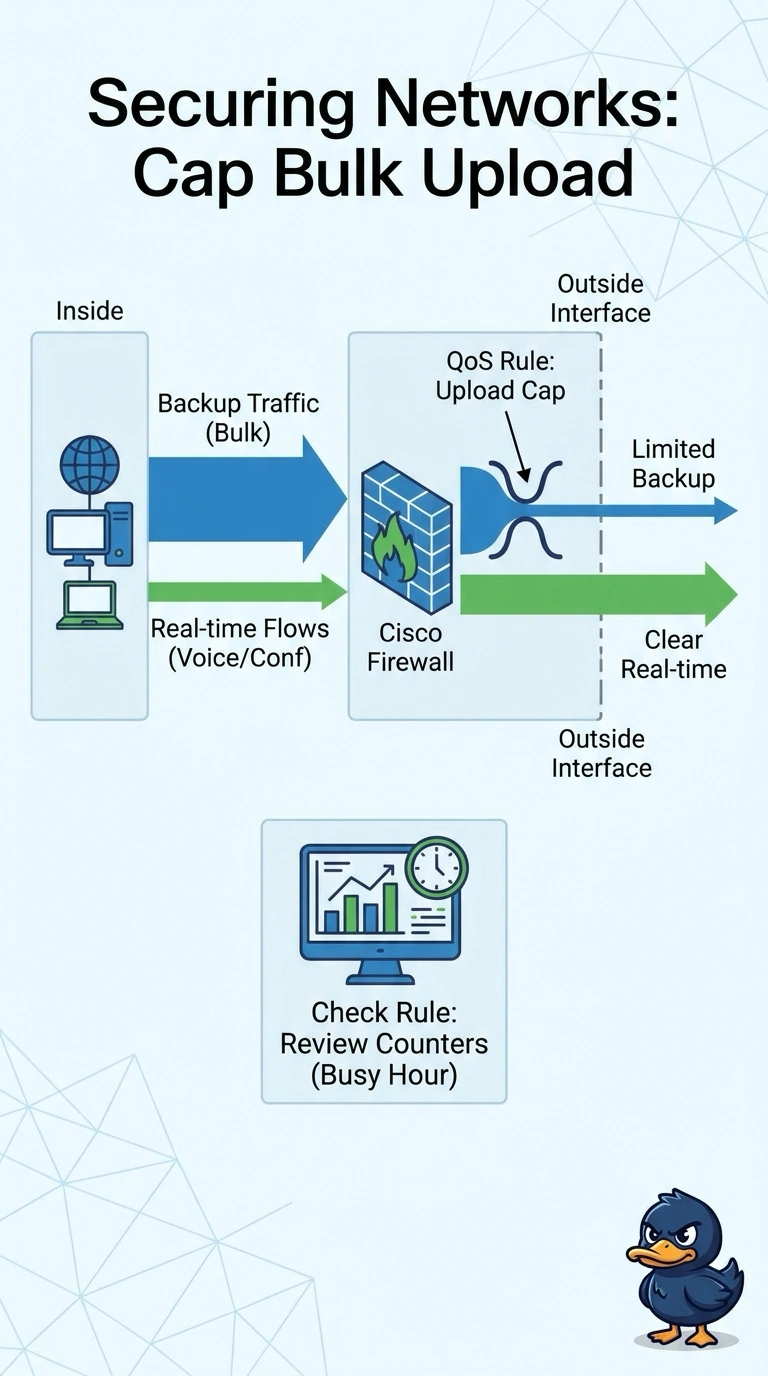
You can add a rate-limiting QoS rule on the outside interface to cap backup uploads, leaving more of the link available for your voice and video. It’s like keeping one car from hogging the road; this limits backups but doesn’t reserve bandwidth for real-time traffic.
Full Explanation
Threat Defense QoS rules can apply upload and download rate limits, in megabits per second, to matching traffic on a selected interface. A rule matching the backup traffic on the outside interface limits that flow and can reduce its competition with SIP and conferencing during the busy hour; it does not reserve bandwidth or guarantee call quality. A priority queue with guaranteed bandwidth is not a control offered by the QoS policy editor. A cap on all uploads limits the aggregate but does not prioritize real-time traffic within that limit. Ceilings on voice and conferencing limit those flows while leaving the backup unrestricted. Check the QoS rule counters during the busy hour to confirm that the backup traffic is being limited.