
The bank is inserting an FTD appliance between its server VLAN and the internet edge router so traffic can be inspected and controlled. The server subnet keeps its existing addressing, outbound sessions must be translated to the outside interface address, and the appliance must learn remote routes from the router through OSPF rather than from static entries. Which routed-mode configuration should the engineer implement for addressing, NAT, and routing?
Select an answer to reveal the explanation.
Short Explanation
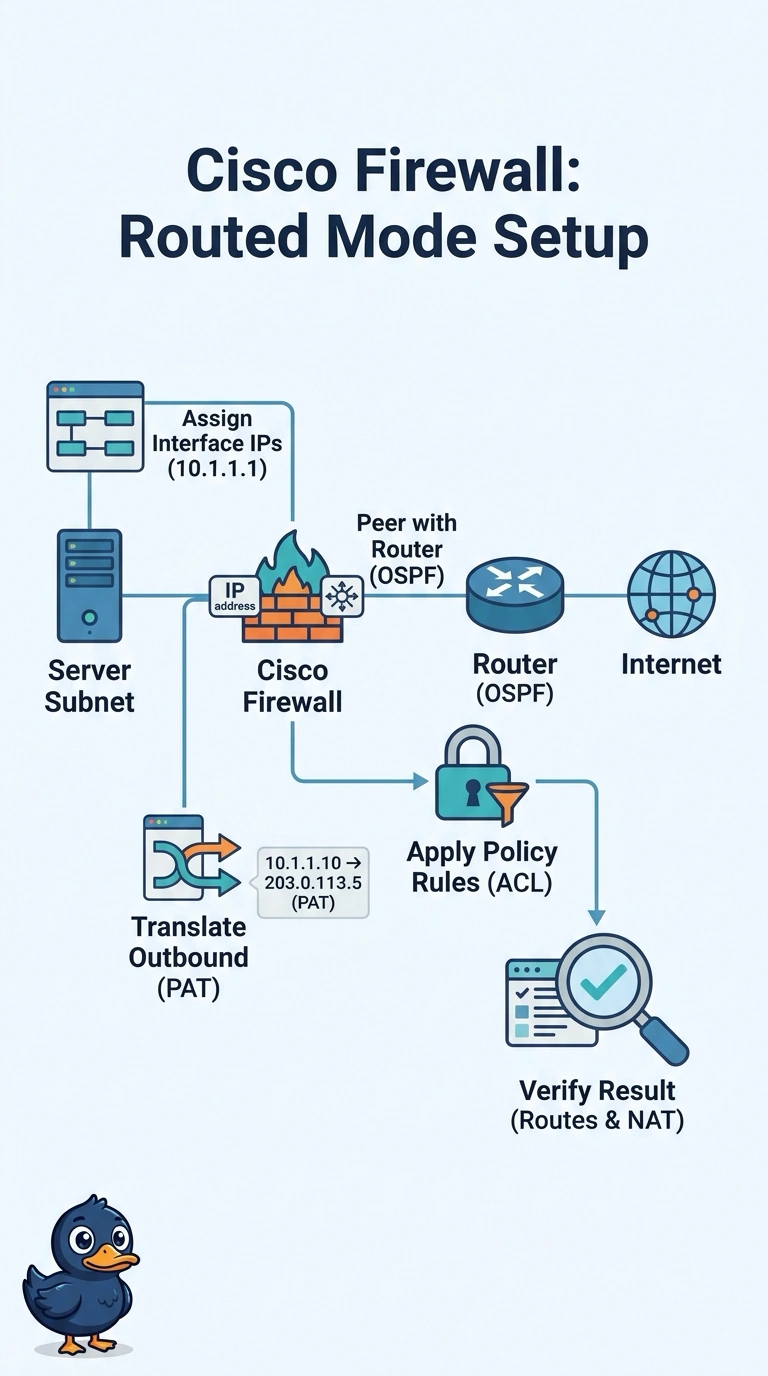
In routed mode, you’ll give each data interface an IP address in its connected subnet and peer with the router using OSPF to learn remote routes. Use outbound PAT so your server traffic shares the outside interface’s address, like several packages using one return address.
Full Explanation
The correct configuration preserves the servers’ existing subnet while giving the FTD data interfaces addresses appropriate to their connected networks. OSPF lets the appliance learn remote routes dynamically from the edge router, and outbound PAT translates many server sessions to the outside interface address as required. A dedicated public NAT address is a conventional alternative when an organization has a routed public address pool, but it fails here because the required translated address is specifically the outside interface address. Static routes are also used in routed deployments, particularly for small or stable networks, but they do not satisfy the requirement to learn remote routes from the router through OSPF. Renumbering servers into a new subnet can be a valid network redesign, yet it violates the requirement to retain the current server addressing. Exam caveat: distinguish the address used for PAT from the address configured on the outside interface; a public pool address is not automatically the interface address. As a practical check, verify the OSPF neighbor and learned routes, then generate an outbound server flow and confirm the translated source in the FTD connection or NAT output.