
A city maps UCS QoS so GPU markings match the Nexus AI fabric design. What must align?
Select an answer to reveal the explanation.
Short Explanation
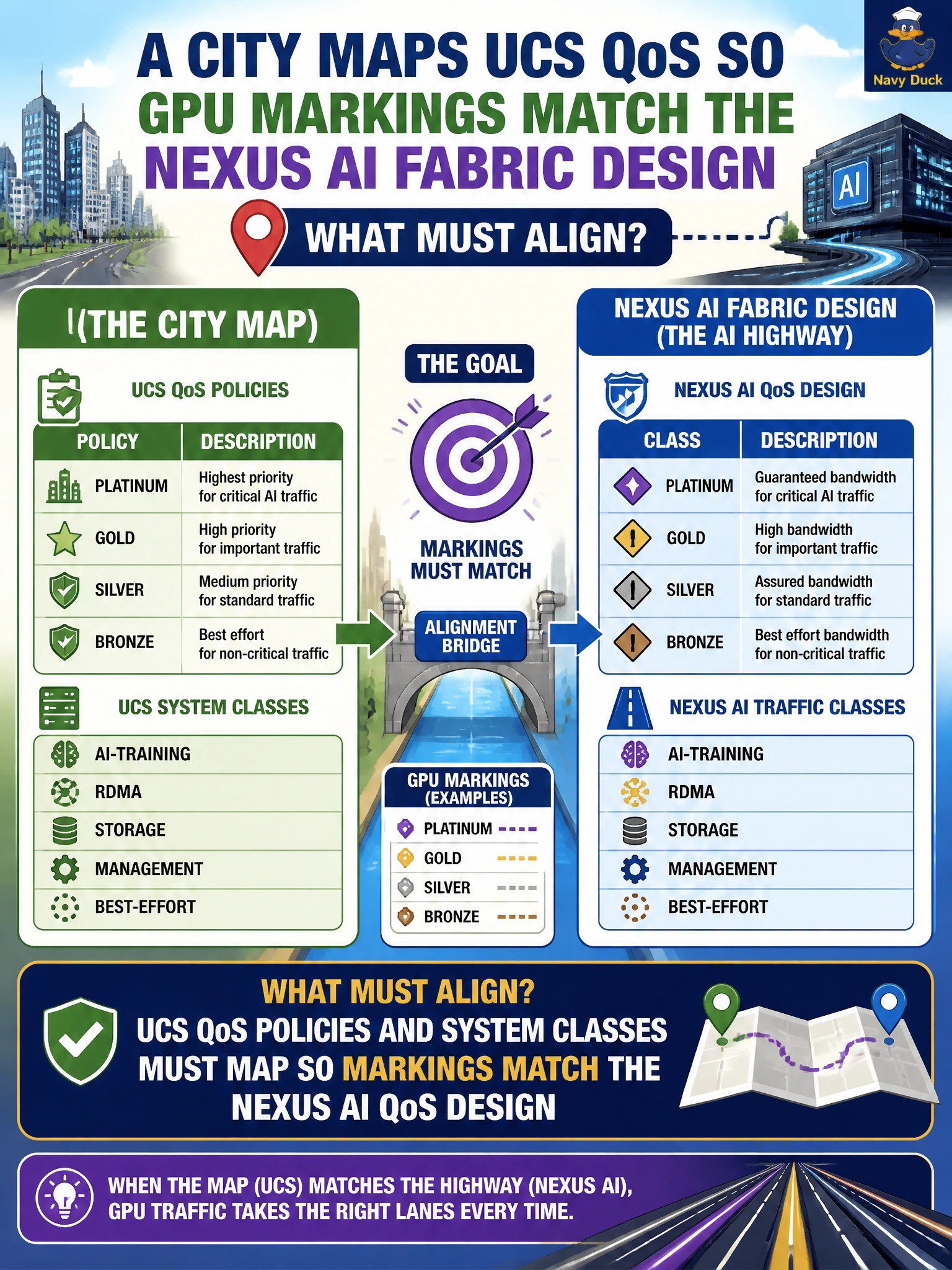
UCS and Nexus have to speak the same QoS language—same classes, same markings. If you map Gold or LAN or SAN markings when it's expecting the AI markings, you'll put RDMA in the wrong queue. Align the maps.
Full Explanation
When a city maps UCS QoS so GPU markings match the Nexus AI fabric design, UCS QoS policies and system classes must map so markings match that Nexus AI QoS design. Adapter-side classes and DSCP/CoS values are useless if the fabric classifies different codepoints into best-effort or the wrong queue. Domain 3.2.e requires UCS-to-fabric AI class alignment for municipal GPU racks carrying RDMA. Mapping Gold markings in UCS QoS policies and system classes does not align with the Nexus AI QoS design; the AI fabric expects its dedicated AI class codepoints, so Gold-marked RDMA lands in best-effort or the wrong queue despite QoS being configured on both sides. Mapping FI QoS system classes and vNIC policies so CoS matches the Nexus AI LAN design does not align UCS markings with the Nexus AI fabric design; the LAN classification map is a different scope and leaves GPU RDMA in best-effort or the wrong AI queue. Mapping UCS QoS policies and system classes with PFC markings to match the Nexus SAN QoS design does not align with the Nexus AI design; SAN lossless classes use different codepoints and queues, so PFC without matching AI classification still fails to protect the intended RDMA class end to end. Exam caveat: alignment includes both marking production on UCS and trust or rewrite behavior on Nexus; mismatch either direction breaks the design. Operational check: document the Nexus AI class-to-DSCP/CoS map, configure UCS QoS policies and system classes to emit the same markings, capture a GPU RDMA flow across the first hop, and confirm the leaf classifies it into the lossless AI class as designed.
Prefer to study offline? Printable PDF study book + test engine ($7.50, unofficial). These questions stay free here.