
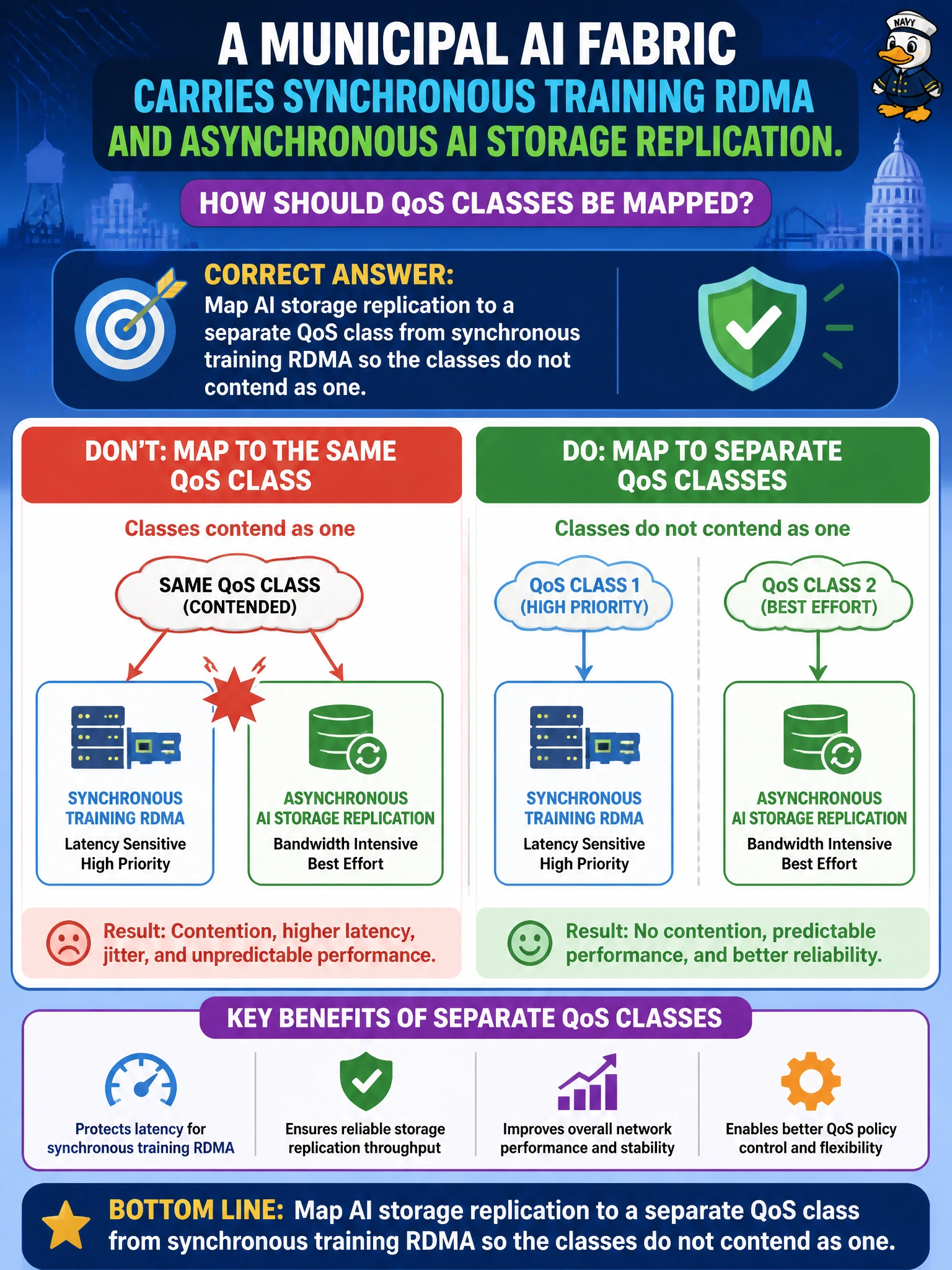
A municipal AI fabric carries synchronous training RDMA and asynchronous AI storage replication. How should QoS classes be mapped?
Select an answer to reveal the explanation.
Short Explanation
Training RDMA and storage replication are different neighbors—they should not share one traffic class. Give storage its own QoS bucket so it cannot shove all-reduce off the road. Mapping both to a shared lossless class with PFC is how replication bursts can still pause the RDMA queue you need.
Full Explanation
A municipal AI fabric that carries both synchronous training RDMA and asynchronous AI storage replication must map those flows to separate QoS classes so they do not contend as one undifferentiated queue. Synchronous all-reduce is latency- and completion-sensitive; storage replication is often bursty and bandwidth-hungry. Domain 3.1.c expects distinct traffic-class treatment so congestion, ETS shares, and PFC/ECN behavior can be tuned per workload. Mapping synchronous training RDMA and storage replication to a shared lossless class with PFC enabled for throughput forces unrelated traffic into one pause domain, so replication bursts can still trigger pauses that stall sensitive all-reduce. Mapping synchronous training RDMA to a lossy ECN class while reserving the lossless PFC class for storage replication puts the latency-sensitive flow on a lossy path and gives bulk replication the lossless treatment, which inverts the right behavior. Mapping both flows to a shared strict-priority class and using ETS scheduling to share bandwidth with municipal traffic still over-elevates bulk AI work and lets ETS arbitrate between two workloads that should be isolated from each other. Exam caveat: “separate classes” does not mean both get strict priority; mapping both to a shared strict-priority class with ETS still shares a priority queue they should not share, and storage often rides a lower, bandwidth-managed class while RDMA keeps lossless treatment. Operational check: define class-maps for training RDMA versus AI storage replication, assign distinct DSCP/CoS and ETS/PFC treatment, generate concurrent training and replication load on the municipal fabric, and confirm pause/drop and completion metrics show storage bursts no longer collapse the RDMA class.
Prefer to study offline? Printable PDF study book + test engine ($7.50, unofficial). These questions stay free here.