
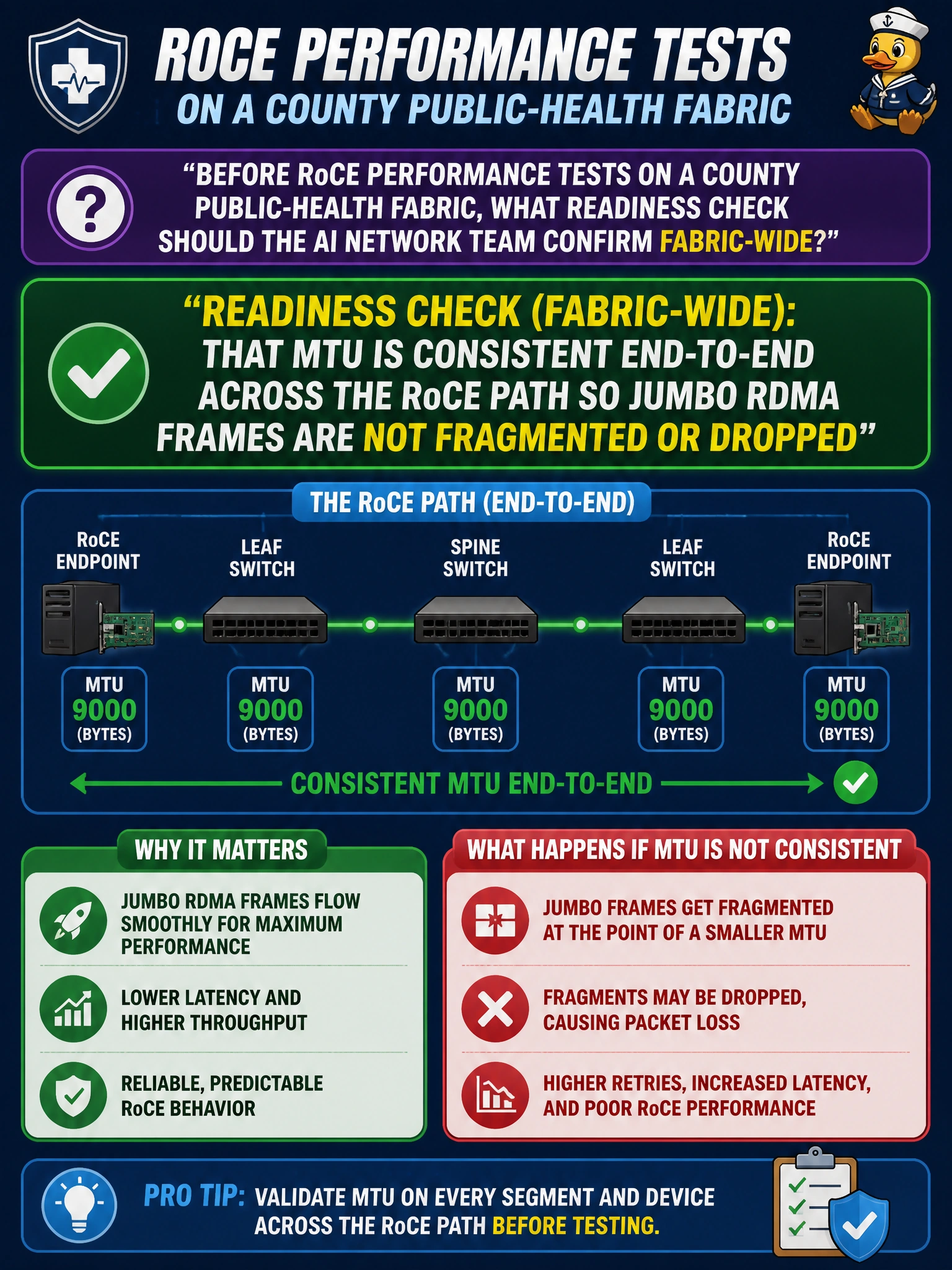
Before RoCE performance tests on a county public-health fabric, what readiness check should the AI network team confirm fabric-wide?
Select an answer to reveal the explanation.
Short Explanation
RoCE jumbo frames need the same MTU all the way—like a tunnel with one height limit. Mismatched MTUs smash big RDMA frames. Check fabric-wide consistency before you blame the GPUs.
Full Explanation
Before RoCE performance tests on a county public-health fabric, the AI network team must confirm MTU is consistent end-to-end across the RoCE path so jumbo RDMA frames are not fragmented or silently dropped. Domain 3.1.b treats MTU alignment—host vNIC, leaf, spine, and any intermediate hops—as a readiness gate for Ethernet RDMA. Aligning ECN marking thresholds fabric-wide on the RoCE queue to signal congestion at high buffer occupancy tunes congestion feedback for RoCE flows, but it does not confirm end-to-end MTU consistency for RoCE jumbo frames and is not a substitute for the MTU readiness gate. Tuning PFC pause thresholds end-to-end on the RoCE priority to allow brief queue overflow before pausing is a lossless-queue tuning task that should trigger pause before drops, not after overflow, and it does not verify that jumbo RDMA frames can traverse the path without fragmentation or drops. Enabling DCQCN end-to-end on the RoCE path manages sender rate response to congestion signals, but holding reduced rates through extended idle intervals misstates recovery behavior and does not verify that every hop on the RoCE path carries the same MTU. End-to-end consistency means every hop that forwards RDMA frames advertises the same effective MTU, including any port-channel or breakout members on the public-health path. Exam caveat: hosts, switches, and storage targets may each expose MTU knobs; a leaf-only change is insufficient if GPU NICs or storage remain at 1500. Operational check: set and document a fabric-wide jumbo target (for example 9216 or the vendor-supported RDMA MTU), verify vNIC and switch interfaces match, send large RDMA or ping-based path MTU probes across representative public-health GPU paths, and only then run RoCE microbenchmarks and training collectives.
Prefer to study offline? Printable PDF study book + test engine ($7.50, unofficial). These questions stay free here.