
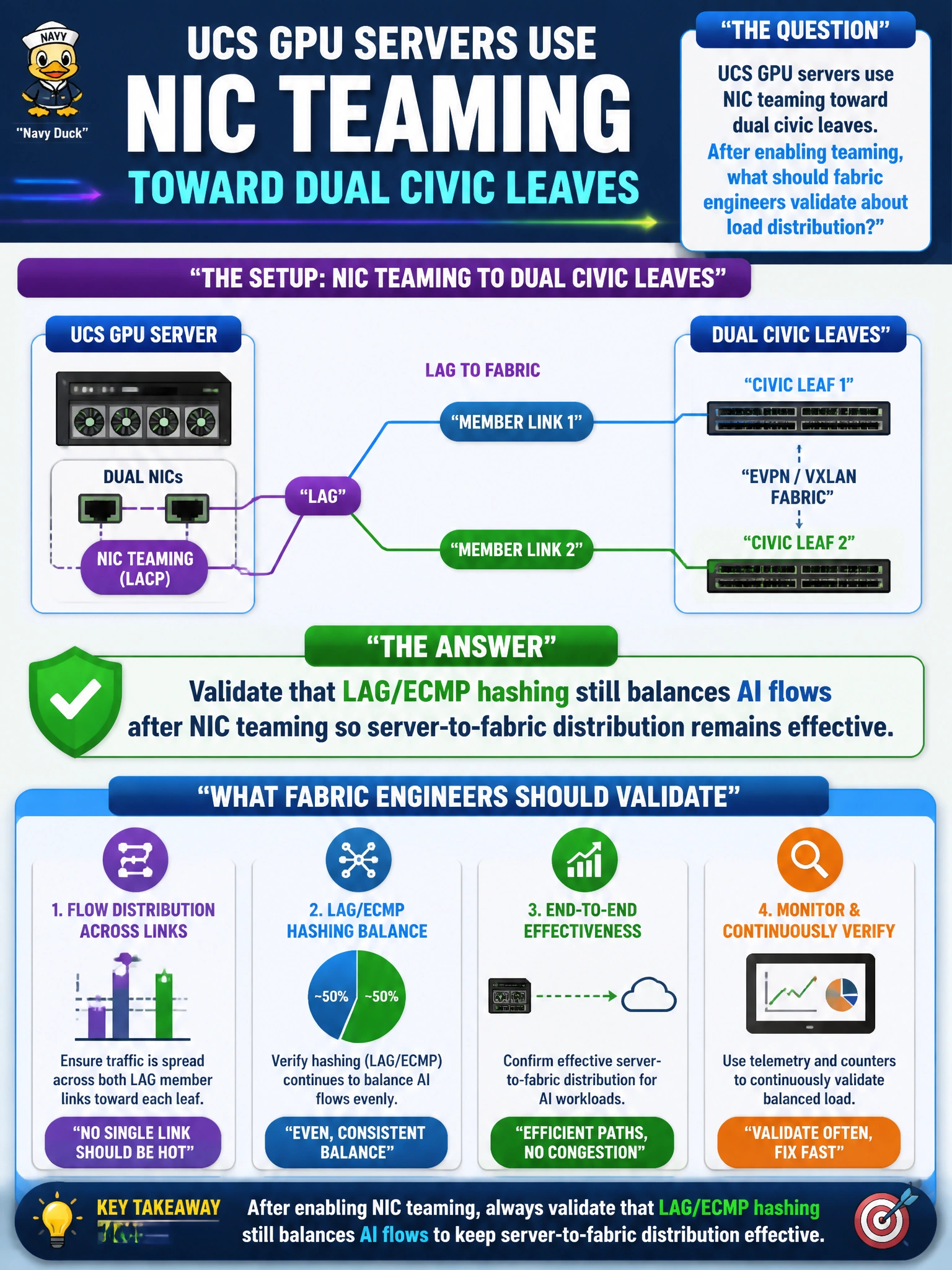
UCS GPU servers use NIC teaming toward dual civic leaves. After enabling teaming, what should fabric engineers validate about load distribution?
Select an answer to reveal the explanation.
Short Explanation
UCS teaming pairs NICs; ECMP pairs uplinks. Make sure your hash still works across both—you have four uplink destinations (two NICs × two leaves) and you want traffic spread across all four, not stuck on one.
Full Explanation
UCS GPU servers use NIC teaming toward dual civic leaves. When both NIC team members face ECMP-capable leaves, the combined hash (NIC teaming hash and ECMP hash) can distribute AI flows across four uplink destinations: NIC1-to-Leaf1, NIC1-to-Leaf2, NIC2-to-Leaf1, NIC2-to-Leaf2. That distribution prevents elephant flows from overloading any single leaf or NIC path. Validating that LAG/ECMP hashing still balances AI flows ensures the combined hash is working correctly. Renegotiating LACP priorities only elects which side controls port selection for active versus standby members, but it does not rebalance AI flows across NIC-to-leaf paths during normal operation, which is what the question asks. Adding LAG member bandwidth only increases aggregate capacity; it does not validate whether the combined NIC teaming and ECMP hash is distributing AI elephant flows across the four uplink destinations, since a single elephant flow can still saturate one member while others sit idle. Checking ECMP hashing on teamed server MACs alone is insufficient because teamed NICs share MAC addresses with little flow entropy, so it does not validate whether the combined NIC teaming and LAG/ECMP hash on higher-layer fields is balancing AI flows across the server-to-fabric uplinks, which is the focus of the question. Exam caveat: both UCS NIC teaming and leaf-side ECMP must be configured to work together; incomplete configuration on either side breaks the four-way load distribution. Operational check: confirm hashing algorithm consistency between UCS and Nexus leaves, run a mixed-flow test with multiple elephant flows, and show balanced distribution across all four uplink destinations.
Prefer to study offline? Printable PDF study book + test engine ($7.50, unofficial). These questions stay free here.