
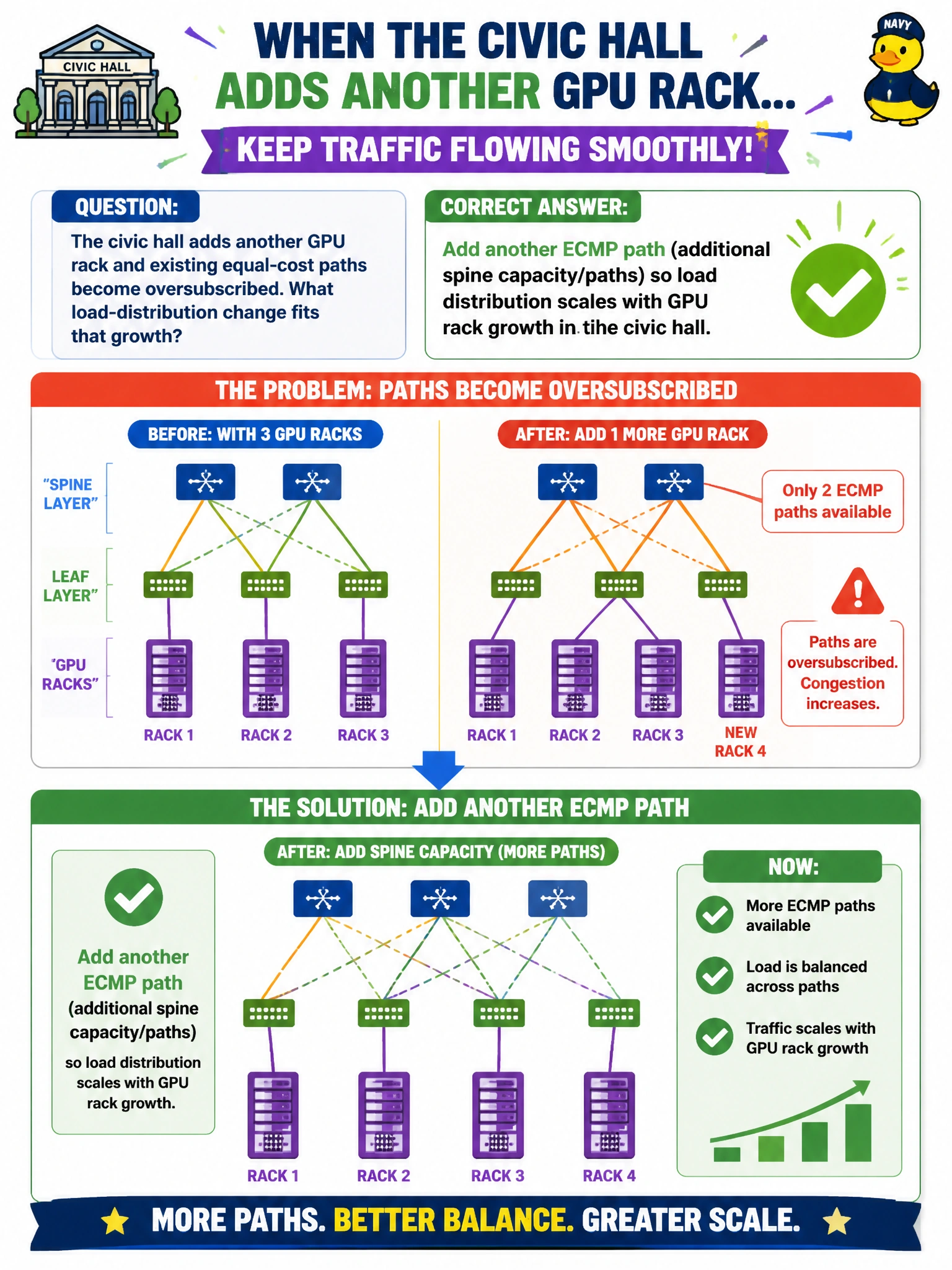
The civic hall adds another GPU rack and existing equal-cost paths become oversubscribed. What load-distribution change fits that growth?
Select an answer to reveal the explanation.
Short Explanation
More GPU racks mean more east-west flood—don't pretend the old path count still fits. Add ECMP capacity so the civic hall's new trainers have more equal-cost roads, not a smaller parking lot.
Full Explanation
When the civic hall adds another GPU rack and existing equal-cost paths become oversubscribed, the fitting load-distribution change is to add another ECMP path—additional spine capacity or paths—so distribution scales with GPU rack growth. Capacity and path count must grow with east-west AI demand; otherwise new trainers simply intensify oversubscription on the old mesh and recreate hot uplinks. Rehashing ECMP flows with new leaf hash fields only reshuffles elephant flows across the same constrained spines; it does not add capacity, so the new rack's traffic still overwhelms the existing fabric. Enabling ECMP resilient hashing on leaf switches only retains flow mapping during table changes; it adds no paths and cannot absorb the new rack's load. Activating ECMP unequal-cost balancing via BGP bandwidth still shares new GPU rack flows across only the current spines; with equal-cost links already oversubscribed, it adds no new paths and cannot absorb growth. Exam caveat: adding a spine path requires cabling, routing adjacency, and ECMP membership updates on leaves—installing hardware without programming it into the ECMP set does not help trainers. Operational check: after adding civic hall GPU capacity, add and verify new equal-cost spine paths in the routing/ECMP tables, remeasure oversubscription under training load, and confirm the new rack's east-west flows use the expanded path set.
Prefer to study offline? Printable PDF study book + test engine ($7.50, unofficial). These questions stay free here.