
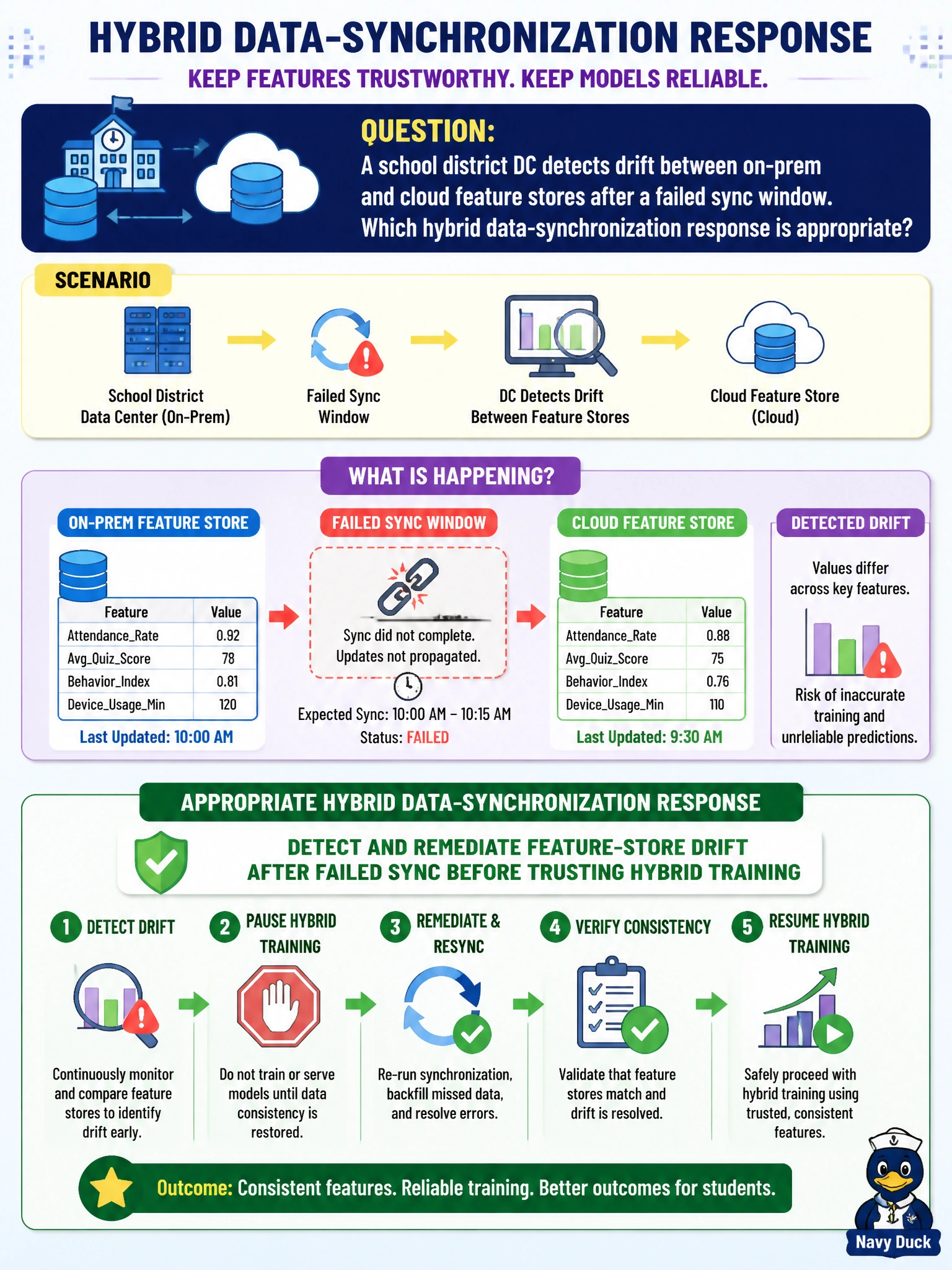
A school district DC detects drift between on-prem and cloud feature stores after a failed sync window. Which hybrid data-synchronization response is appropriate?
Select an answer to reveal the explanation.
Short Explanation
A failed sync window that leaves feature stores disagreeing is a red flag, not a vibes-based "probably fine." Detect the drift and fix it before hybrid training trusts those features. Silent disagreement ships bad models.
Full Explanation
When a school district DC detects drift between on-prem and cloud feature stores after a failed sync window, the appropriate hybrid data-synchronization response is to detect and remediate feature-store drift after failed sync before trusting hybrid training. Divergent features produce irreproducible or biased models; training against "whichever side looks newer" institutionalizes silent disagreement.
Validating feature schema parity after failed sync before resuming hybrid training runs checks structure, not content: matching schemas can still hide value-level drift after a failed sync, so resuming on schema alone lets divergent features flow into training without remediation. Reconciling feature-store drift with timestamp merge after failed sync before validating lineage merges by recency without establishing trust: a newer timestamp may belong to an incomplete or corrupted write from the failed window, so lineage must be validated before merging, not after. Pinning hybrid training to cloud snapshot after failed sync before reconciling on-prem drift trains on one side while drift remains unresolved: the cloud snapshot may itself be stale or incomplete after the failed window, and it leaves on-prem divergence to corrupt future syncs and reproducibility.
Exam caveat: Domain 2.5 hybrid AI depends on reliable synchronization; post-failure drift detection and repair are part of the sync design, not optional cleanup.
Operational check: after a simulated sync failure, run drift detection between district on-prem and cloud feature stores, remediate to a known-good baseline, and only then release hybrid training jobs. Prefer automated drift reports with feature-level diffs and timestamps from the failed sync window so district data engineers can re-sync only the divergent partitions. Hybrid training gates should stay closed until both stores hash-agree on the feature sets those jobs consume.
Prefer to study offline? Printable PDF study book + test engine ($7.50, unofficial). These questions stay free here.