
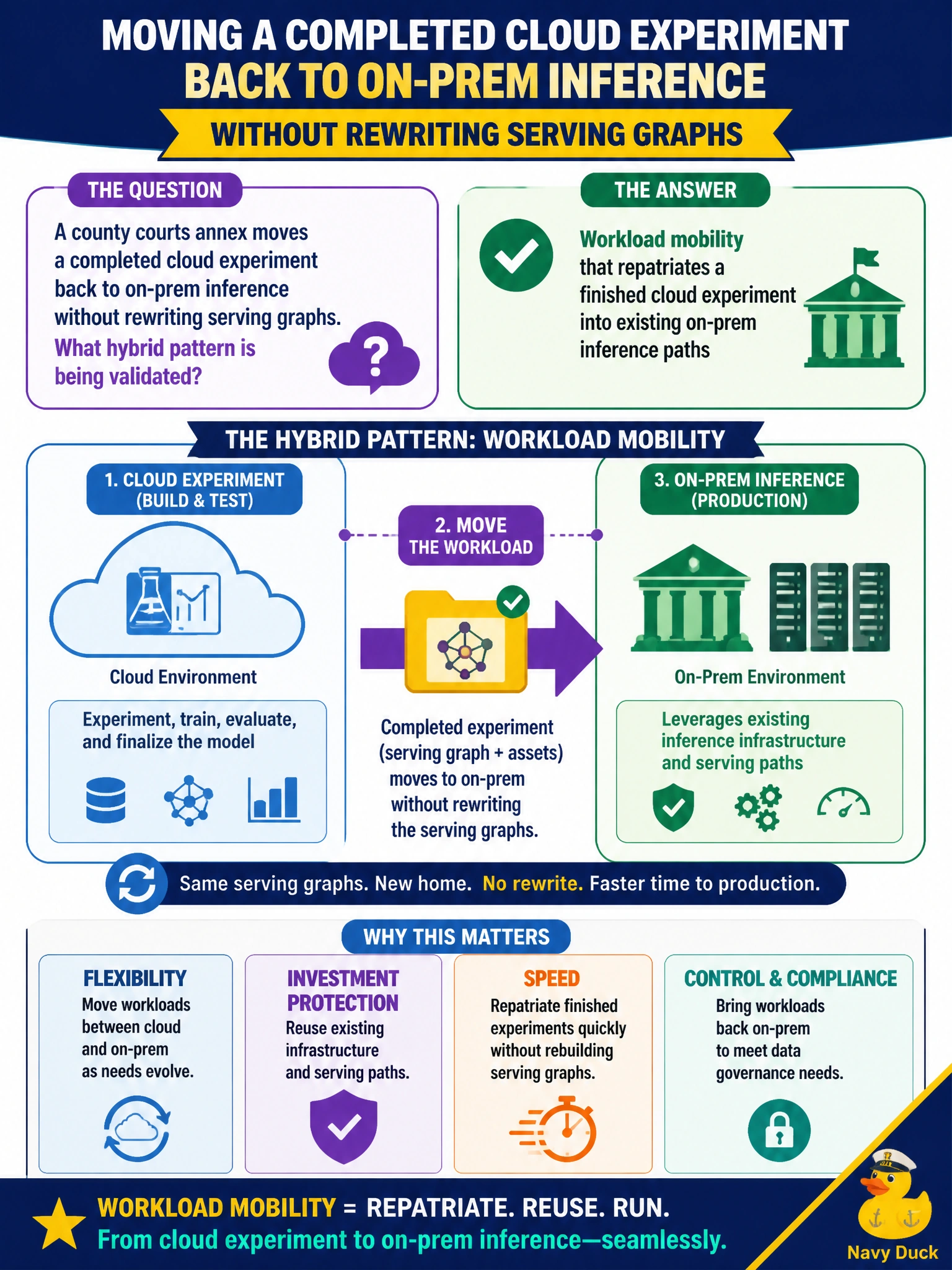
A county courts annex moves a completed cloud experiment back to on-prem inference without rewriting serving graphs. What hybrid pattern is being validated?
Select an answer to reveal the explanation.
Short Explanation
Train or experiment in cloud, then drop the result back onto the civic inference path you already run — that is mobility with a return ticket. Calling it disaster recovery isn't mobility for you because you're proving a planned return to your existing graph, not a failover restore for continuity. Calling it cloud bursting or federated learning misses for you too since you'll burst out to cloud for peaks and you'll federate gradients to train together, not bring one finished experiment home to serve unchanged.
Full Explanation
A county courts annex that moves a completed cloud experiment back to on-prem inference without rewriting serving graphs is validating workload mobility that repatriates a finished cloud experiment into existing on-prem inference paths. The hybrid win is a return ticket: experiment where capacity exists, serve on the municipal graph you already operate, without a rewrite tax every round-trip.
Cloud bursting that repatriates a finished cloud experiment into existing on-prem inference capacity mislabels the direction, because cloud bursting extends on-prem inference into cloud capacity for peaks, which is the opposite of bringing a finished cloud experiment back to the municipal graph. Federated learning that repatriates a finished cloud experiment into existing on-prem inference paths mislabels collaborative training as mobility, because federated learning aggregates distributed gradients into a shared model rather than moving one finished experiment back into an existing on-prem serving path. Disaster recovery that repatriates a finished cloud experiment into existing on-prem inference service mislabels continuity as mobility, because disaster recovery validates failover and restoration, not serving a repatriated model through the unchanged on-prem graph without a rewrite.
Exam caveat: Domain 2.5 treats repatriation into existing inference paths as a mobility success criterion; formats, registries, and graph interfaces must be planned up front.
Operational check: complete a cloud experiment, import the artifact into the courts annex on-prem registry, attach it to the unchanged serving graph, and confirm production inference serves the repatriated model. Courts annex teams should version repatriated artifacts in the municipal registry with provenance noting the cloud experiment ID, so operators can roll back without rediscovering which hybrid run produced the weights. Mobility without provenance still creates operational ambiguity even when the serving graph itself did not need a rewrite.
Prefer to study offline? Printable PDF study book + test engine ($7.50, unofficial). These questions stay free here.