
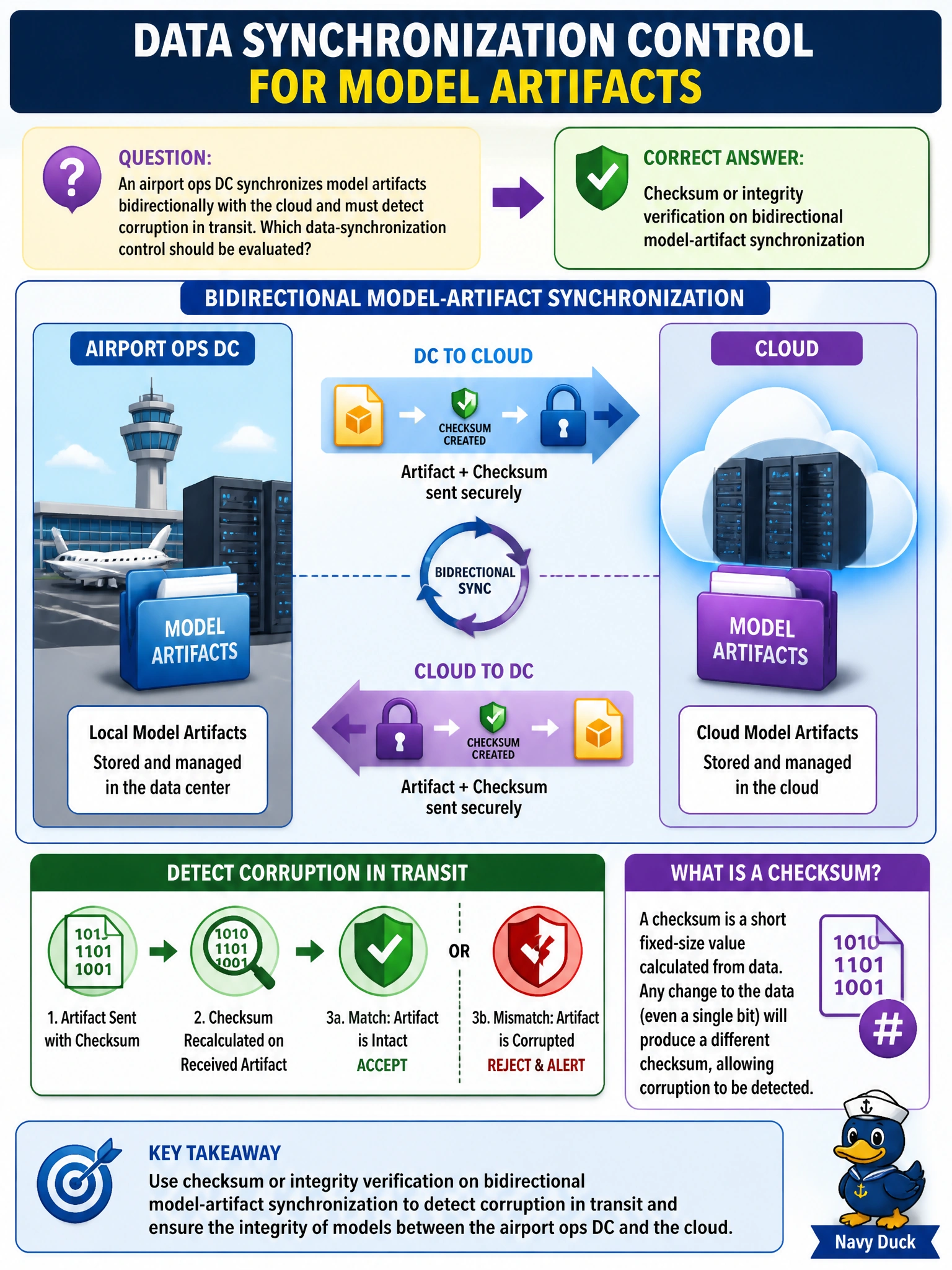
An airport ops DC synchronizes model artifacts bidirectionally with the cloud and must detect corruption in transit. Which data-synchronization control should be evaluated?
Select an answer to reveal the explanation.
Short Explanation
Bidirectional model sync without checksums is faith-based IT. Verify the bits so a mangled weight file does not quietly poison inference. File-size and timestamp matching won't catch corrupted bits, so you still need checksums.
Full Explanation
An airport ops DC that synchronizes model artifacts bidirectionally with the cloud and must detect corruption in transit should evaluate checksum or integrity verification on that bidirectional model-artifact synchronization. Weights and graphs must match what was published; silent bit-rot or truncated transfers can poison inference on either side of the hybrid link. File-size and timestamp reconciliation on bidirectional model-artifact synchronization only compares metadata; it cannot detect bit-rot, truncation, or silent corruption inside the transferred weights, so it is not an integrity control for transit corruption. Version identifier comparison on bidirectional model-artifact synchronization only confirms that both sides report the same version label, but it does not verify that the artifact bits transferred intact, so it will not catch corruption in transit. Replication acknowledgment tracking on bidirectional model-artifact synchronization only confirms that the peer acknowledged receipt, not that the payload arrived intact, so it cannot detect corrupted model artifacts in transit. Exam caveat: Domain 2.5 evaluates data synchronization quality for hybrid AI, including integrity of artifacts moved between sites—not merely that a copy job exited zero. Operational check: enable checksum or equivalent verify on push and pull of model artifacts, inject a deliberately truncated file in a test lane, and confirm the sync path rejects it before airport inference loads it. Airport model promotion pipelines should treat failed integrity checks as release blockers, the same way they treat failed functional tests. Bidirectional sync without verify can silently reintroduce a bad artifact from cloud back to on-prem after a rollback, so both directions need the same checksum policy and retained evidence of matches.
Prefer to study offline? Printable PDF study book + test engine ($7.50, unofficial). These questions stay free here.