
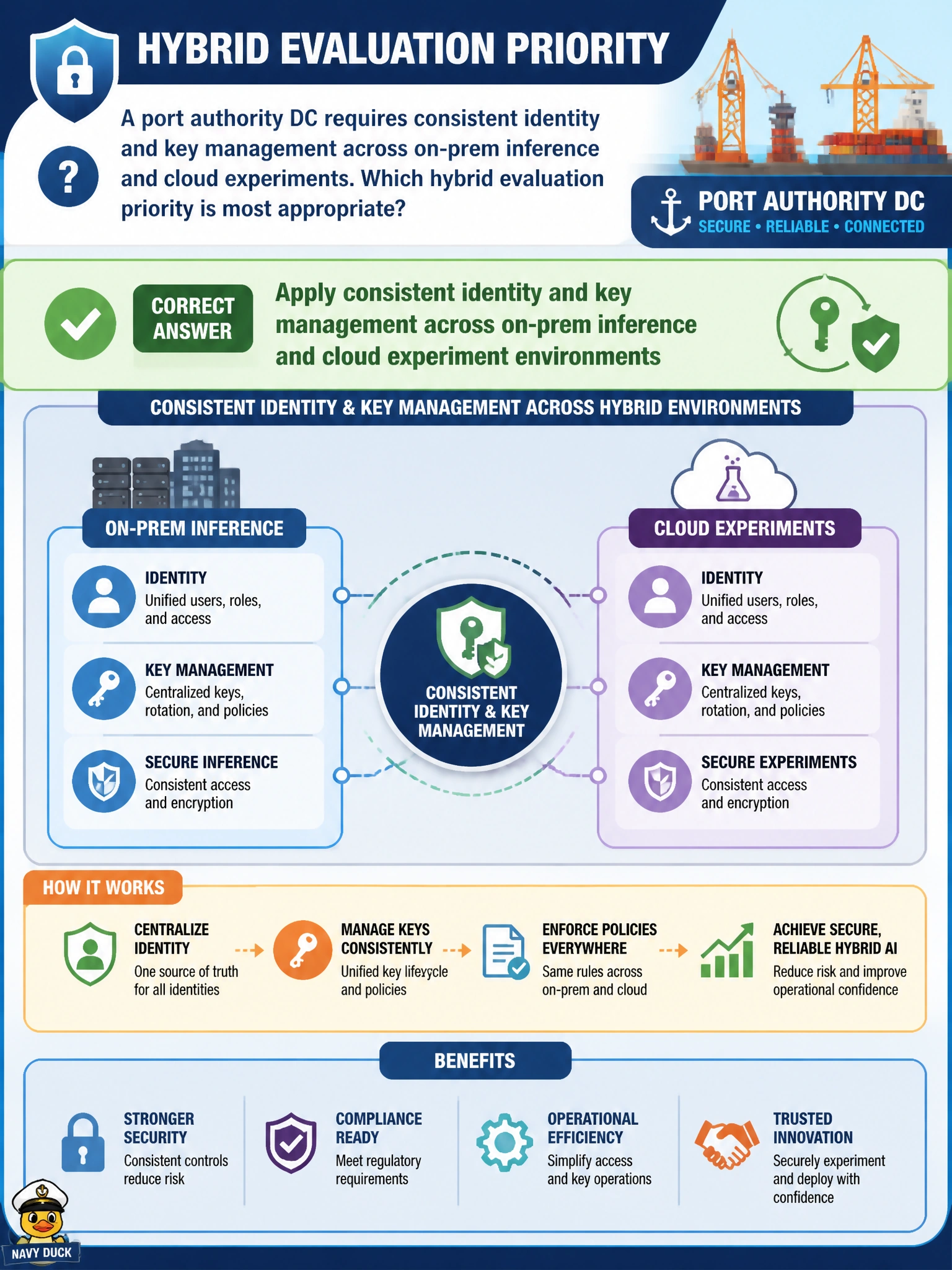
A port authority DC requires consistent identity and key management across on-prem inference and cloud experiments. Which hybrid evaluation priority is most appropriate?
Select an answer to reveal the explanation.
Short Explanation
Hybrid AI without shared identity discipline is a keys-everywhere mess. Keep identity and key management consistent from on-prem inference to cloud experiments. Shared long-lived keys, secrets in your experiment tracking store, and baked image secrets don't give you safe rotation and audit — you'll end up with over-privileged, leaky credentials across the hybrid path.
Full Explanation
A port authority DC that requires consistent identity and key management across on-prem inference and cloud experiments should apply consistent identity and key management across those environments. Hybrid security fails when each cloud sandbox invents its own secrets and identities while production inference uses a different regime—operators lose rotation, audit, and least-privilege coherence across the municipal boundary.
Applying consistent identity using shared long-lived keys across on-prem inference and cloud experiment workloads shares one over-privileged credential across environments, so rotation, least-privilege, and revocation coherence are lost across the municipal boundary. Applying consistent key management via experiment tracking store across on-prem inference and cloud experiment runs pushes credentials through a tracking tool not built for secrets management, breaking secure storage, rotation and audit across environments. Applying consistent authentication using baked image secrets across on-prem inference and cloud experiment jobs embeds unrotatable credentials in images that spread through registries, so secrets cannot stay least-privilege, rotatable or auditable across the municipal hybrid boundary.
Exam caveat: Domain 2.5 includes secure connectivity and integration controls; identity and key consistency is part of making hybrid operable under municipal policy, not a "nice to have" after networking works.
Operational check: verify on-prem inference and cloud experiment principals come from the same identity/key management system of record, with rotation and audit covering both sides of the port authority hybrid path. In port environments, hybrid experiments often spawn quickly; without a shared identity backbone those short-lived projects leave orphan keys that still can call municipal APIs. Aligning lifecycle, rotation intervals, and break-glass procedures across on-prem inference and cloud labs closes that gap and keeps auditors able to trace who trained what.
Prefer to study offline? Printable PDF study book + test engine ($7.50, unofficial). These questions stay free here.