
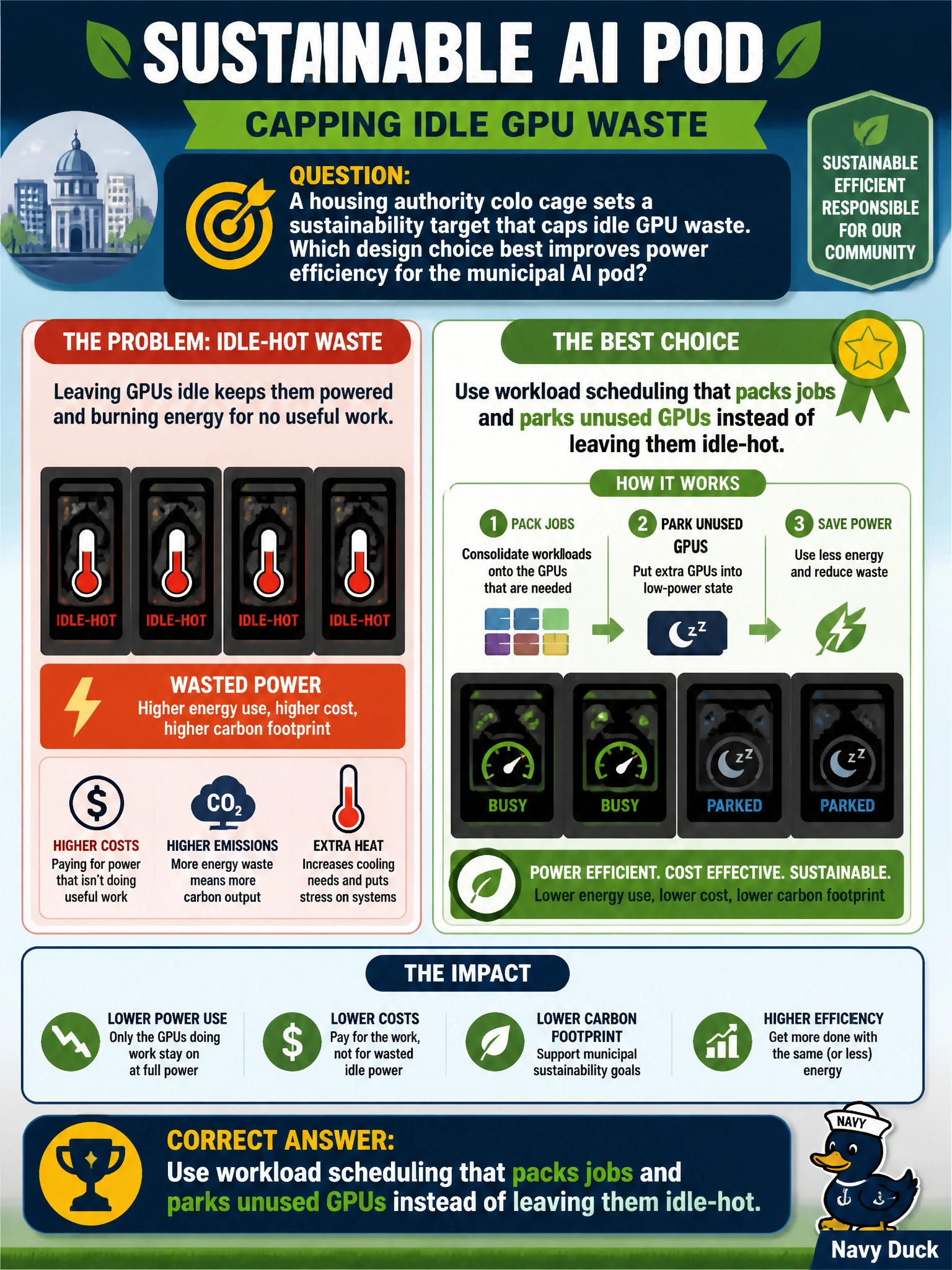
A housing authority colo cage sets a sustainability target that caps idle GPU waste. Which design choice best improves power efficiency for the municipal AI pod?
Select an answer to reveal the explanation.
Short Explanation
Capping GPU board power to limit draw cuts peak watts while you're training but still lets unused cards sit idle-hot between jobs. Better scheduling packs real work onto fewer cards and parks the rest. That's how you hit a sustainability target without guessing.
Full Explanation
For a housing authority colo cage chasing a sustainability target that caps idle GPU waste, the efficiency lever is utilization discipline rather than GPU board power caps that limit draw to reduce peak watts during active training phases. Workload scheduling that packs queued jobs onto a smaller active GPU set and parks unused accelerators (clock down, power state, or out of the hot idle pool) cuts watts that produce no civic AI work. That design directly reduces idle-hot burn while preserving capacity for real housing-analytics or inspection-model jobs when demand returns.
Enforcing GPU board power caps that limit draw to reduce peak watts during active training phases misses the target: it slows useful epochs while doing nothing to park idle-hot GPUs, so the municipal pod still burns power on unused cards between jobs. Distributing queued jobs evenly across available GPUs to sustain balanced utilization fleet-wide defeats packing: more cards stay powered and idle-hot between tasks, which increases idle waste instead of parking unused accelerators. Upgrading CRAH units with variable-speed EC fans to improve facility cooling-side PUE for the pod sidesteps the cap: better cooling does not reduce the idle GPU watts themselves, and wasteful allocation continues unchecked.
Exam caveat: denser GPU installs improve throughput only if power and cooling budgets track useful work; Domain 2.4-style facility evaluation treats idle waste as a first-class design input, not a side effect to ignore after purchase. Parking policy must still respect reboot and warm-up SLAs for time-sensitive municipal jobs.
Operational check: correlate scheduler occupancy with PDU or GPU power telemetry during an idle window; confirm unused cards drop out of the high-power idle band and that queued housing-authority jobs still pack onto the remaining active set without starving the queue.
Prefer to study offline? Printable PDF study book + test engine ($7.50, unofficial). These questions stay free here.