
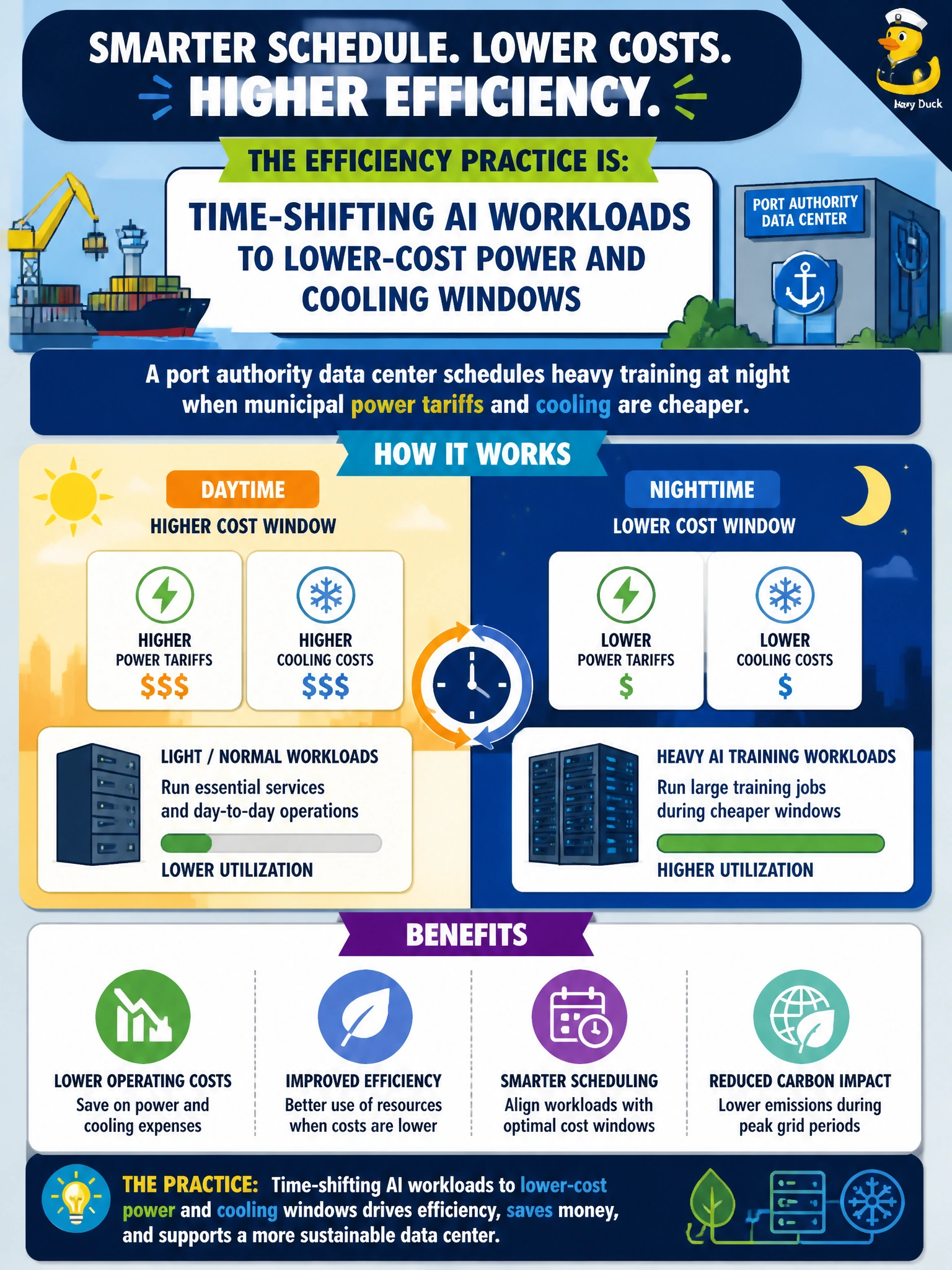
A port authority data center schedules heavy training at night when municipal power tariffs and cooling are cheaper. What efficiency practice is this?
Select an answer to reveal the explanation.
Short Explanation
Night training when power and cooling are cheaper is like running the big printers on the off-peak utility plan. Time-shifting heavy AI jobs is an efficiency win. Shifting your jobs for low-latency inference won't tap your cheap night power, running at midday peaks misses your off-peak savings, and you'll lose your night cooling edge if you're chasing peak sun across zones.
Full Explanation
A port authority data center that schedules heavy training at night when municipal power tariffs and cooling are cheaper is time-shifting AI workloads to lower-cost power and cooling windows. Efficiency here is operational: the same GPU work costs less and stresses cooling less when run off-peak, without changing model architecture. Domain 2.4 recognizes workload scheduling against tariff and thermal windows as a facility efficiency practice.
Geo-shifting AI workloads to low-latency regions for faster inference is geographic placement for latency, not the off-peak scheduling described; it doesn't shift work to cheaper tariff and cooling windows. Time-shifting AI workloads to midday peaks for grid balancing support moves work into the expensive peak window rather than away from it, so it isn't the tariff-and-cooling time-shift described in the stem. Follow-the-sun AI workloads to track peak solar output across zones chases daytime solar availability across regions, not workload scheduling into local night tariffs and cheaper cooling windows.
Exam caveat: Not every inference SLA can shift to night; the stem's heavy training jobs are the elastic workload. Time-shifting complements, rather than replaces, right-sized power and cooling capacity.
Operational check: encode tariff and cooling-cost windows in the port's job scheduler; verify night jobs still meet thermal limits with cooling in normal night mode; report $/epoch and PUE-adjacent savings so efficiency gains are measured, not assumed.
Prefer to study offline? Printable PDF study book + test engine ($7.50, unofficial). These questions stay free here.