
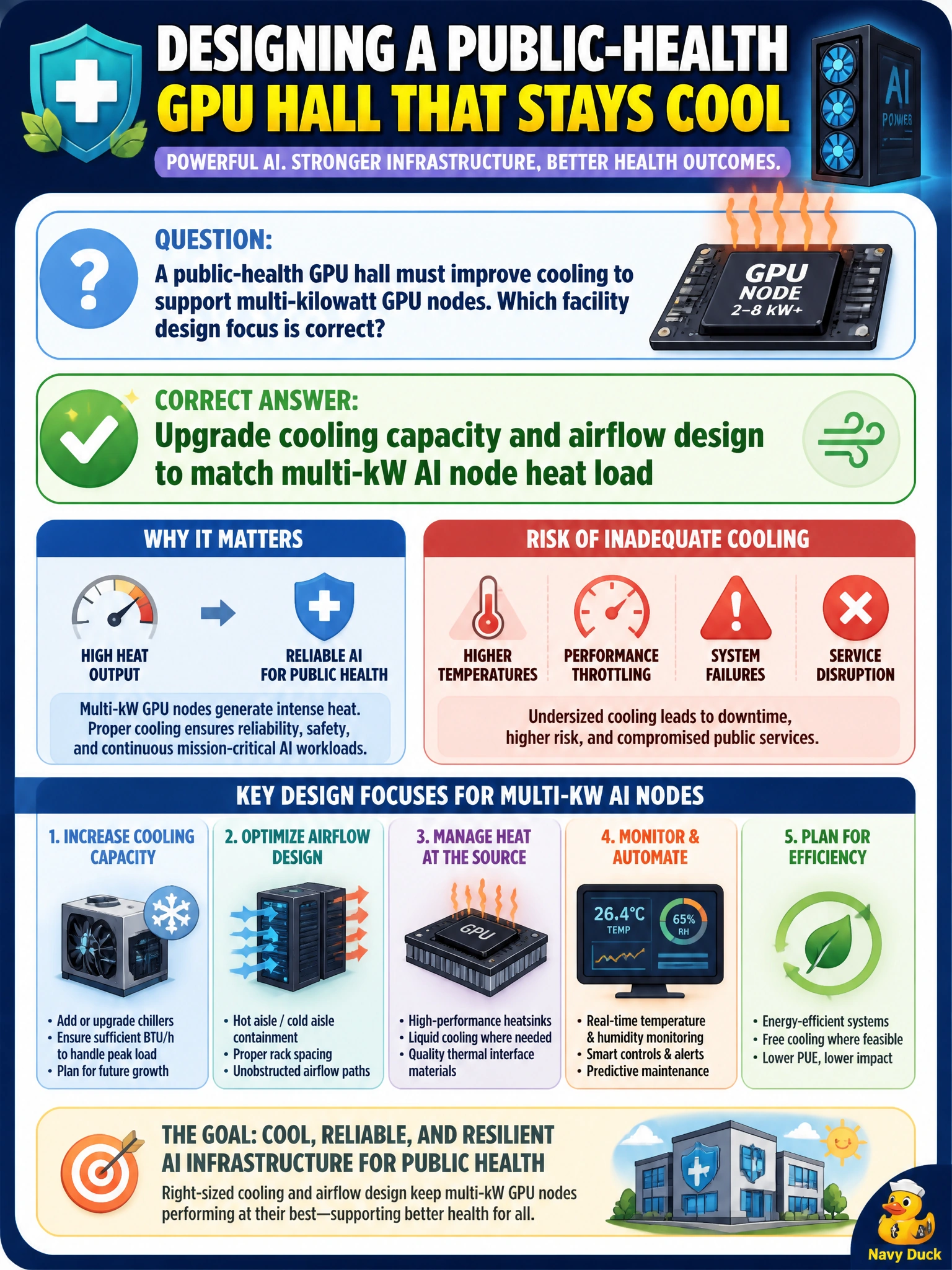
A public-health GPU hall must improve cooling to support multi-kilowatt GPU nodes. Which facility design focus is correct?
Select an answer to reveal the explanation.
Short Explanation
Multi-kW GPU nodes are space heaters with Tensor cores — you'll need real cooling upgrades since just raising CRAH fan speed and lowering the chilled-water setpoint leaves dense racks starved for airflow. Match airflow and cooling capacity to the new heat load. You'll still get hot spots if you just expand perimeter CRAC capacity with raised-floor airflow, and in-row coolers with open room return just let hot air mix back in.
Full Explanation
A public-health GPU hall supporting multi-kilowatt GPU nodes must upgrade cooling capacity and airflow design to match the new heat load. Simply deploying in-row coolers with open room return cannot address dense GPU heat; without containment and directed return, hot and cold airstreams mix and bypass so nodes cannot stay within thermal envelopes despite added row capacity. Domain 2.4 cooling evaluation is inseparable from successful GPU densification.
Expanding perimeter CRAC capacity and raised-floor airflow to match multi-kW AI heat load fails by concept: perimeter delivery over long distances with floor leakage and mixing cannot deliver cold air to dense multi-kW racks or scavenge concentrated exhaust, so adding perimeter tonnage alone leaves hot spots instead of right-sizing close-coupled cooling and containment for the load that is actually there. Raising CRAH fan speed and lowering the chilled-water setpoint to match multi-kW AI heat load cannot ensure predictability and control for a public-health hall under multi-kW GPU loads; higher fan energy with colder water without redesigned distribution causes bypass, humidity and condensation risk, and wasted energy while dense racks remain starved for airflow. Deploying in-row coolers with open room return fails load math; without sealed hot-aisle containment, nameplate TDP and concentrated airflow needs overwhelm open mixing and recirculation by an order of magnitude.
Exam caveat: Airflow redesign may include containment, higher-capacity CRACs, or liquid-assist later; this item's correct focus is matching cooling capacity to multi-kW AI node heat, not a specific OEM product.
Operational check: recalculate heat load from GPU node TDPs; validate supply temperatures and hot-aisle conditions under full training load; commission cooling upgrades before public-health jobs run sustained multi-kW densification.
Prefer to study offline? Printable PDF study book + test engine ($7.50, unofficial). These questions stay free here.