
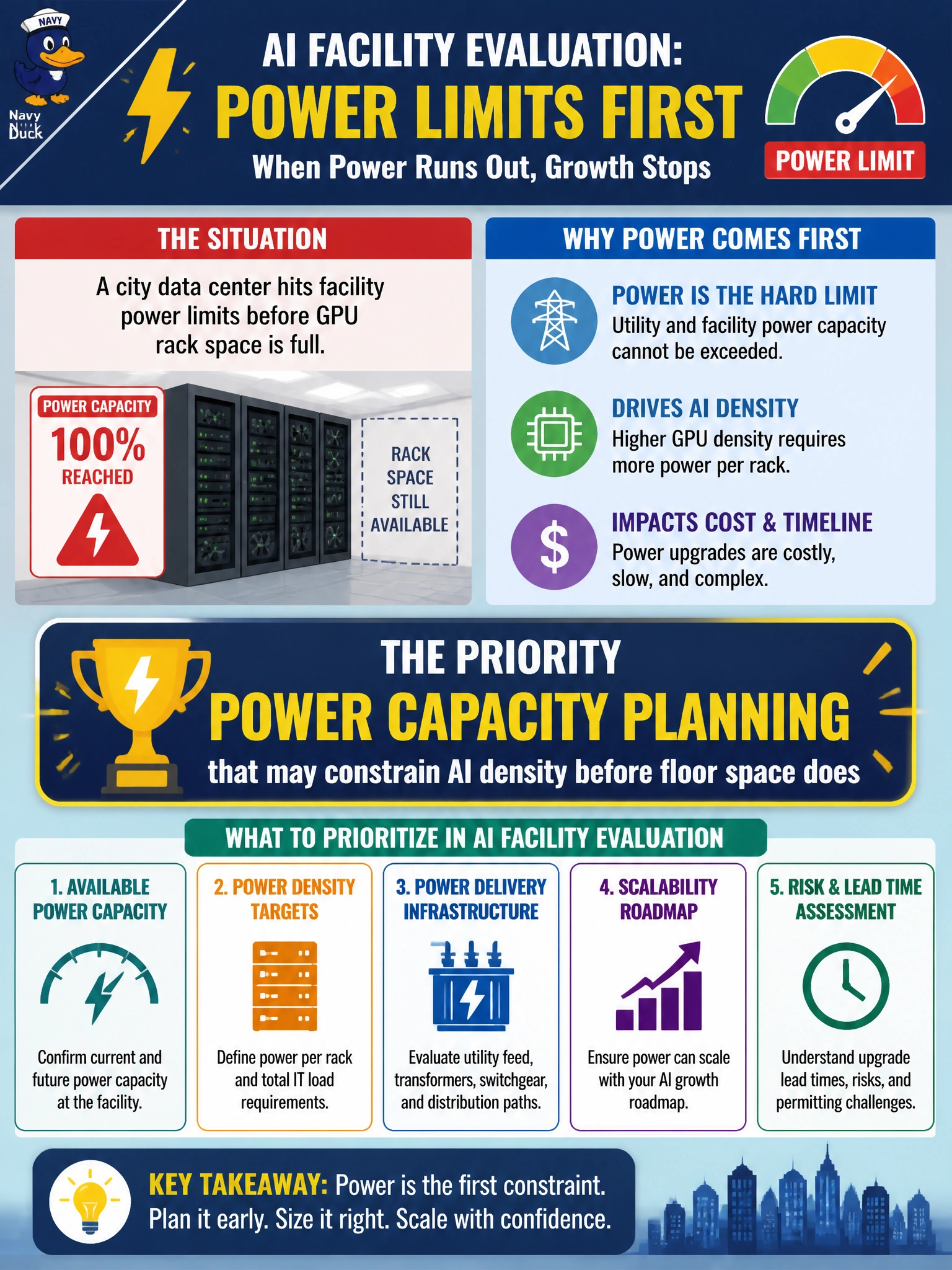
A city data center hits facility power limits before GPU rack space is full. What should the AI facility evaluation prioritize?
Select an answer to reveal the explanation.
Short Explanation
Empty rack space with a tripped power budget is like an empty parking lot with no electricity for the chargers — space is not the bottleneck. Power capacity often caps AI density first. Measure and plan watts before stuffing more GPUs.
Full Explanation
When a city data center hits facility power limits before GPU rack space is full, AI facility evaluation must prioritize power capacity planning that may constrain AI density before floor space does. Dense GPU racks often exhaust watts, breakers, and UPS/generator margins while empty U-space remains. Domain 2.4 power, efficiency, and sustainability evaluation therefore treats electrical capacity as a first-order densification limit for municipal AI halls.
Power distribution redundancy analysis that may ensure dual feeds for GPU racks fails as the priority here: the stem identifies total facility watts as the binding constraint, so dual feeds improve availability but do not add capacity when feeders and breakers run out first. Uninterruptible power supply sizing that may sustain GPU racks through outages fails as the priority here: the binding constraint is steady-state power for densification, not outage ride-through, so a larger UPS does not create headroom when the site power limit is already hit. Power usage effectiveness tracking that may benchmark cooling efficiency over time fails as the priority here: tracking PUE measures efficiency but does not add electrical capacity, so benchmarking does not solve the wattage bottleneck while U-space remains empty.
Exam caveat: Space, cooling, and power interact; this item isolates power as the binding constraint when U-space is still available. Cooling may bind in other scenarios (see related Domain 2.4 items).
Operational check: map PDU/UPS/feeder capacity against planned GPU TDP and diversity factors; stop densification at measured electrical headroom; present power upgrades or workload placement options to the city before racking accelerators into powerless empty U.
Prefer to study offline? Printable PDF study book + test engine ($7.50, unofficial). These questions stay free here.