
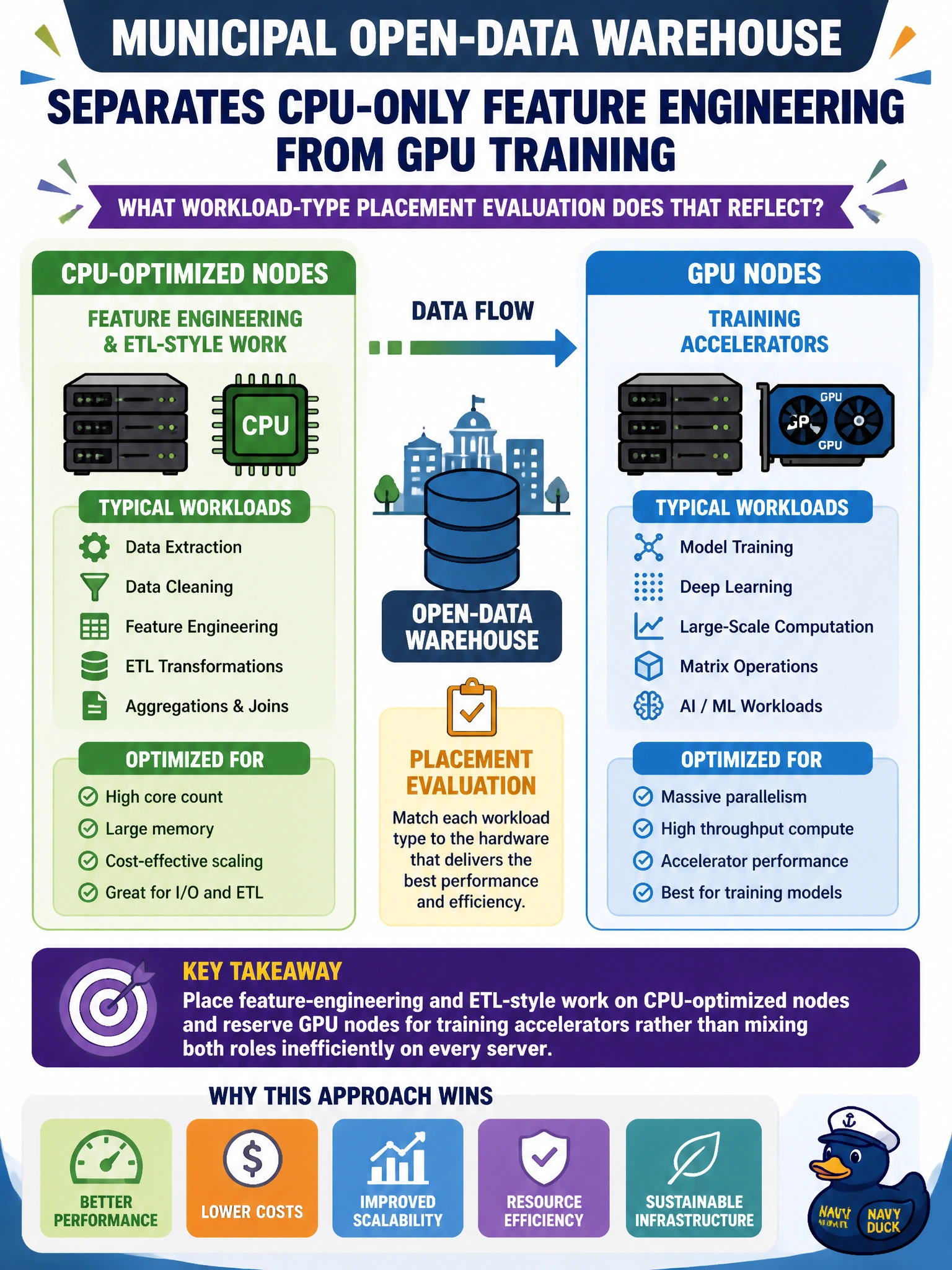
A municipal open-data warehouse separates CPU-only feature engineering from GPU training. What workload-type placement evaluation does that reflect?
Select an answer to reveal the explanation.
Short Explanation
Feature engineering is prep work at the cutting board; GPU training is the hot stove. You don’t tie up the stove chopping onions. Park ETL-style CPU work on CPU nodes and keep the GPU boxes for actual training.
Full Explanation
Municipal open-data warehouses that separate CPU-only feature engineering from GPU training are evaluating workload-type placement. Placing ETL-style feature work on CPU-optimized nodes and reserving GPU nodes for training accelerators works because those roles stress different resources: feature pipelines need host CPU, memory, and storage bandwidth, while training needs accelerators. Separating them improves efficiency, isolation, and cost transparency for civic data programs.
Running feature engineering and model training together on GPU-accelerated nodes to minimize data movement and keep pipelines on a unified instance type for operations teams fails because it burns scarce accelerator capacity on CPU-shaped prep work, delays training while ETL jobs finish, and chooses operational simplicity over workload fit. Assigning model training to scaled-out CPU-optimized nodes for cost control while using GPU nodes to accelerate SQL scans and dashboard rendering for analysts fails because it starves GPU-bound training of accelerators and wastes GPU cycles on lightweight SQL and dashboard tasks that CPUs can handle. Deploying feature engineering and training on general-purpose nodes with attached local SSDs to simplify scheduling and keep intermediate datasets close to compute fails because it mixes roles on the same hardware, so GPUs sit idle during ETL and CPU work starves training of cycles, and local SSDs do not resolve that mismatch.
Exam caveat: some light transforms may efficiently use GPU libraries; separation is a default efficiency pattern, not a ban on accelerated feature steps when measurement shows benefit. Operational check: profile feature-engineering CPU/memory/IO versus GPU training utilization; keep roles split when GPUs idle during ETL or when ETL noise lengthens training iteration time on shared nodes.
Prefer to study offline? Printable PDF study book + test engine ($7.50, unofficial). These questions stay free here.