
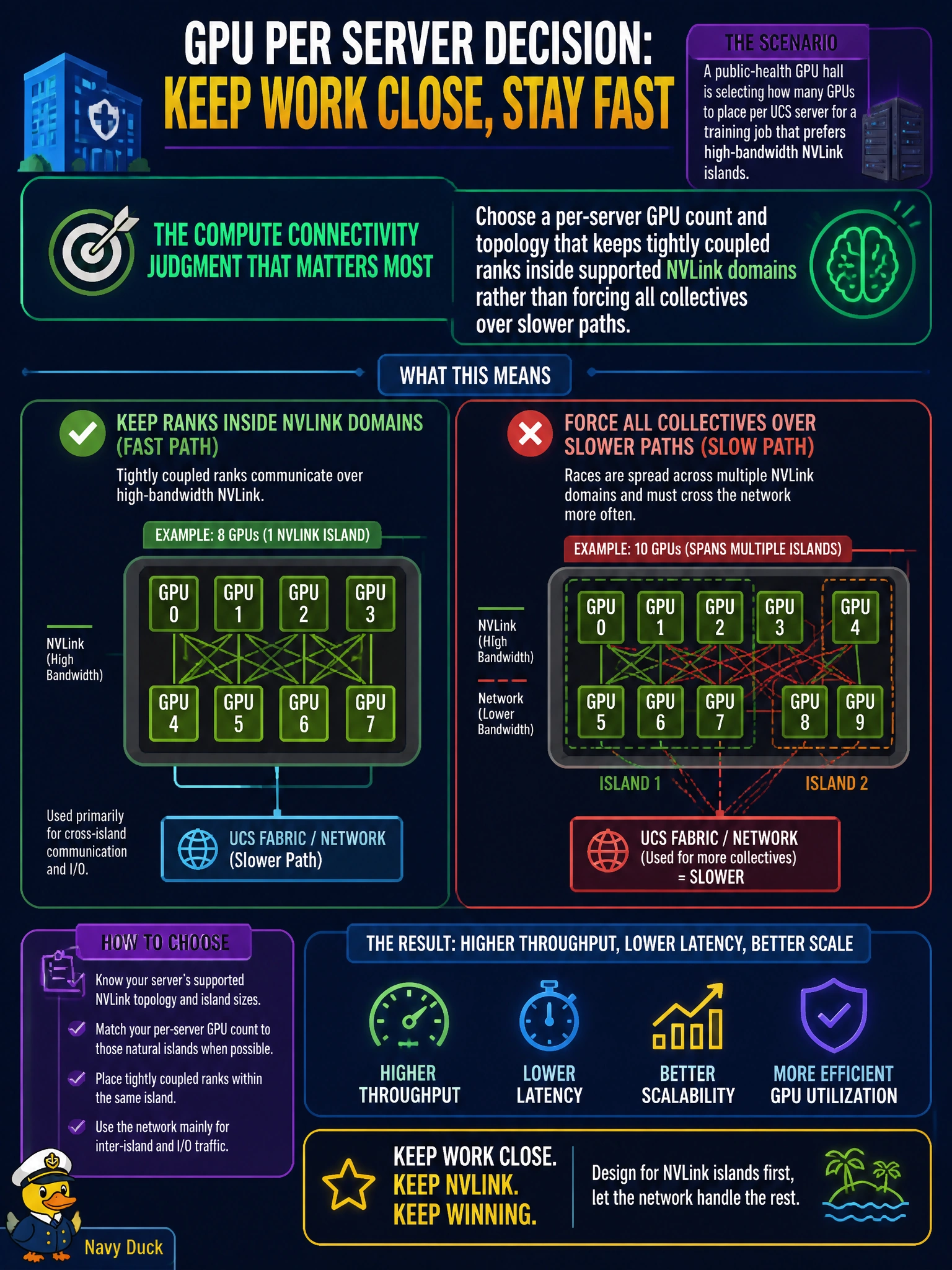
A public-health GPU hall is selecting how many GPUs to place per UCS server for a training job that prefers high-bandwidth NVLink islands. What compute connectivity judgment matters most?
Select an answer to reveal the explanation.
Short Explanation
NVLink is the express lane between GPUs in the same island—great when your training ranks need to chat constantly. You'll lose that speed if you split your tight-knit ranks across separate islands for load balance, even with full NVLink Switch trays, so keep them together in one supported domain on your UCS box.
Full Explanation
Public-health GPU halls training with a preference for high-bandwidth NVLink islands must choose per-server GPU count and topology so tightly coupled ranks stay inside supported NVLink domains. That judgment works because collectives and gradient exchange among tightly coupled ranks are far faster on NVLink than when forced entirely over PCIe and Ethernet. Compute connectivity evaluation therefore aligns server population and GPU placement with the vendor's supported multi-GPU domains rather than treating every GPU as an interchangeable Ethernet endpoint. Sizing per-server GPU count to populate NVLink Switch trays for improved peer bandwidth while scheduling tightly coupled collectives across separate islands for load balance fails because splitting tightly coupled ranks across islands forces their constant collectives over slower inter-island paths, negating the peer-bandwidth benefit the trays were meant to provide. Selecting per-server GPU density around PCIe Gen5 x16 lane throughput for host transfers while treating NVLink domain limits as secondary tuning for collective performance gets the compute connectivity judgment backward; NVLink domain membership, not host-transfer throughput, must determine where tightly coupled ranks live for this NVLink-preferring job. Deriving per-server GPU count from host InfiniBand NIC count for GPUDirect RDMA throughput while mapping tightly coupled ranks to NVLink islands spanning multiple servers misplaces the priority; NVLink islands do not span servers, so tightly coupled ranks must stay inside the supported per-server domain rather than being sized around NIC throughput and stretched across boxes. Operational check: map rank placement to NVLink domains in the scheduler, confirm vendor-supported GPU counts per UCS/server SKU, and benchmark all-reduce time inside versus across domains before locking the public-health bill of materials.
Prefer to study offline? Printable PDF study book + test engine ($7.50, unofficial). These questions stay free here.