
A port authority DC must isolate PHI inference traffic from public kiosk networks. What network evaluation focus applies?
Select an answer to reveal the explanation.
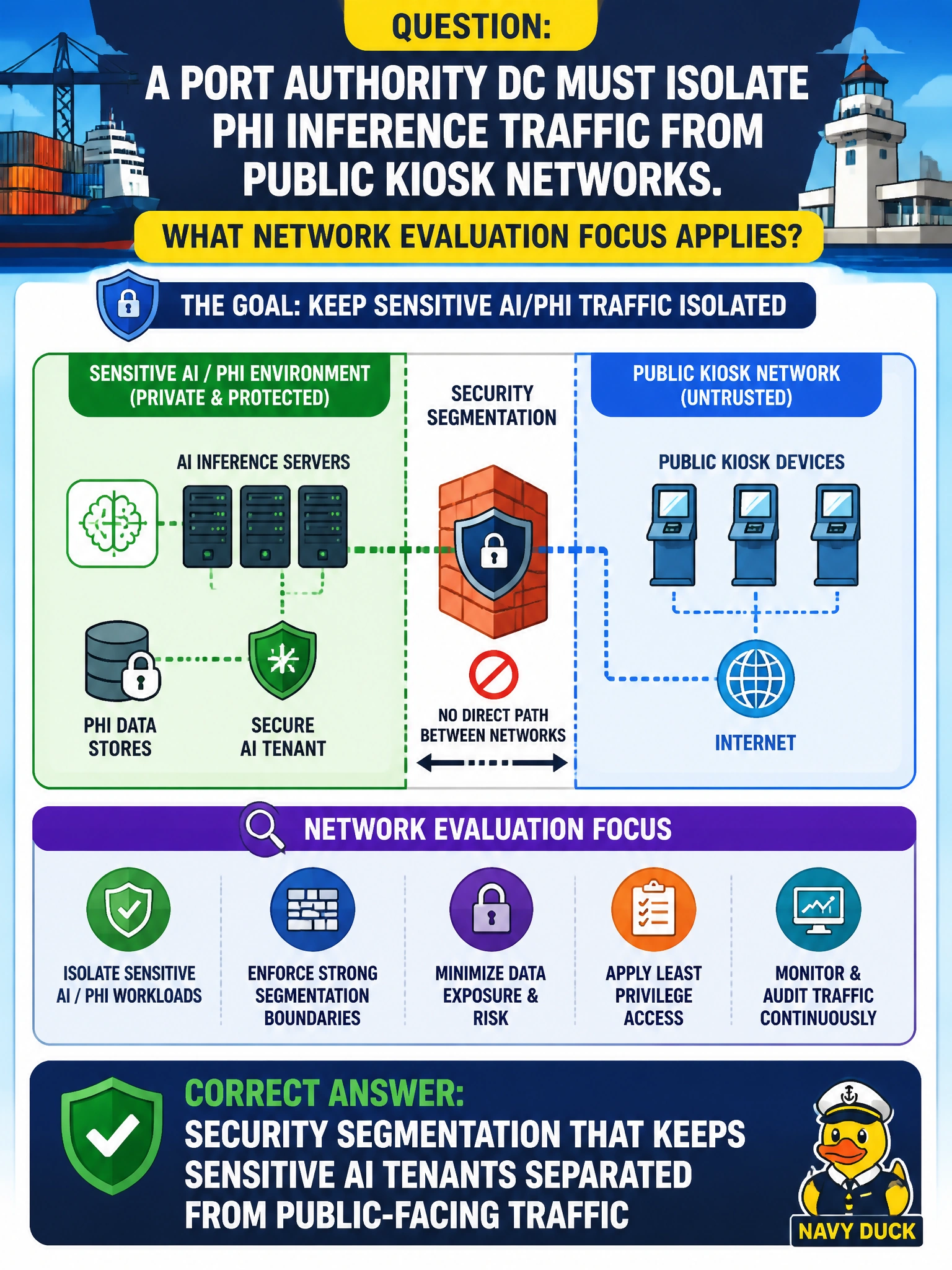
Short Explanation
PHI inference and tourist kiosks should not share a path. Segment the AI tenant so sensitive traffic stays fenced off. If you chase bandwidth guarantees, east-west capacity, or fewer hops, you'll still leave PHI without isolation from public traffic.
Full Explanation
A port authority DC that must isolate PHI inference traffic from public kiosk networks should focus network evaluation on security segmentation that keeps sensitive AI tenants separated from public-facing traffic. VRFs, VLANs, and policy boundaries keep PHI inference away from lower-trust kiosk domains so a compromised public endpoint cannot freely reach sensitive AI workloads or their data paths. That separation is a first-class fabric requirement alongside bandwidth for regulated municipal AI.
QoS evaluation that prioritizes inference bandwidth guarantees for latency-sensitive tenants ensures performance for sensitive workloads but creates no trust boundary with public kiosk networks; guaranteeing bandwidth does nothing to keep PHI inference separated from lower-trust traffic. Throughput analysis that validates east-west capacity for distributed training replication confirms fabric capacity for replication flows but does not isolate PHI inference from public-facing kiosk domains. Latency optimization that minimizes hop count for inference serving across spine-leaf fabric speeds inference serving paths but provides no segmentation to keep regulated PHI traffic away from kiosk networks.
Exam caveat: Security segmentation of AI tenants is scored alongside bandwidth and latency when evaluating AI network deployment—especially where PHI or other regulated data is involved. Operational check: verify PHI inference and kiosk traffic never share a flat domain or a path chosen for throughput or latency alone, confirm management interfaces are not Internet-exposed, and test ACL/VRF policy with a denied cross-tenant probe before go-live.
Prefer to study offline? Printable PDF study book + test engine ($7.50, unofficial). These questions stay free here.