
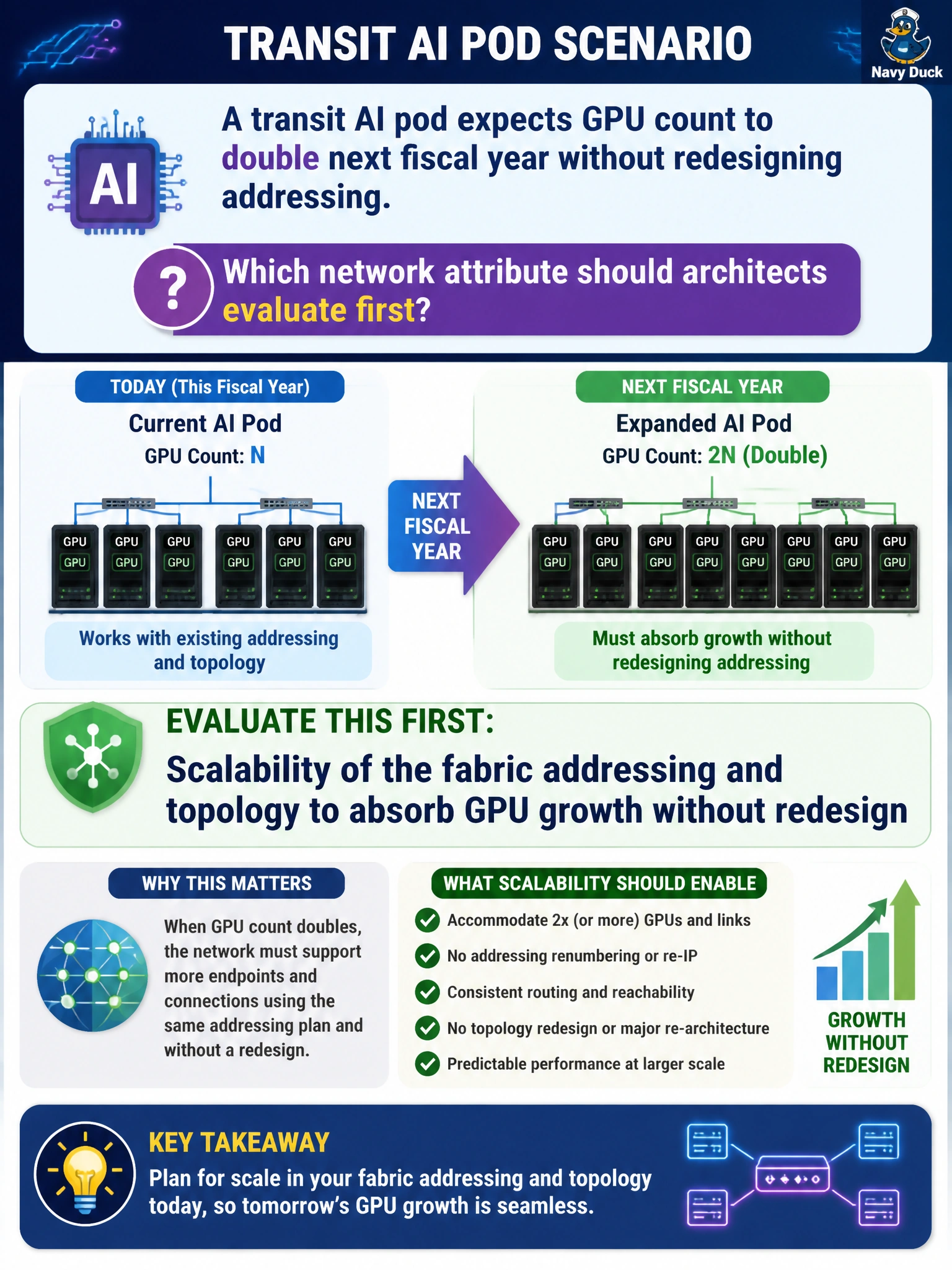
A transit AI pod expects GPU count to double next fiscal year without redesigning addressing. Which network attribute should architects evaluate first?
Select an answer to reveal the explanation.
Short Explanation
If GPUs are about to double, the fabric’s addressing and topology need headroom now—not a redesign mid-budget year. You'll care about spine-leaf topology latency, uplink fabric throughput, and path timer resiliency, but they don't give your addressing any more room when GPUs double. Plan to grow.
Full Explanation
A transit AI pod that expects GPU count to double next fiscal year without redesigning addressing should evaluate scalability of the fabric addressing and topology to absorb GPU growth without redesign first. Addressing plans, leaf capacity, and topology headroom must anticipate municipal budget-year growth so mid-year forklift redesigns do not freeze training expansion when the new accelerators arrive.
Evaluating latency of the spine-leaf interconnect topology to absorb GPU growth without redesign is worthwhile for training performance, but it is not the first attribute to check when the requirement is absorbing GPU growth without redesigning addressing; a fast fabric can still run out of addresses or topology headroom. Throughput of the transit uplink fabric capacity to absorb GPU growth without redesign matters for data movement, yet it does not tell you whether the current IP plan has headroom for twice as many GPUs. Resiliency of the redundant fabric path timers to absorb GPU growth without redesign tunes failover speed, but it does not prevent an addressing redesign when the GPU count doubles.
Exam caveat: Scalability of addressing and topology is a core AI network evaluation axis when GPU growth is known or expected—not spine-leaf interconnect topology latency, transit uplink fabric capacity throughput, or redundant fabric path timer resiliency as the first criterion. Operational check: model next year’s doubled GPU count against IP plan and leaf/spine port math, reserve addressing and uplink headroom now, and document the growth path so fiscal expansion does not force an emergency redesign.
Prefer to study offline? Printable PDF study book + test engine ($7.50, unofficial). These questions stay free here.