
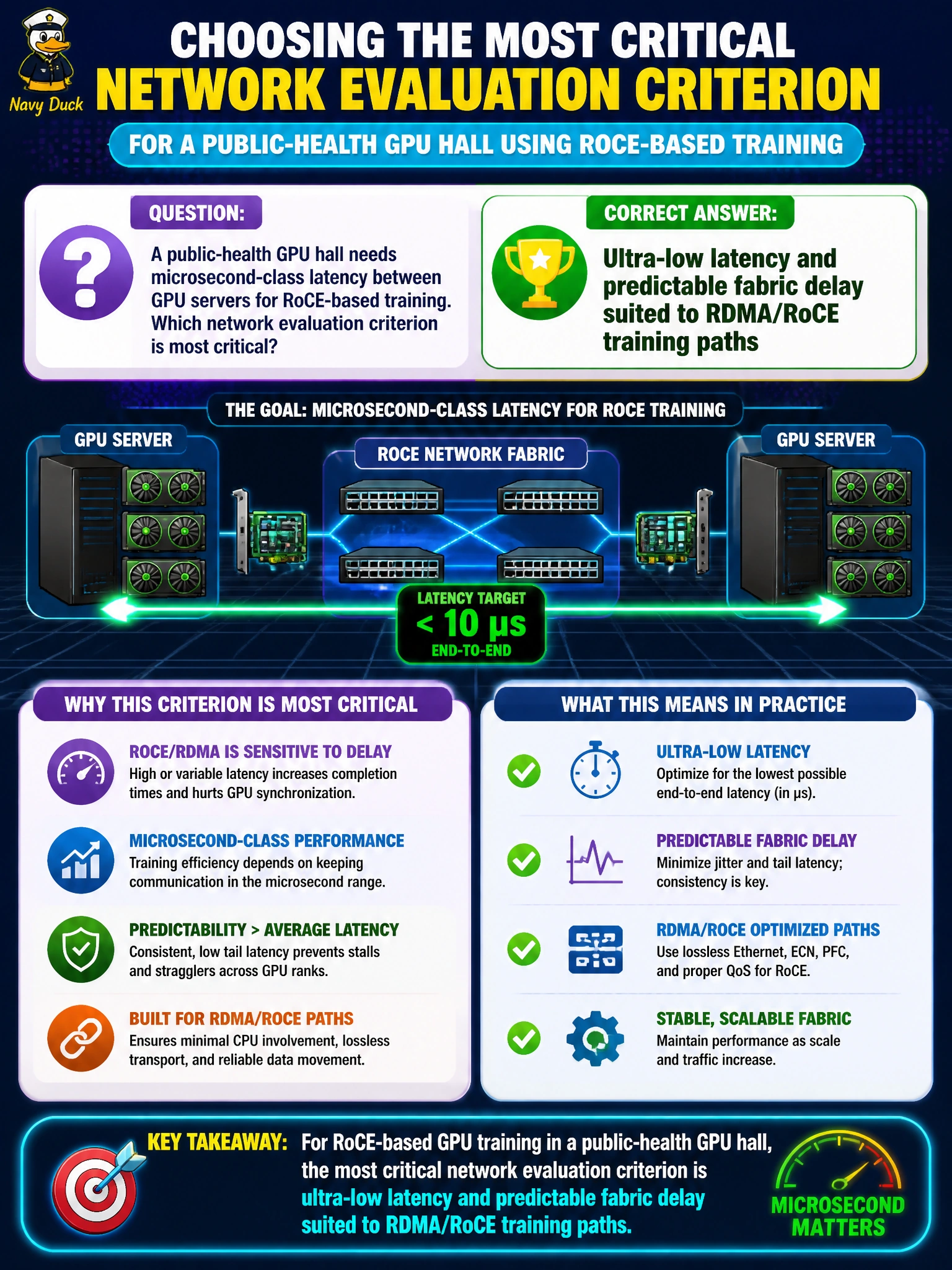
A public-health GPU hall needs microsecond-class latency between GPU servers for RoCE-based training. Which network evaluation criterion is most critical?
Select an answer to reveal the explanation.
Short Explanation
RoCE training hates waiting—think GPUs finishing each other’s sentences. Accepting higher latency tolerance with deep buffers or standard latency with TCP retransmission won’t give you microsecond east-west delay. And settling for variable latency with best-effort ECMP routing won’t fix the GPU-to-GPU jitter that breaks your sync steps.
Full Explanation
A public-health GPU hall that needs microsecond-class latency between GPU servers for RoCE-based training must treat ultra-low latency and predictable fabric delay suited to RDMA/RoCE training paths as the critical network evaluation criterion. RoCE/RDMA training iterations are sensitive to hop delay and jitter; fabrics that add unnecessary latency stretch sync barriers and waste expensive GPU time on epidemiology workloads.
Higher latency tolerance with deep buffers tuned for RDMA/RoCE training paths accepts the wrong delay budget and adds queuing delay that RoCE paths cannot afford. Standard latency with TCP retransmission handling for RDMA/RoCE training paths misjudges the fabric; retransmission-based recovery does not preserve GPU-to-GPU delay and can erode the microsecond-class budget RoCE collectives need. Variable latency with best-effort ECMP routing for RDMA/RoCE training paths undermines the predictable east-west GPU-to-GPU fabric that actually determines training latency.
Exam caveat: For RoCE/RDMA AI fabrics, latency and predictability are first-class evaluation criteria alongside bandwidth—not optional after bandwidth looks “fast enough” on average. Operational check: measure GPU-to-GPU latency and jitter on the proposed public-health fabric under load, do not accept standard latency with TCP retransmission handling for RDMA/RoCE training paths, and reject topologies that force multi-hop trombones for every collective.
Prefer to study offline? Printable PDF study book + test engine ($7.50, unofficial). These questions stay free here.