
A city data center must support nonblocking east-west bandwidth for all-reduce traffic during distributed training. What network-deployment evaluation priority should architects emphasize?
Select an answer to reveal the explanation.
Short Explanation
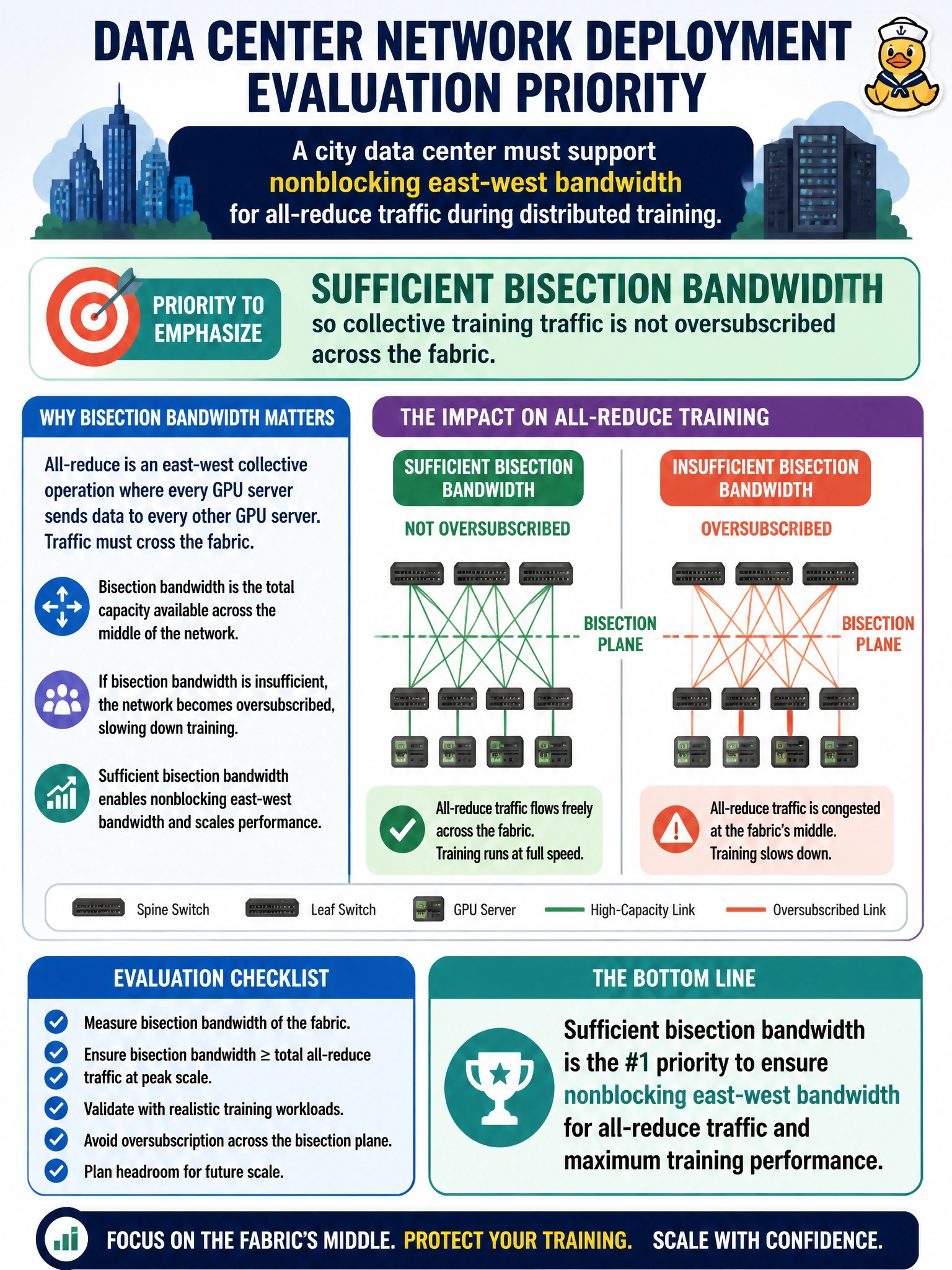
All-reduce is basically a gossip storm between GPUs — if you leave the fabric oversubscribed, your training crawls. Size east-west bisection like a multilane freeway for that chatter; you'll still bottleneck if you just enlarge MTUs within the same oversubscribed links. Tuning RoCE congestion thresholds for smoother pacing or evening out ECMP won't save you when bisection is short, and you'll just watch jobs die.
Full Explanation
A city data center that must support nonblocking east-west bandwidth for all-reduce traffic during distributed training should emphasize sufficient bisection bandwidth so collective training traffic is not oversubscribed across the fabric. All-reduce and related collectives generate heavy GPU-to-GPU east-west flows; if the fabric's bisection capacity is oversubscribed like a classic campus design, iteration time collapses and municipal training SLAs fail. Enlarging east-west MTU sizes so collective training throughput scales within current fabric links improves per-packet efficiency but does not create additional bisection bandwidth, so all-reduce flows on oversubscribed links still congest and iteration time collapses. Tuning RoCEv2 congestion thresholds so east-west collective traffic paces smoothly across existing links smooths queue behavior on existing links but leaves bisection capacity unchanged, so all-reduce traffic still congests and iteration time collapses. Optimizing equal-cost multipath hashing so east-west flows balance evenly across available fabric paths improves utilization of available paths but does not provision the nonblocking bisection capacity required for GPU collectives. Exam caveat: AI network-deployment evaluation prioritizes east-west bisection and nonblocking behavior for distributed training collectives—not east-west MTU enlargement within current links, RoCE congestion threshold tuning across existing links, or ECMP balancing across available paths. Operational check: size and measure fabric bisection against the city's all-reduce profile, verify oversubscription ratios are AI-appropriate, and load-test a representative training job before calling the municipal GPU fabric production-ready.
Prefer to study offline? Printable PDF study book + test engine ($7.50, unofficial). These questions stay free here.