
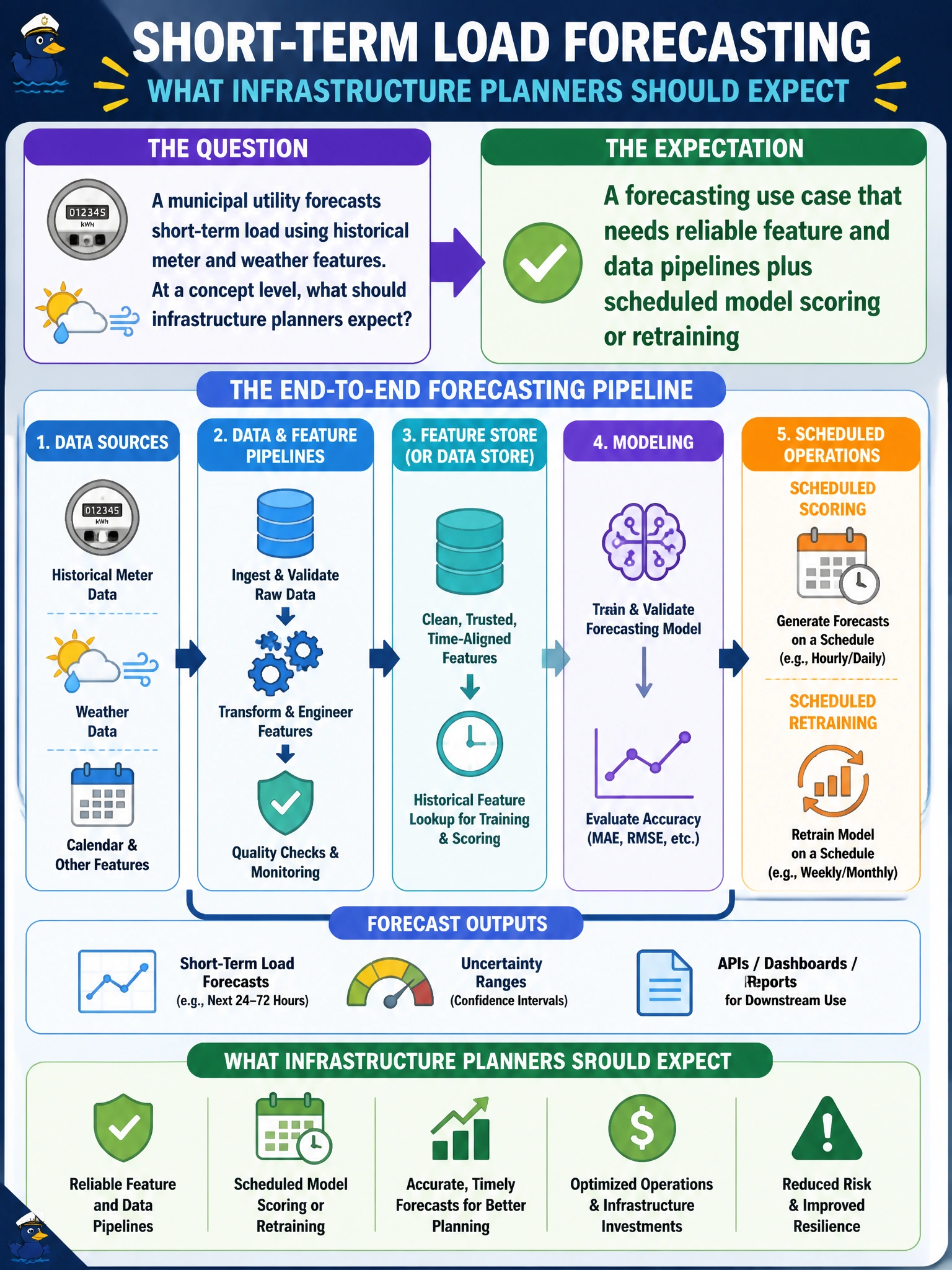
A municipal utility forecasts short-term load using historical meter and weather features. At a concept level, what should infrastructure planners expect?
Select an answer to reveal the explanation.
Short Explanation
Load forecasting is weather-plus-meters math on a schedule—pipelines in, scores out—not a chatbot hobby and not tossing history in the shredder.
Full Explanation
A municipal utility forecasting short-term load from historical meter and weather features is a forecasting use case. Infrastructure planners should expect reliable feature and data pipelines plus scheduled model scoring and periodic retraining when demand regimes change with weather, calendar, or customer mix. Interactive chatbots alone with no numerical forecasting path do not produce megawatt forecasts from meter and weather features and should not be treated as a substitute architecture for grid operations. Exclusive edge camera face recognition in substations is a vision or physical-security pattern, not short-term load forecasting. Discarding meter history because forecasts never use past features contradicts how short-term load models consume lagged demand, temperature, and related signals. Exam caveat: forecasting may use classical ML or deep models on CPUs or GPUs; the exam-level expectation is trustworthy pipelines plus scheduled scoring or retrain—not chatbot or face-recognition substitution. Operational check: monitor feature freshness for meters and weather feeds, schedule scoring ahead of operating intervals, track forecast error by horizon, alert when error spikes, and trigger retraining when error or regime change exceeds thresholds without shredding the historical features the models need.
Prefer to study offline? Printable PDF study book + test engine ($7.50, unofficial). These questions stay free here.