
County IT maps stages from collecting 911 incident labels through model retirement for a dispatch AI project. Which statement best reflects the AI lifecycle at program level?
Select an answer to reveal the explanation.
Short Explanation
Think of the dispatch AI like a city vehicle from purchase to scrapyard: you gather data, train, test, put it on the road, watch it, then retire it. You've got to test after you train, so the auditing version that skips testing and the flipped order that tests before you train won't work. You'll still need to keep watching it on the road, so the optimization version that drops monitoring isn't complete.
Full Explanation
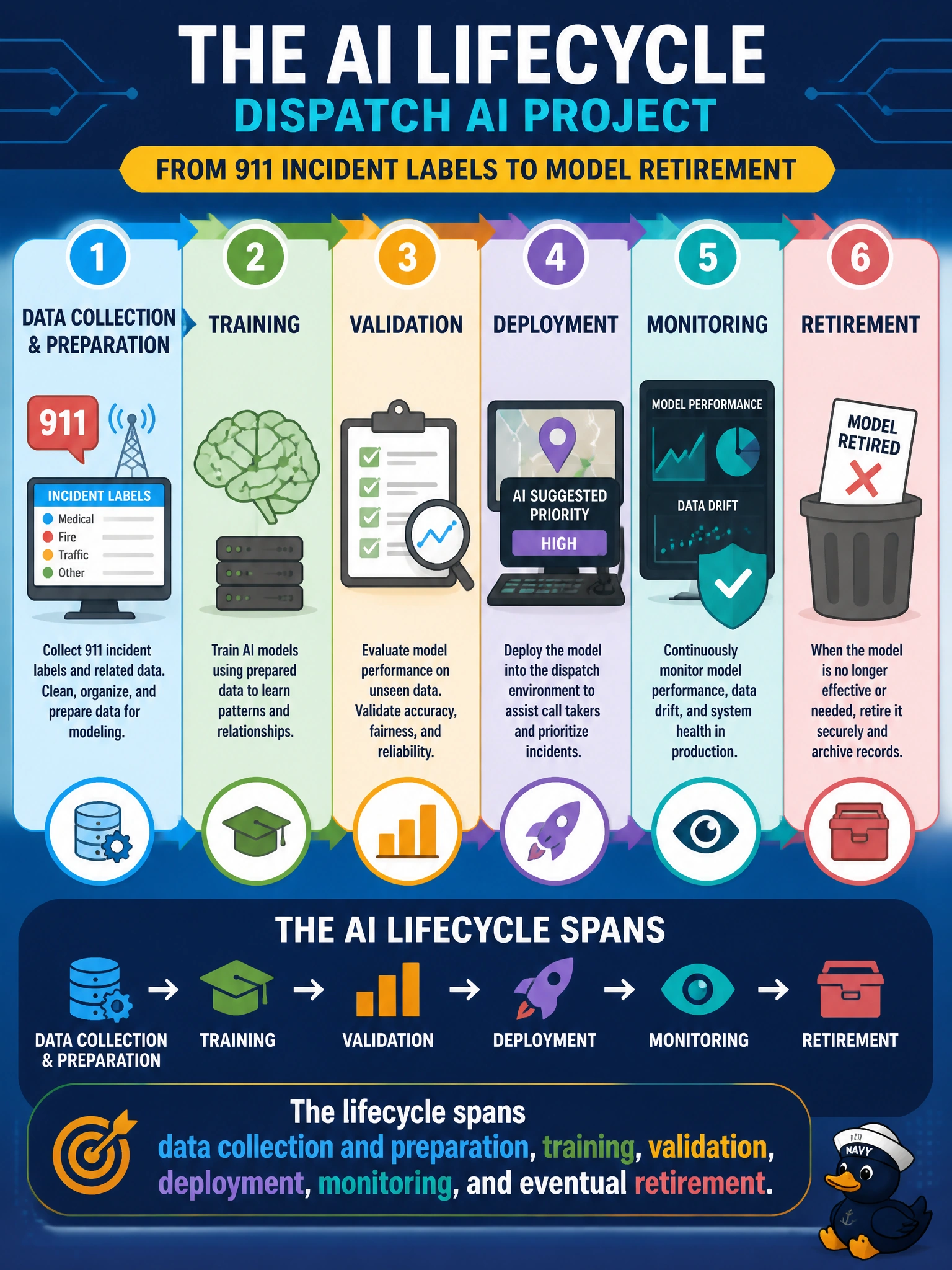
At program level, the AI lifecycle for a county 911 dispatch project spans data collection and preparation, training, validation, deployment, monitoring, and eventual retirement. Mapping stages from collecting incident labels through model retirement reflects that full chain, not the auditing variant that spans data collection, training, deployment, monitoring, and auditing while omitting validation. The lifecycle does not swap validation for auditing with training flowing straight to deployment and auditing added at the end; it spans data preparation through retirement, with validation, gates, serving, and supersession defined within the program. Describing the lifecycle with optimization in place of monitoring, spanning data collection, training, validation, deployment, and optimization, omits ongoing monitoring for drift and performance as a required program-level stage. Placing validation before training with data collection, validation, training, deployment, and monitoring reverses the required order, since validation must evaluate the trained model before deployment. Exam caveat: vendors may use slightly different stage names, but exam answers expect the end-to-end span including monitoring and retirement—not an auditing-for-validation swap that omits validation, an optimization-for-monitoring swap that omits monitoring, or a validation-before-training order reversal. Operational check: maintain a lifecycle checklist for the dispatch AI (data → train → validate → deploy → monitor → retire), with named owners and exit criteria for each stage, so 911 governance can track progress across the full chain rather than accepting a checklist that swaps validation for auditing and loses the validate-after-train gate.
Prefer to study offline? Printable PDF study book + test engine ($7.50, unofficial). These questions stay free here.