
A school district confuses chatbot answer generation with classic supervised image-classifier training. What distinction should the municipal architect emphasize?
Select an answer to reveal the explanation.
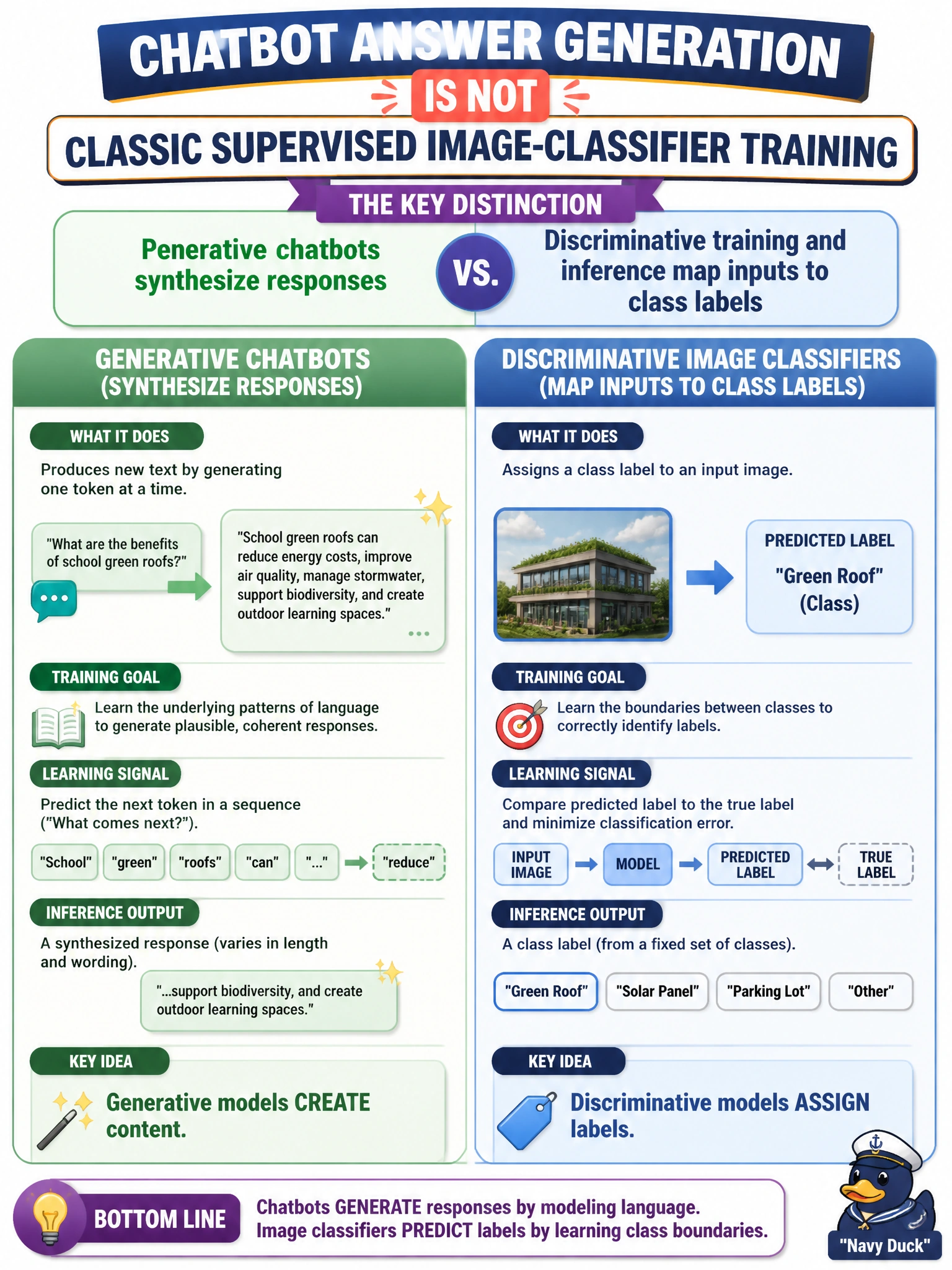
Short Explanation
A chatbot writes an answer; a classifier picks a bucket like 'bus' or 'bike.' One invents wording, the other stamps a label—don't teach the board they're the same class.
Full Explanation
The school district must separate chatbot answer generation from classic supervised image-classifier training. Generative chatbots synthesize response text (often with retrieval or tools), whereas discriminative training and inference map inputs to class labels. Emphasizing that distinction prevents treating every GPU job as the same municipal AI pattern. Saying generative chatbot training maps prompts to intent labels whereas discriminative inference samples tokens autoregressively reverses the roles—generative training synthesizes responses rather than mapping to intent labels, and discriminative inference maps inputs to class labels rather than sampling tokens autoregressively. Saying generative chatbots optimize next-token prediction whereas discriminative classifiers optimize image-caption generation loss gets the generative half right but misstates the discriminative task—discriminative classifiers optimize classification loss over class labels rather than generation loss for captions. Claiming generative chatbot inference predicts intent labels whereas discriminative inference decodes token sequences greedily reverses the tasks—generative serving synthesizes text token by token rather than predicting a fixed intent label, and discriminative inference maps inputs to class labels rather than decoding token sequences. Exam caveat: some systems combine generative and discriminative heads; still grade the dominant task—synthesis versus label mapping—when the question asks for the distinction. Operational check: label jobs in the district's AI catalog as generative serving versus discriminative training/inference, and schedule capacity and evaluation metrics accordingly rather than merging them into one vague chatbot-equals-classifier bucket.
Prefer to study offline? Printable PDF study book + test engine ($7.50, unofficial). These questions stay free here.