
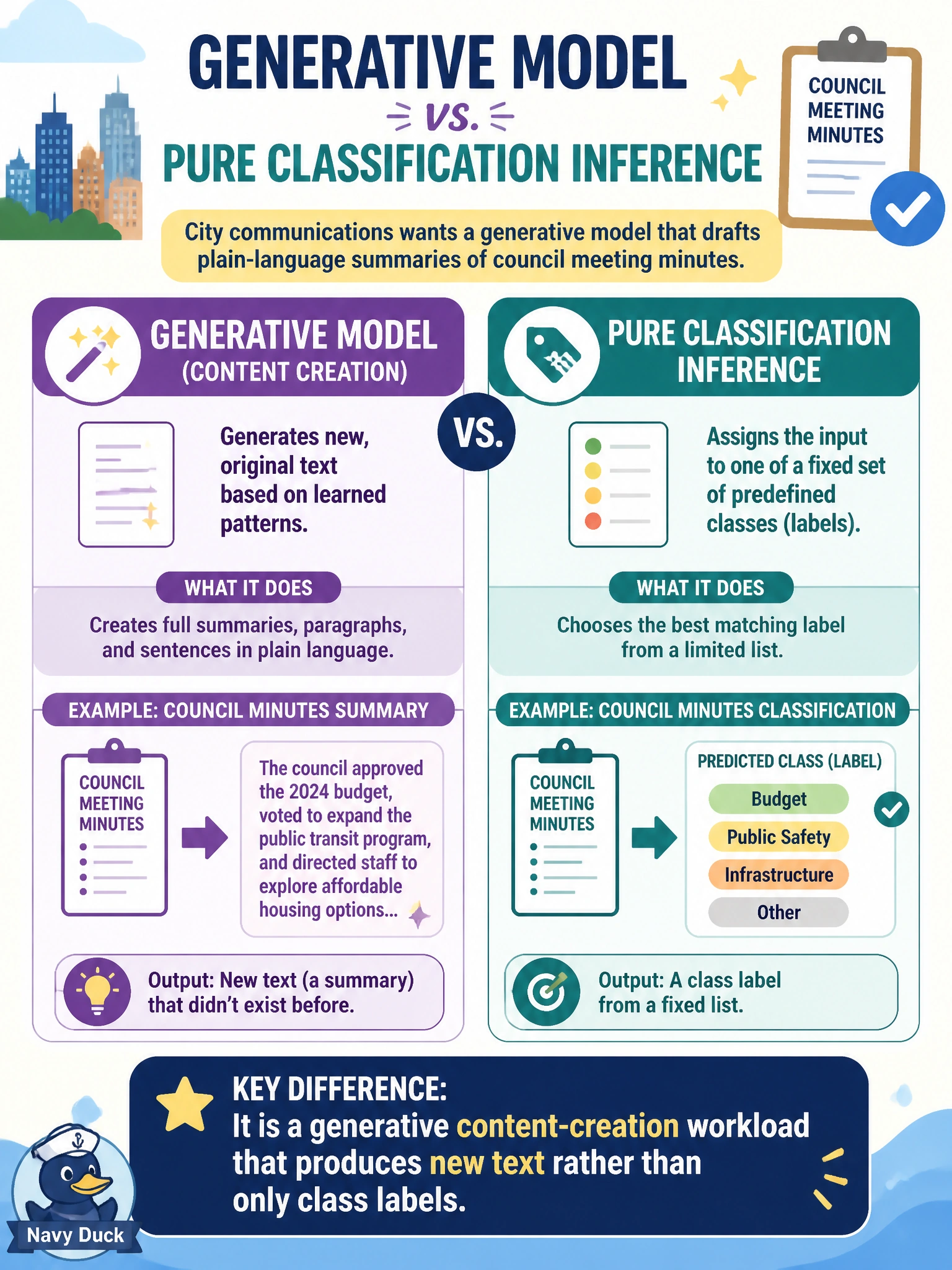
City communications wants a generative model that drafts plain-language summaries of council meeting minutes. How does this differ from pure classification inference?
Select an answer to reveal the explanation.
Short Explanation
You're not sorting minutes into preset summary template categories with multi-label classification. Generative summarization writes the short briefing from the minutes. Same AI world, different job description.
Full Explanation
Drafting plain-language summaries of council meeting minutes with a generative model is a generative content-creation workload: the system produces new text conditioned on the minutes rather than emitting only a class label from a closed set. That differs from pure classification inference, which assigns council meeting minutes to predefined summary template categories without composing a fresh summary. Treating the task as a multi-label classification workload that assigns council meeting minutes to predefined summary template categories collapses generation into discrimination and misses the token-generation serving profile. Calling it only a retrieval workload that selects a similar archived summary from a council vector database describes a lookup pattern that does not draft a new summary from the minutes. Treating it as a sequence-labeling workload that tags named entities in council minutes for indexing and search produces annotations rather than a plain-language summary and misses the generative content-creation task. Exam caveat: generative summarization may still use classification or retrieval as helper stages, but the primary workload distinction on the exam is generating text versus only labeling. Operational check: validate summary fidelity against approved minutes, set token and latency budgets appropriate for generation (not just classifier scores), and keep human review where municipal communications policy requires it.
Prefer to study offline? Printable PDF study book + test engine ($7.50, unofficial). These questions stay free here.