
An orchestrator at a transit provider already holds service intent for a new security function, but nothing in the cloud is filtering as that function. What is missing?
Select an answer to reveal the explanation.
Short Explanation
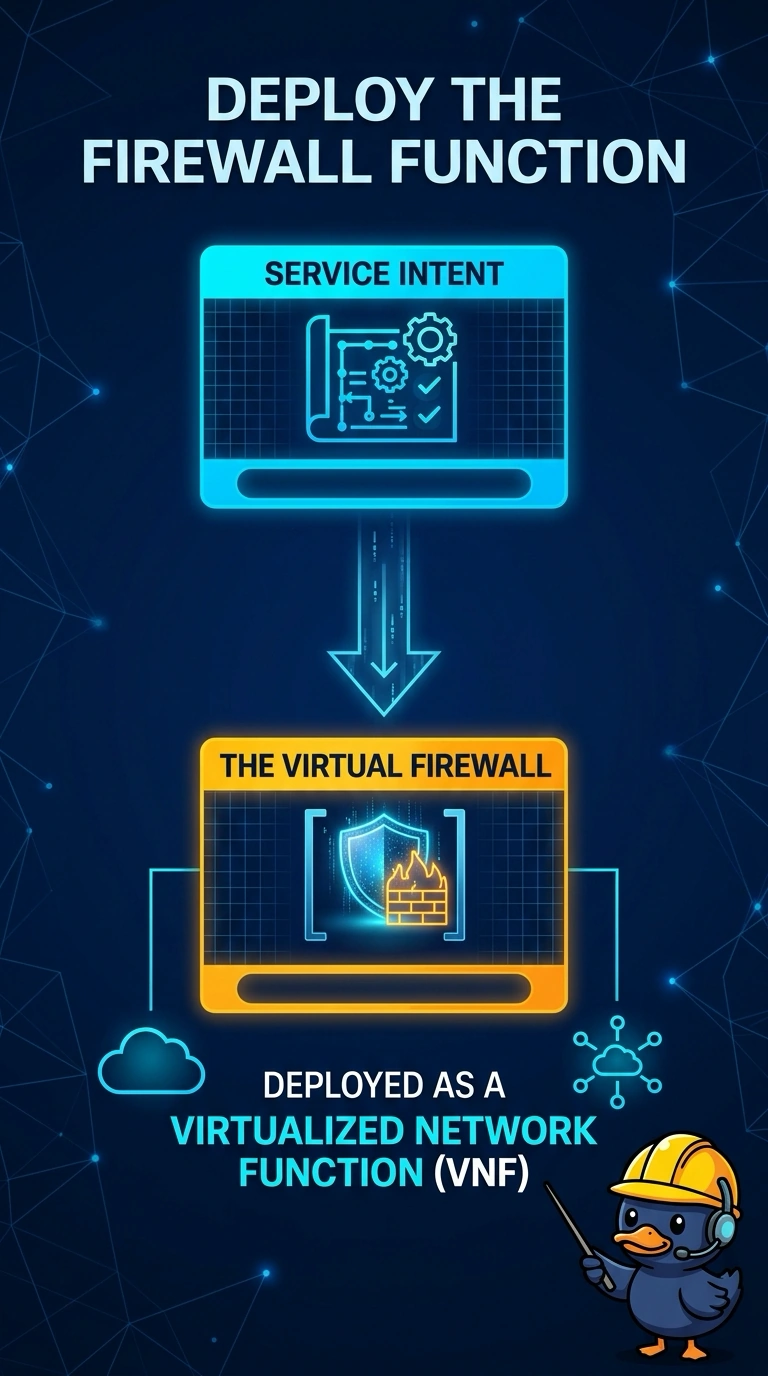
The work order is written and the truck that does the job was never sent. You deploy the virtual firewall as the virtualized network function the intent already names. A restated NFV approach, a second NSO, and a virtual router leave the filtering function itself unplaced.
Full Explanation
NFV is the approach of running network functions on the cloud. A VNF is the function itself. NSO is the orchestrator that already holds this service intent. The virtual firewall is the platform that filters. Intent with no firewall function means the missing object is that virtual firewall, not another copy of the orchestrator and not a slogan about NFV. The virtual firewall itself, deployed as the virtualized network function is the design that meets this requirement. A fresh statement of the NFV approach without placing any filtering function is the wrong fit because NFV is the approach already chosen, and restating it does not place the filtering function in the cloud. A second NSO system to store the intent the current orchestrator already holds is the wrong fit because the orchestrator already holds the service intent, so another NSO system copies a store that is not the gap. A virtual router platform standing in for the required filtering function is the wrong fit because a virtual router is the platform for a routing function, and the missing function here is filtering. Exam caveat: Keep the approach, the function, the orchestrator, and the virtual platform distinct. Intent stored in NSO does not filter traffic until the virtual firewall is running. Operational check: Confirm a virtual firewall instance is in service and that the existing NSO intent is bound to it rather than to an empty orchestration record.