
A harbor leaf has used only a few hundred VLAN identifiers, yet two tenants each require VLAN 200 with overlapping addresses. How should the leaf separate them?
Select an answer to reveal the explanation.
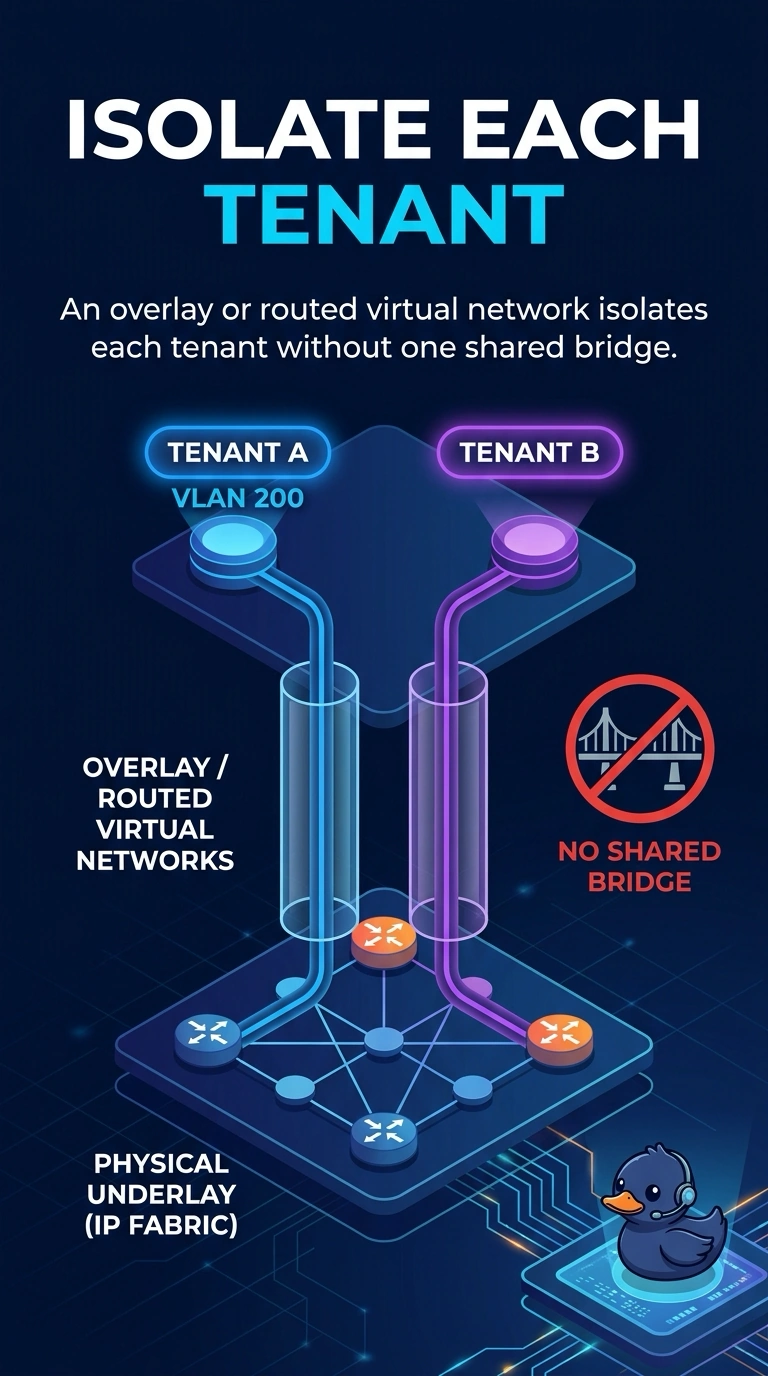
Short Explanation
Two crews painting stall 200 cannot share one garage when their floor maps overlap. You separate them with an overlay or routed virtual network, even though your VLAN budget is not used up. Unique bridged identifiers, one shared VLAN 200, and identifiers past 4094 either change the required label, merge the tenants, or invent IDs the tag cannot hold.
Full Explanation
One bridged domain isolates tenants by VLAN identifier, and the usable 802.1Q space stops at 4094. This leaf is nowhere near that budget. The constraint is that both tenants must keep VLAN 200 and overlapping addresses on the same leaf, which a shared bridge cannot separate. Segmentation then moves to an overlay or to routed tenancy, where each tenant gets its own virtual network even though the bridged identifier is reused. An overlay or routed virtual network that isolates each tenant without one shared bridge is the design that meets this requirement. Unique bridged VLAN identifiers and non-overlapping addresses for the two tenants is the wrong fit because renumbering into unique VLANs fits tenants who can change identifiers and address plans, not tenants locked to VLAN 200 and the overlap. One bridged VLAN 200 shared by both tenants with the address overlap left in place is the wrong fit because both tenants would share one broadcast domain, so the overlapping addresses collide instead of staying isolated. Additional 802.1Q identifiers past the 4094 usable values on that same bridge is the wrong fit because the 802.1Q field has 4094 usable identifiers, from 1 through 4094, and unused headroom does not create IDs beyond that. Exam caveat: Running out of VLAN identifiers is only one reason to leave a shared bridge. Overlapping tenants on the same identifier need an overlay or routed tenancy too. Operational check: On the leaf, confirm each tenant has its own virtual network, both still present VLAN 200 inward, and their overlapping addresses no longer share a bridge.