
A catalog team ships a stateless web front end built to run as a process on the host kernel and to be scheduled in many copies. Which placement matches that workload?
Select an answer to reveal the explanation.
Short Explanation
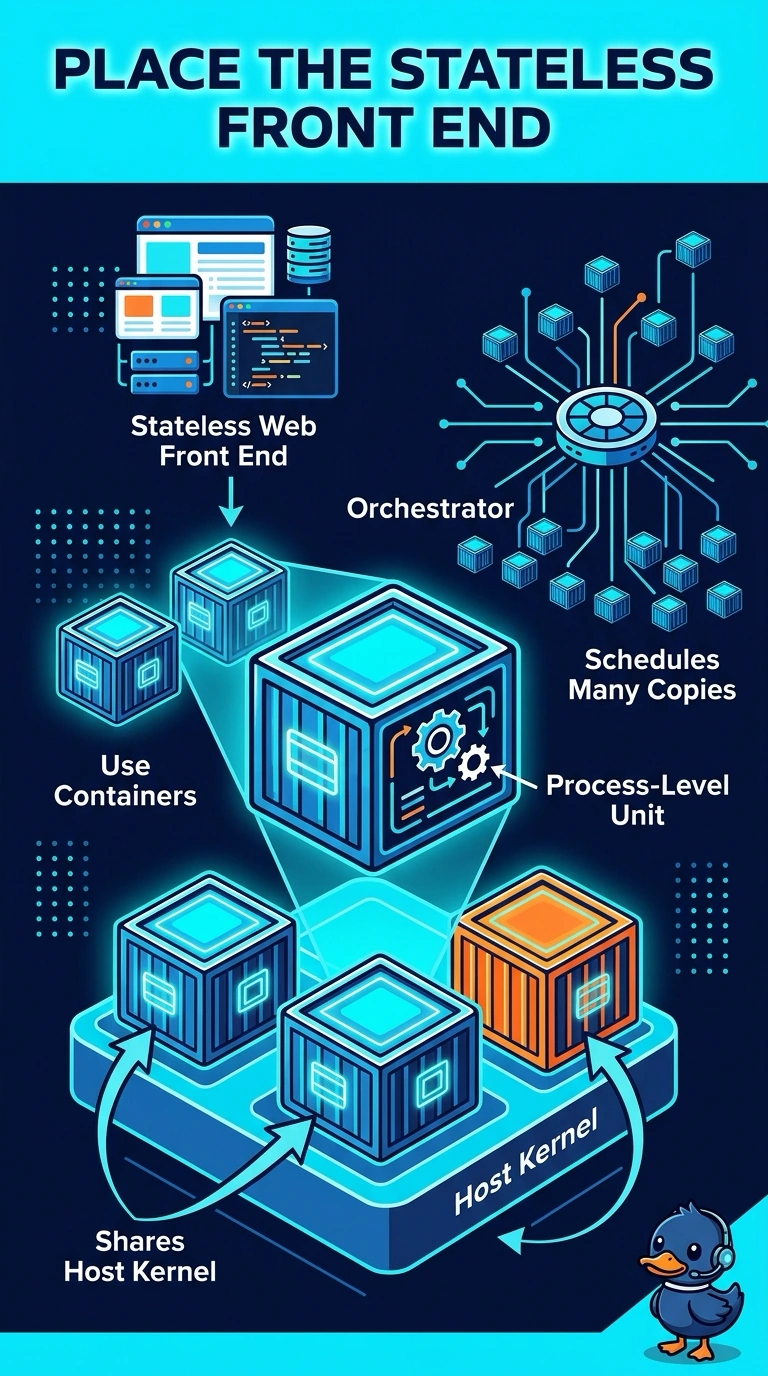
A food truck that shares the city streets is enough when you do not need a private highway. You run the front end in a container on the shared host kernel. A separate guest kernel, a strongly isolated untrusted guest, and a process outside the orchestrator are more than this workload needs.
Full Explanation
A container shares the host kernel. Run the workload in a container. In Kubernetes, the scheduler places a Pod containing the container on a node. Rescheduling starts a replacement instance; it does not imply migration of the running process. That matches this stateless front end because it is built as a process-level unit to run in many copies on the shared kernel. A virtual machine that boots a separate guest kernel this front end does not ship or need is the wrong fit because a separate guest kernel fits a workload that needs a different kernel, and this front end does not. A strongly isolated guest reserved for untrusted code that must not share the host kernel is the wrong fit because a hard guest boundary fits untrusted code that must stay off the host kernel, and this front end is not that case. A node process started outside the orchestrator with no scheduled replica and no image is the wrong fit because it is not a scheduled replica of the shipped image and cannot scale as copies. Exam caveat: If the front end later needs its own kernel or a hard guest boundary, the placement becomes a virtual machine.