
Carrier routers still accept one shared local password for operator login, and the team needs per-user authentication plus command accounting. What should they deploy?
Select an answer to reveal the explanation.
Short Explanation
A badge reader at the equipment-room door is a different problem from a filter on the freight. You put TACACS on operator login so each person is authenticated and each command is accounted. An access list, unicast reverse-path forwarding, and MACsec police packets or a link, not the person typing on the router.
Full Explanation
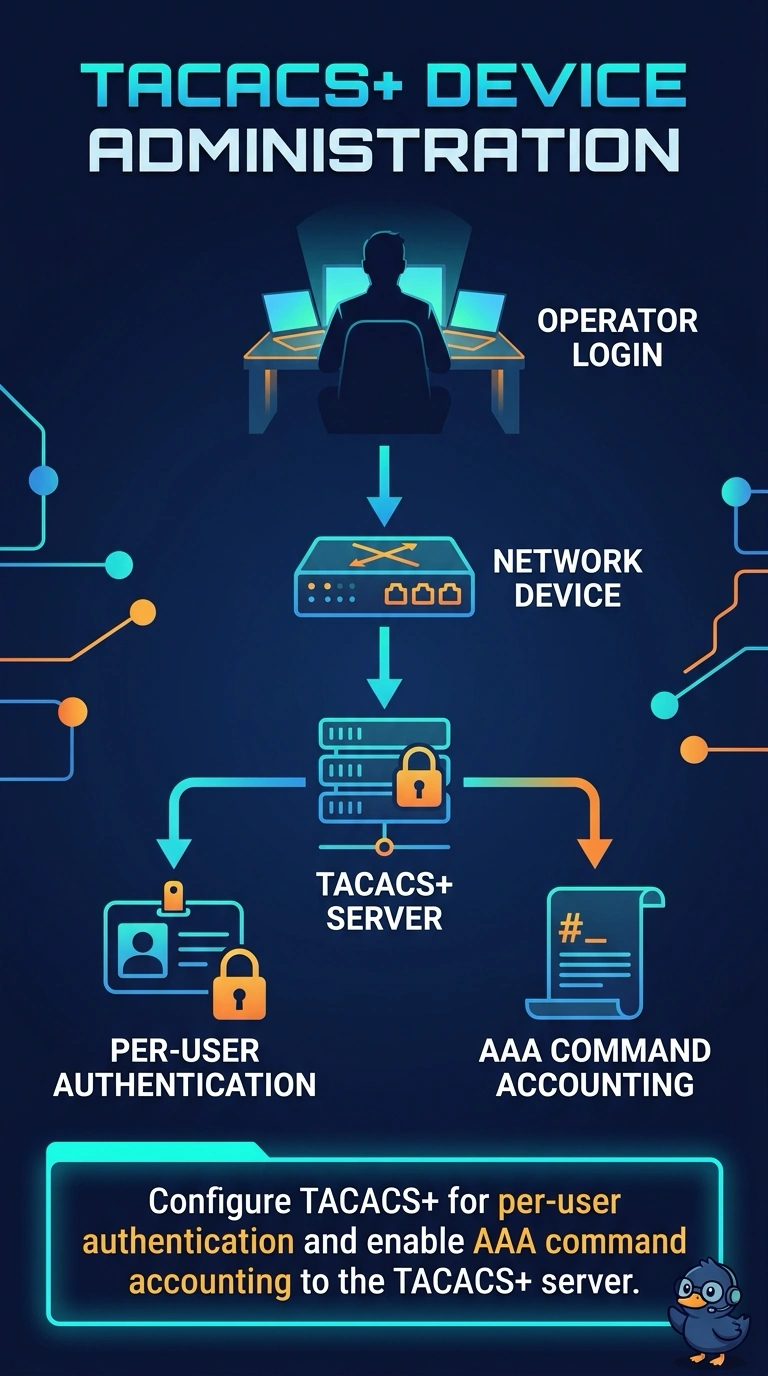
TACACS+ is the device-administration control that authenticates each operator and records commands. Command accounting must be configured; adding a TACACS+ server alone does not turn it on. An access list filters packets or prefixes on the data plane. Unicast reverse-path forwarding drops traffic whose source would not route back the way it arrived. MACsec encrypts a single Ethernet hop. None of those data-plane or link controls replaces per-user administration of the router. Configure TACACS+ for per-user authentication and enable AAA command accounting to the TACACS+ server is the design that meets this requirement. An access list that filters customer data packets on the router interfaces is the wrong fit because an access list filters packets or prefixes, and it does not authenticate operators or account their commands. Unicast reverse-path forwarding applied on the customer edge interfaces is the wrong fit because unicast reverse-path forwarding drops packets whose source is not reachable back that way, which is not operator login. MACsec enabled on the Ethernet hop between each pair of adjacent routers is the wrong fit because MACsec ciphers one Ethernet hop between routers, and it does not identify which operator typed a command. Exam caveat: TACACS+ administers the device. It is not a packet filter, a reverse-path check, or encryption of an Ethernet hop, and those controls do not record operator commands. Operational check: Log in separately as two different operators and confirm each command accounting record names that operator rather than one shared local account.