
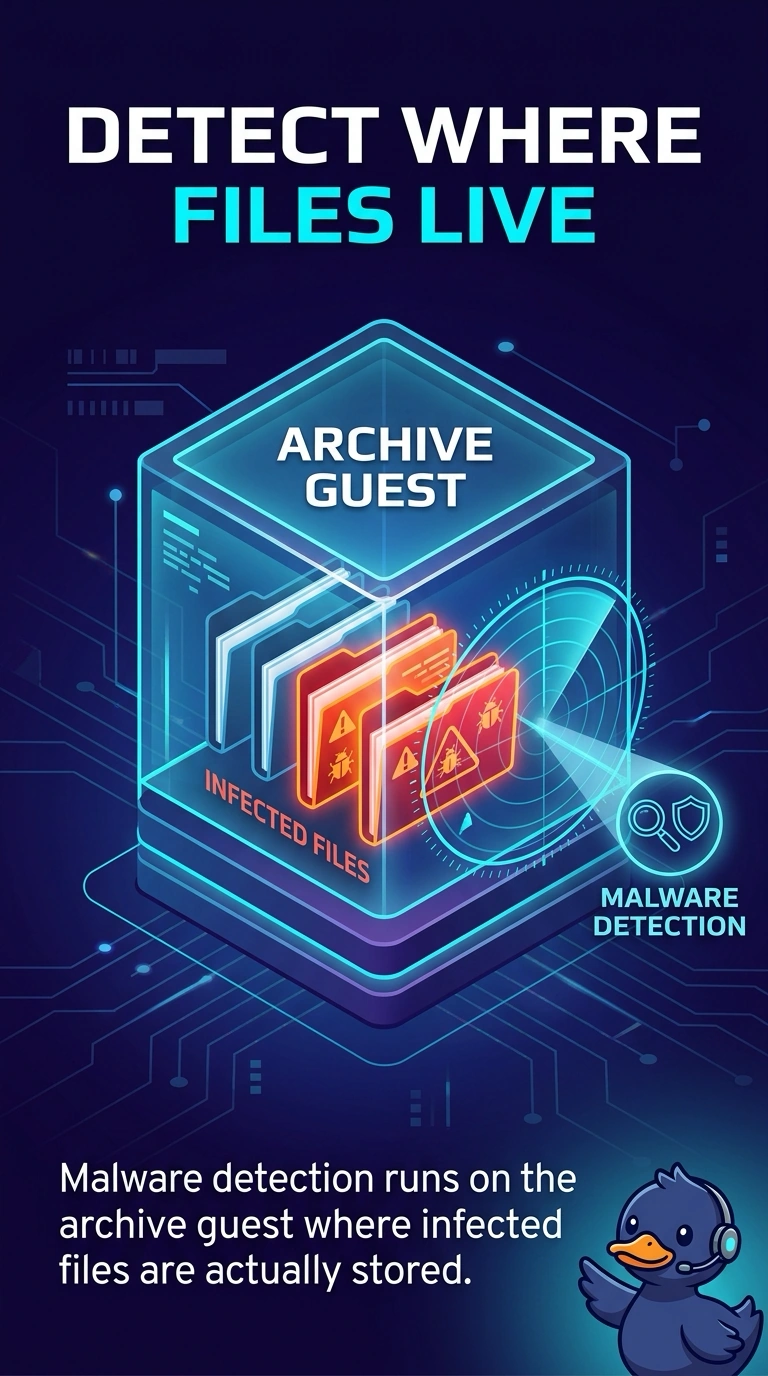
An archive guest stores infected files. Recursive queries from that guest look ordinary, and the live flow shows no exploit. Where should detection be placed?
Select an answer to reveal the explanation.
Short Explanation
You won’t find a spoiled jar in the pantry by tasting the water or reading the mail. Place malware detection on the archive guest that stores the infected files; DNS security sees only ordinary queries, exploit detection sees a live flow with no exploit, and the gateway packet filter does not open the stored files.
Full Explanation
Malware detection belongs on the archive guest where the infected files are stored. The guest holds those files, while its recursive queries look ordinary and the live flow shows no exploit, so detection must be placed where the files themselves can be read. DNS security on the recursive resolvers is a poor fit because those resolvers see only ordinary queries; DNS security inspects queries, not stored files. Exploit detection on the live flow is a poor fit because that flow does not carry an exploit from this guest, so it provides no exploit evidence to detect. A gateway packet filter is also a poor fit: it can filter packets, but it does not open the files stored on the archive guest. The design that meets the requirement is malware detection on that guest, where the infected files are actually stored. Exam caveat: DNS security does not scan a disk, and a flow detector cannot see a file that never crosses the live path. Place each service where its evidence appears. As a practical check, scan the stored files on the archive guest and confirm the infection is reported there while the recursive queries remain ordinary and the live flow remains free of an exploit during the same test.