
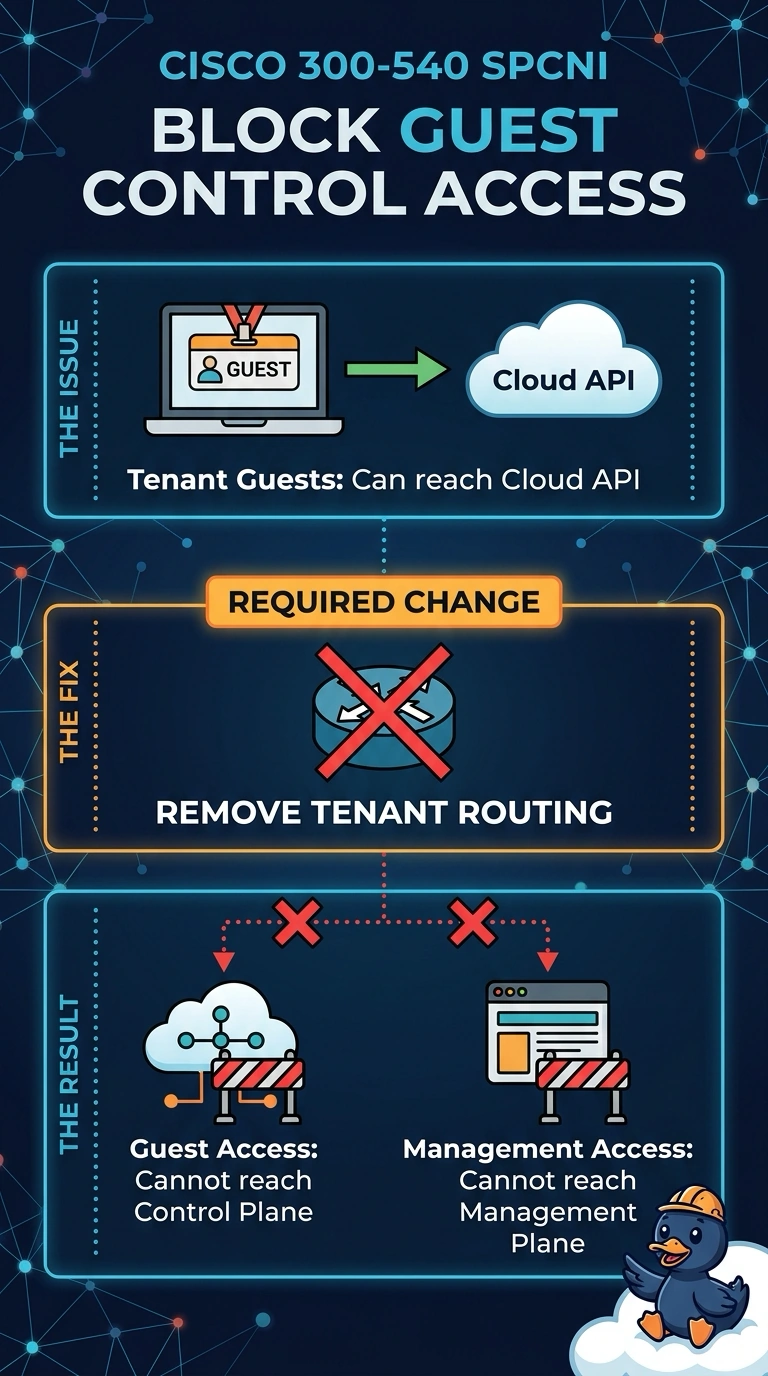
Tenant guests in a virtualized infrastructure can open sessions to the cloud controller API. The operator wants those workloads unable to reach the control and management plane. Which change matches the requirement?
Select an answer to reveal the explanation.
Short Explanation
Locking the office door matters more than asking for identification from people already inside. You remove tenant routes to the cloud control and management plane. Mutual authentication on an open path, channel encryption alone, or tenant-to-tenant segmentation leaves that plane reachable.
Full Explanation
The cloud control and management plane should not be reachable from tenant workloads. Removing that path is the change that matches the requirement. Mutual TLS lets an authorized client and the API prove each other. TLS protects a channel and does not decide who can route to it. Segmentation between tenants keeps customers apart, and it does not hide the controller from those tenants. Remove tenant routing so guests cannot reach the cloud control and management plane is the design that meets this requirement. Mutual TLS on the controller API while tenant guests can still route to it is the wrong fit because mutual TLS proves both parties on a call, and it does not remove the route from the tenant guest. TLS on the controller API that protects the channel and leaves it reachable is the wrong fit because TLS only protects the channel, and a protected API can still be reached from the tenant guest. Segmentation that separates tenants from each other but not from the controller is the wrong fit because tenant-to-tenant segmentation keeps customers apart and leaves the controller path in place. Exam caveat: API authentication is still required for orchestrator clients who should reach the controller. Hiding the API from tenants does not replace that check. Operational check: From a tenant guest, attempt a session to the controller API and confirm it fails, then confirm an authorized orchestrator client on the management path still authenticates.