
A manufacturer forbids any generated test packet on its trading floor, yet the network team still needs to see how real host traffic behaves there. Which approach fits that rule?
Select an answer to reveal the explanation.
Short Explanation
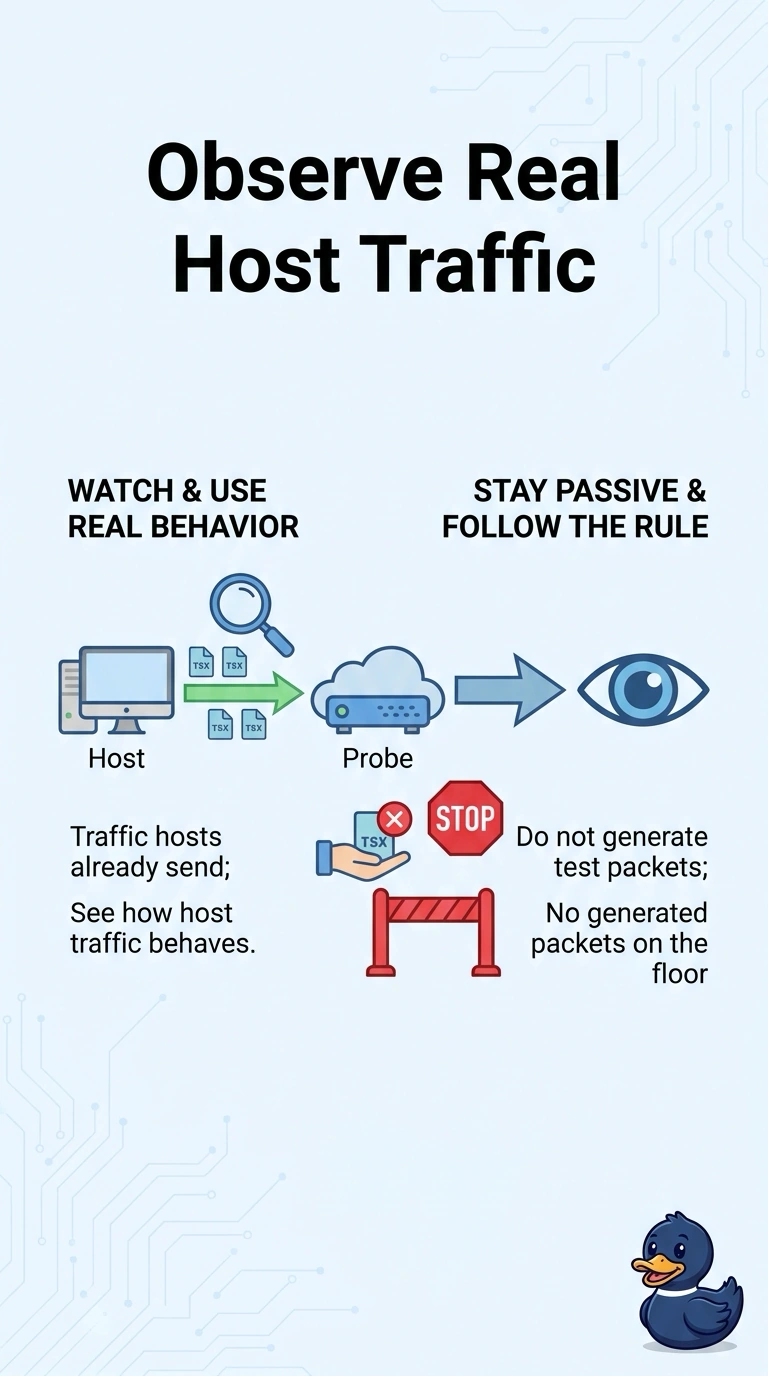
Picture a guard who will let you listen in the hallway but will not let you shout test messages down it. You learn how the trading floor behaves by watching traffic the hosts already send. A saved switch config or a scripted login never shows that live behavior.
Full Explanation
Passive collection records packets and flows the hosts already send, so the measurement adds no test traffic of its own. On a trading floor where security forbids generated test packets, that is the method that still shows who is talking and how those conversations behave. Active probing does the opposite of the rule: it injects synthetic packets toward targets such as the trading gateways and scores those probes. Archiving switch configurations keeps a copy of how the devices are set and lets a later file be compared with a saved one, but a backup contains no live conversations and cannot describe delay or loss on the floor. A synthetic login drives a scripted sign-in to the trading portal and records whether that transaction finishes. It creates its own session and speaks to an application walk, not to the traffic the floor is already producing. Exam caveat: passive data can describe only traffic that is already present, so a host that stays quiet contributes nothing until it sends. Operational check: confirm the collector is receiving a copy of production flows and that no probe schedule is aimed at the restricted floor.