
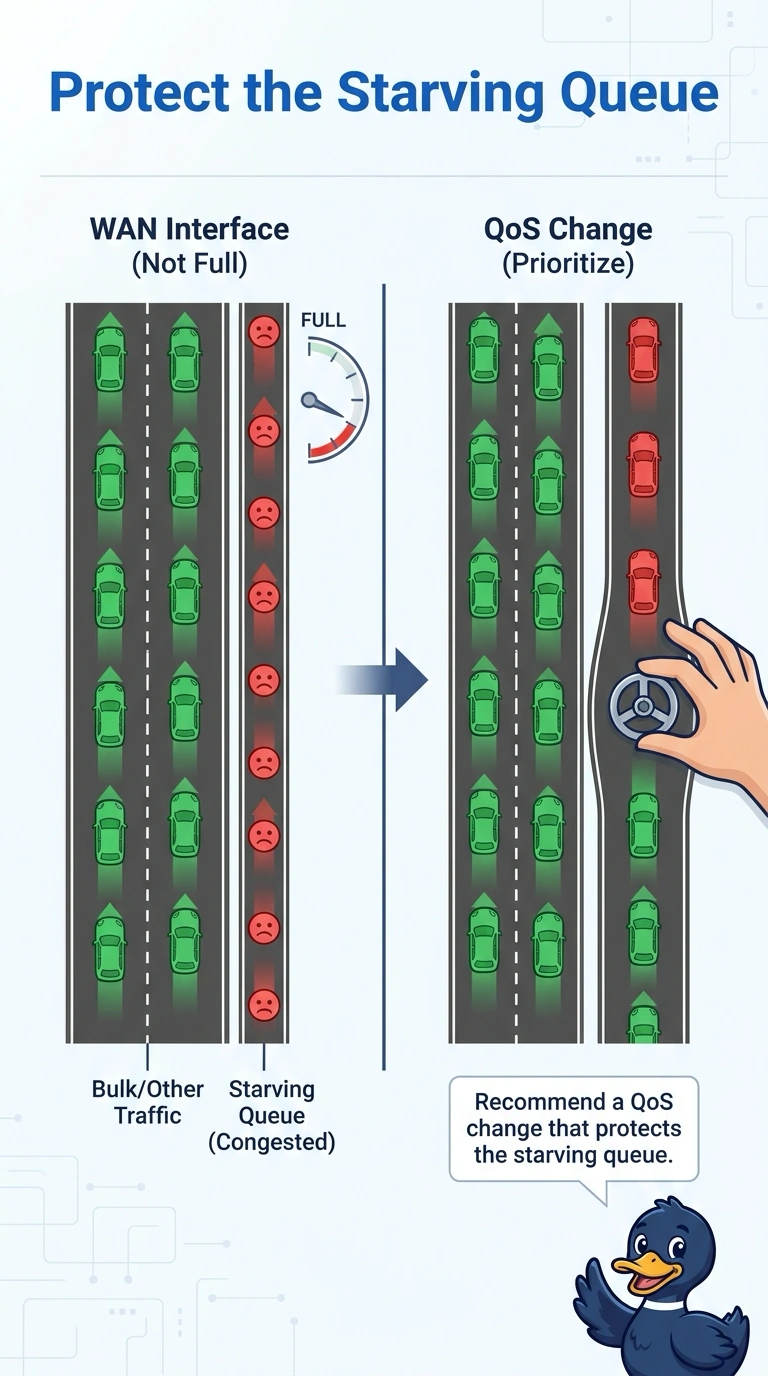
A bank sees one traffic queue starve during the business day while the WAN interface carrying that queue is not full. Which item belongs in the capacity recommendation?
Select an answer to reveal the explanation.
Short Explanation
A checkout line that starves while the store is half empty is a staffing problem, not a bigger building. You recommend a QoS change so the bank's starving queue is served while the interface still has room. Another page, a renamed dashboard, or a duplicate test does not feed that queue.
Full Explanation
A queue that starves while its interface is not full is being denied service by scheduling, not by a lack of circuit size. The capacity recommendation is a QoS change that protects the starving queue. A larger circuit would add unused capacity on an interface that is already not full, and it would not place packets into the queue that is being skipped. Adding another alert that pages the bank network team whenever that queue starves notifies people of a condition the recommendation is supposed to fix, and it does not change the scheduler. Renaming the branch dashboard so the starving queue stands out improves a label and leaves the policy untouched. Running another test that records the same queue starvation and changes no scheduling policy collects a second copy of evidence the report already has. Exam caveat: a full interface can justify more bandwidth, but an idle interface with one starved queue points at QoS. Operational check: after the policy change, confirm the previously starved queue is served and that the interface still shows spare capacity rather than a new physical bottleneck. If drops remain only in that queue, the class is still not protected.