
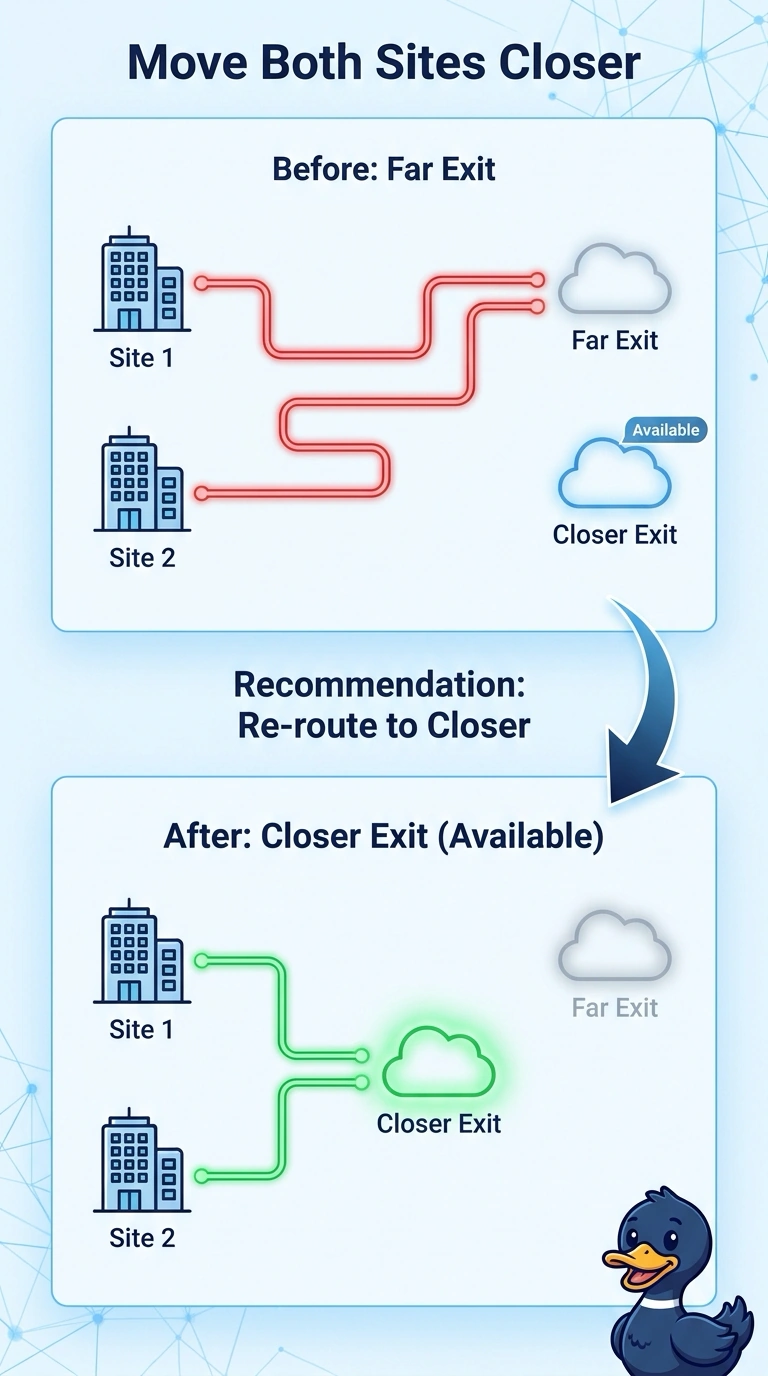
A government agency sees two sites sending traffic through a distant exit even though a closer exit is available and healthy. What should the capacity recommendation propose?
Select an answer to reveal the explanation.
Short Explanation
Two offices driving to a far exit when a near ramp is open have a map problem. You recommend a topology change so the agency sites use the closer exit. Another alert, a renamed view, or more samples of the long path leave both sites where they are.
Full Explanation
The two sites are using a distant exit while a closer healthy exit is available, so the inefficiency is where the traffic is attached. The capacity recommendation is a topology change that moves both sites onto the closer exit. Adding an alert whenever the sites still use the distant exit tells operators the old attachment remains, and it does not move either site. Renaming the agency view so the distant exit is easier to identify changes how the map is labeled and leaves both sites exiting where they exit today. Collecting more measurements of the distant exit without moving either site adds samples of the same long path and includes no topology, configuration, or QoS change. Exam caveat: a closer exit that is itself unhealthy would not be the recommendation, which is why the finding here includes that the closer exit is available and healthy. Operational check: after the move, confirm both sites' traffic leaves through the closer exit and that delay toward their usual destinations improves with the distant exit out of the path. If the distant exit is still on the route, the topology was not changed.