
At a bank, an alert rule passes a syntax check and an engineer treats that check as proof the rule works. What still has to happen?
Select an answer to reveal the explanation.
Short Explanation
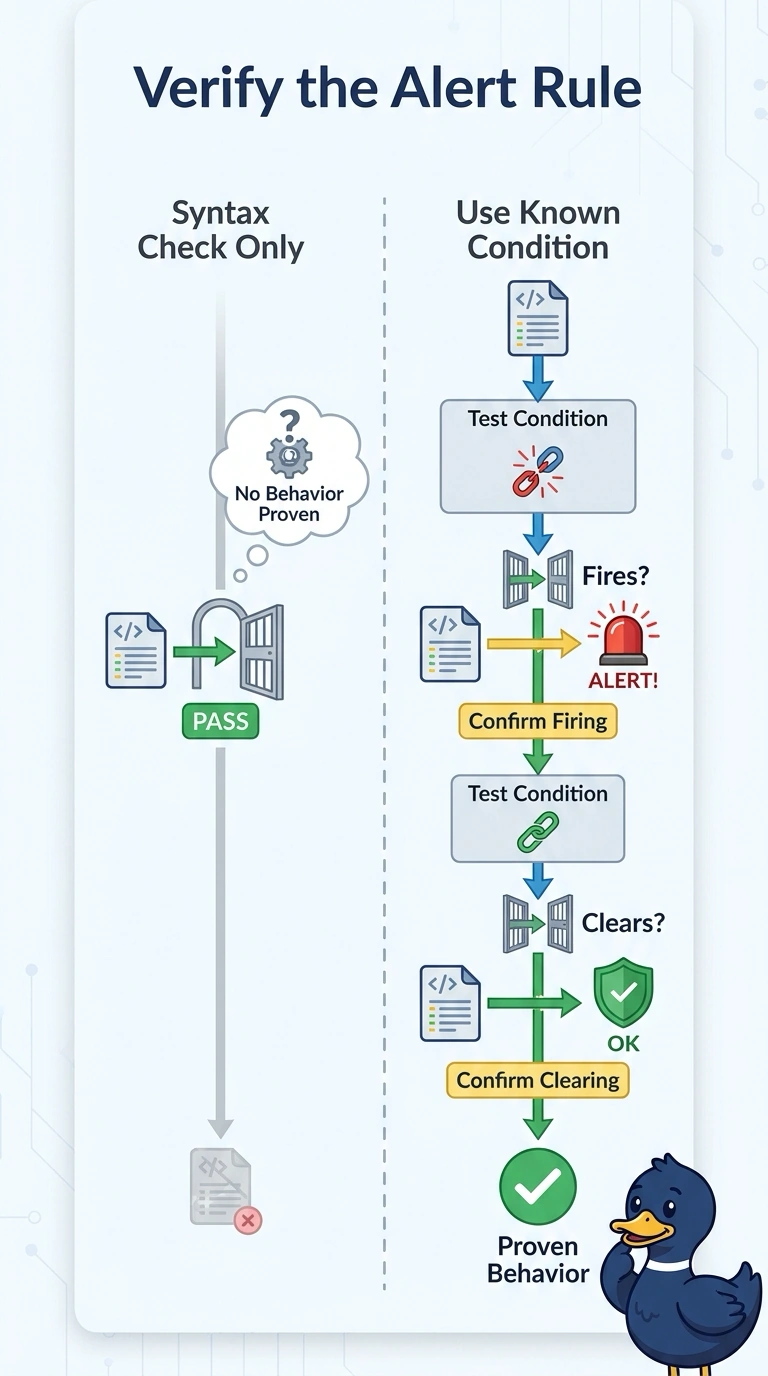
A spell-checker can bless a sentence that still says the wrong thing. You still have to prove the rule fires and clears against a known condition, because a syntax check only proves the rule is well formed. Lowering every threshold, deleting the rule after one page, or trusting it because it was saved does not supply that proof.
Full Explanation
A syntax check tells the bank that the rule is well formed. It does not tell anyone that the condition matches live data, that a page is produced, or that the alert returns to a clear state when the condition ends. The missing step is a known-condition test: create or replay the condition, confirm the rule fires, remove the condition, and confirm the rule clears. Lowering every threshold until a page is likely on the next business day changes the rule's sensitivity in the hope of seeing noise. That is not a controlled proof, and it can page on ordinary trading-floor variation the original condition was meant to ignore. Deleting the rule after the first page removes the control as soon as it has fired once, so there is no way to confirm a clear or to catch the next real event. Trusting the rule because it was saved after the syntax check repeats the same mistake. Storage and grammar are not a fire-and-clear test. Exam caveat: a saved, syntactically valid rule can still watch the wrong metric or never clear. Operational check: in a controlled window, trigger the condition the rule names, confirm one notification, withdraw the condition, and confirm the clear.