
A manufacturer edited an alert rule, and the on-call owner still cites yesterday's validation of the old rule. What should happen before the edited rule is trusted?
Select an answer to reveal the explanation.
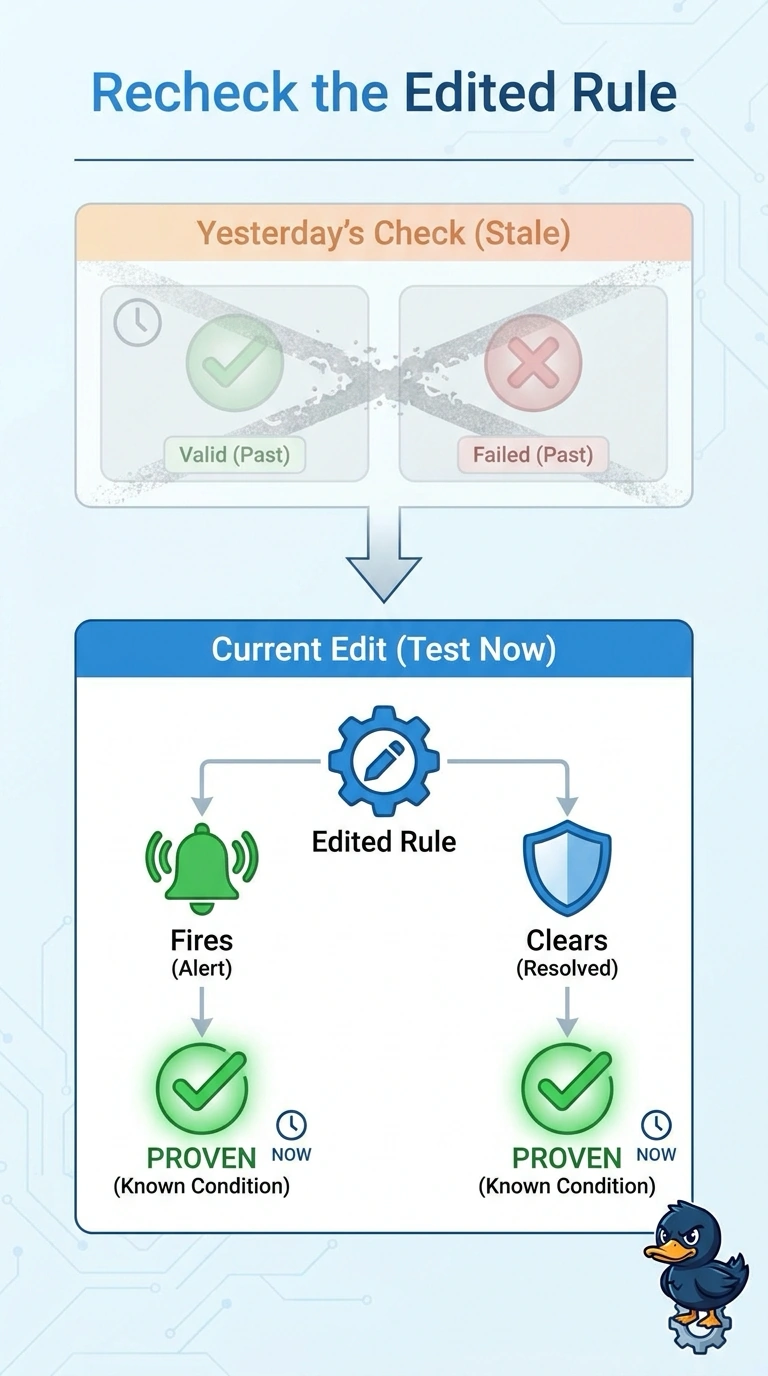
Short Explanation
Yesterday's fire drill does not count after you rearrange the exits. You prove again that the rule fires and clears against a known condition, because a change makes yesterday's validation stale. Lowering every threshold, deleting the rule after a page, or trusting the saved text skips the new proof.
Full Explanation
Validation is evidence about the rule text that was tested. Once the manufacturer edits the rule, yesterday's fire-and-clear result describes a version that is no longer in place. Before the edited rule is trusted, replay a known condition, confirm the new text fires, remove the condition, and confirm it clears. Lowering every threshold so the next shift sees fewer pages changes sensitivity without proving the edit. Quieter pages can mean the condition no longer matches, which is a failure, not a success. Deleting the rule after a single page prevents a second exercise and also prevents a clear test, so the plant loses the alert the edit was supposed to improve. Trusting the saved rule and skipping a new check treats storage as proof. The editor can save a rule that watches the wrong signal or that never returns to normal. Yesterday's note can stay in the change record as history. It cannot authorize the new text. Exam caveat: any material edit invalidates the previous fire-and-clear evidence. Operational check: after the change window, trigger the named condition once, confirm the page, restore normal, and confirm the clear before the shift relies on it.