
At a manufacturer, packet loss appears in the same windows as MPLS label-switched path changes. What should page the WAN team?
Select an answer to reveal the explanation.
Short Explanation
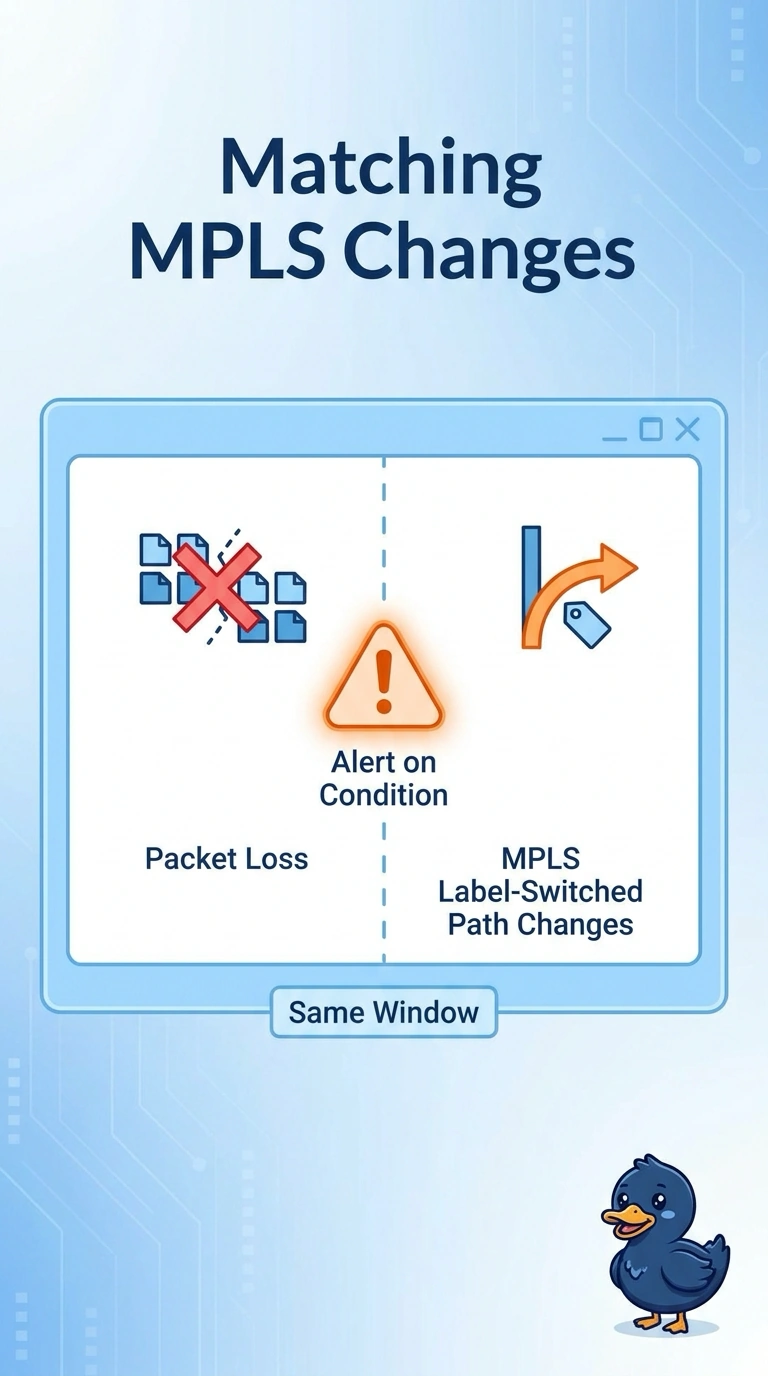
When the potholes and the road closure show up in the same hours, you put the bell on that road. You alert on the MPLS path condition that matches the loss so the WAN team is paged. A plant CPU alert, a dashboard with no rule, or a capacity project that does not page leaves the path change quiet.
Full Explanation
Loss that shows up in the same windows as MPLS label-switched path changes is an MPLS condition, and the WAN team should be paged for that condition. An alert on the MPLS path condition that appears in the same windows as the loss ties the notification to the event that matches the symptom. An end-user CPU alert on a workstation in the plant office watches an endpoint. Office CPU can be idle while the path changes, so a CPU rule does not report the MPLS event. A path dashboard that shows the MPLS changes but has no alert rule gives a picture to someone who is already looking. It does not page the WAN team when the path changes. A capacity project that notes those path changes and does not page anyone might lead to a redesign later. It is not a notification, so the matching loss window can pass with no page. Exam caveat: the MPLS condition is the network signal for this symptom, and a dashboard or a capacity effort does not page on its own. Operational check: review a window where the path change and the loss occurred together and confirm the alert fired then and cleared when that path condition recovered.