
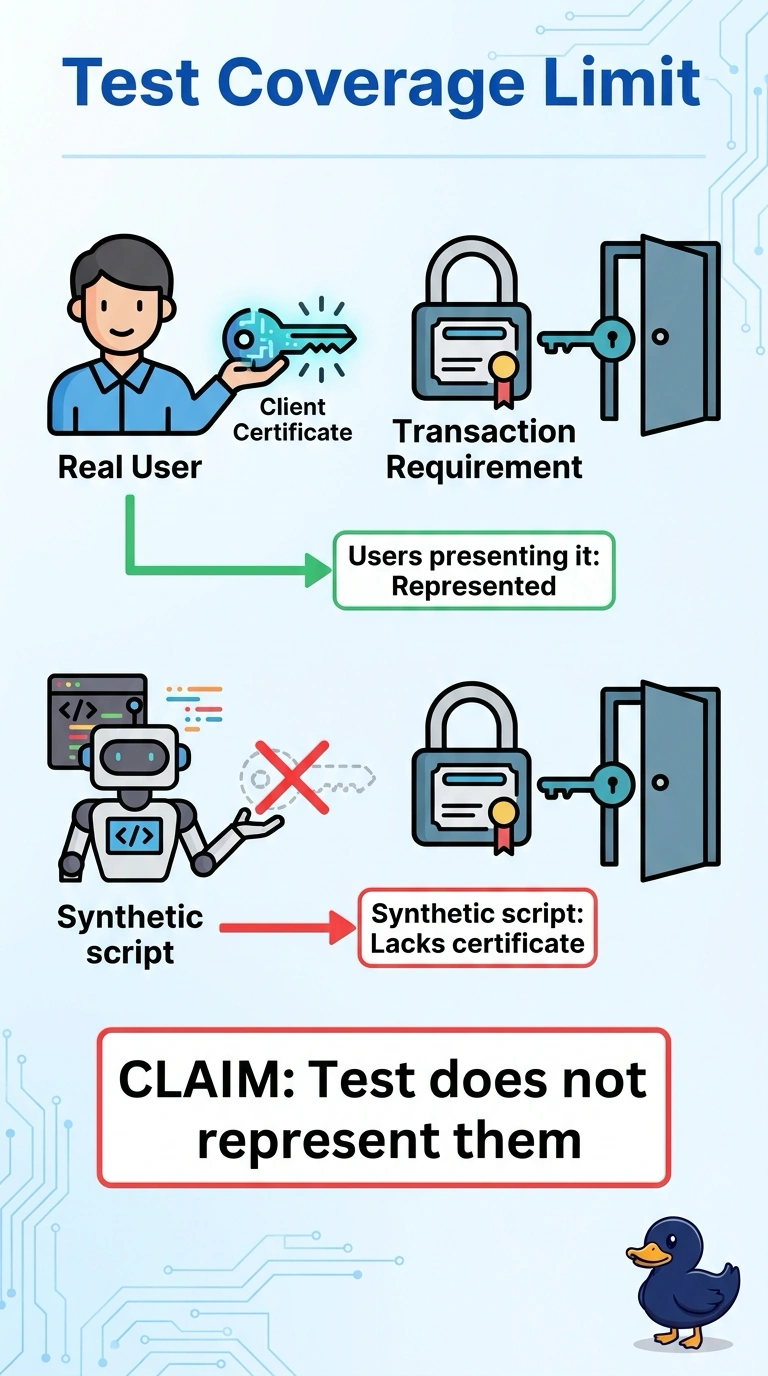
A hospital web transaction requires a client certificate that the synthetic script does not possess. What can the team claim about users who present that certificate?
Select an answer to reveal the explanation.
Short Explanation
A badge reader that your practice badge cannot open is not a tour of the ward. You cannot claim the synthetic test represents clinicians who present a client certificate the script does not have. A script without that certificate is not proof for every browser, a capture of the clinical database, or a stand-in for a real client's waterfall.
Full Explanation
The hospital transaction authenticates with a client certificate. The synthetic script does not have that certificate, so it cannot perform the same authentication the clinicians perform. The test therefore does not represent those users, and a failure or a stop at the certificate challenge speaks about the script's missing credential, not about a clinician who presents one. Claiming the script still proves every clinician browser completed the transaction overstates a run that cannot meet the application's requirement. Treating the synthetic run as a packet capture of the clinical database confuses a web transaction with a copy of database queries the agent does not collect. Replacing a real client's browser waterfall with the script discards timing from a browser that actually presented the certificate, and it substitutes a client the application will not accept as that user. The result stays silent about certificate-authenticated users for as long as the script cannot present that credential. Exam caveat: authentication material the script lacks is a hard boundary on whom the test represents. Operational check: confirm the script has no client certificate for this transaction and label the result as not representative of certificate-authenticated users.