
A hotel chain finds that Room OS units fail a collaboration application while nearby desk PCs succeed, and the failures stay with those room devices. Which test should the team run?
Select an answer to reveal the explanation.
Short Explanation
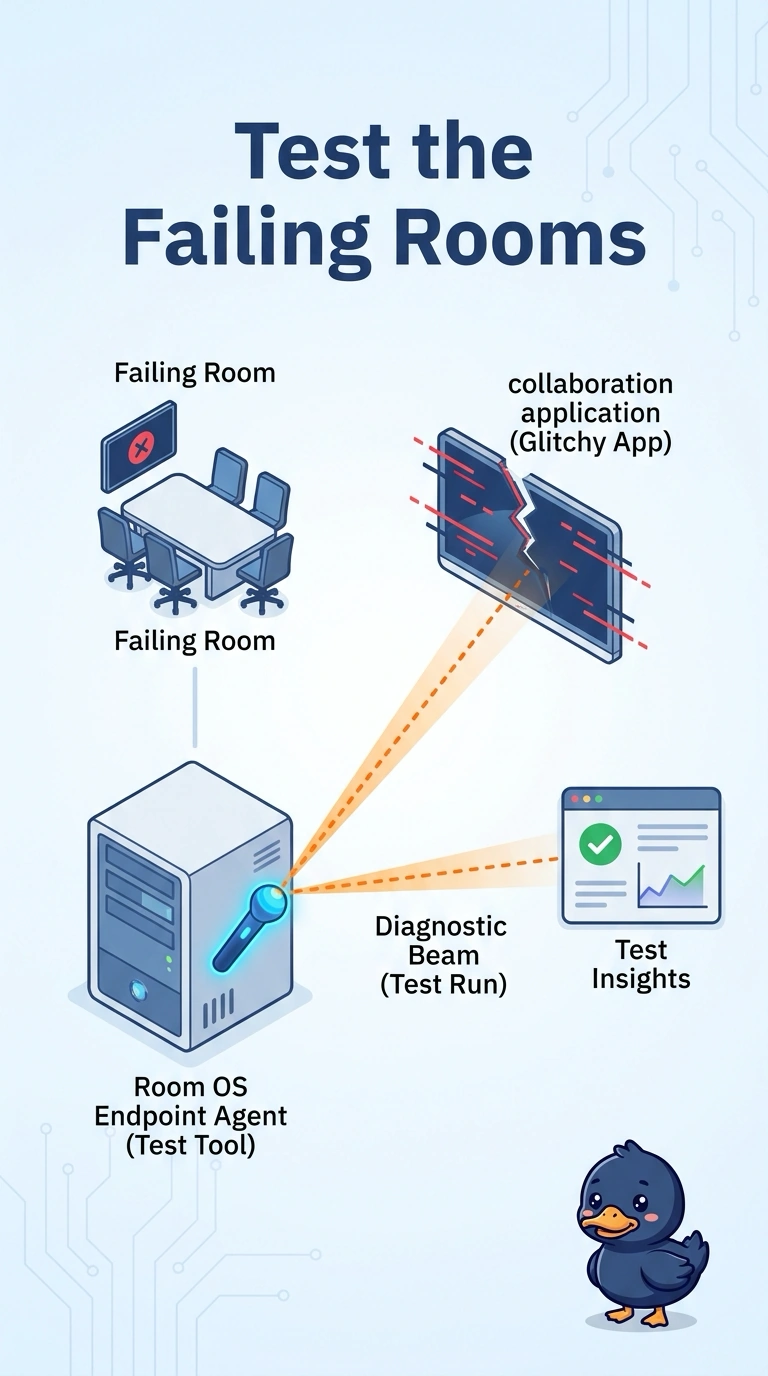
When the room screen fails and a nearby desk PC works, you test the room device, not the desk PC. You run an Endpoint Agent test on the Room OS units that are actually failing. An Enterprise Agent in the data center, a cloud DNS probe, or a server-hosted page-load test stays off that room device.
Full Explanation
Desk PCs succeed at the collaboration application while specific Room OS units fail, and the failures stay with those room devices, so the relevant vantage is the device in the room. An Endpoint Agent test on the failing Room OS units measures from the endpoint exhibiting the problem, rather than from a probe elsewhere in the hotel. An Enterprise Agent in the data center that does not sit on a room device tests from a different location and does not capture the failing units’ local conditions; success there would not resolve the device-specific failure. A DNS test from a cloud probe that does not run on the failing Room OS unit checks a resolver other than the room device’s, so it cannot explain a failure that stays with that unit. A page-load test hosted on a server that does not execute on the room device during the failure does not open the application as the room unit does. Exam caveat: a healthy nearby PC does not clear a device-specific failure; it narrows the test to the device that fails. Practical check: run the Endpoint Agent test on a failing Room OS unit and a working desk PC, then compare the local network conditions each reports.