
A government agency finds that a remote worker's home router sits in front of a failing laptop, and data-center probes do not traverse that home router. Which test should the team run?
Select an answer to reveal the explanation.
Short Explanation
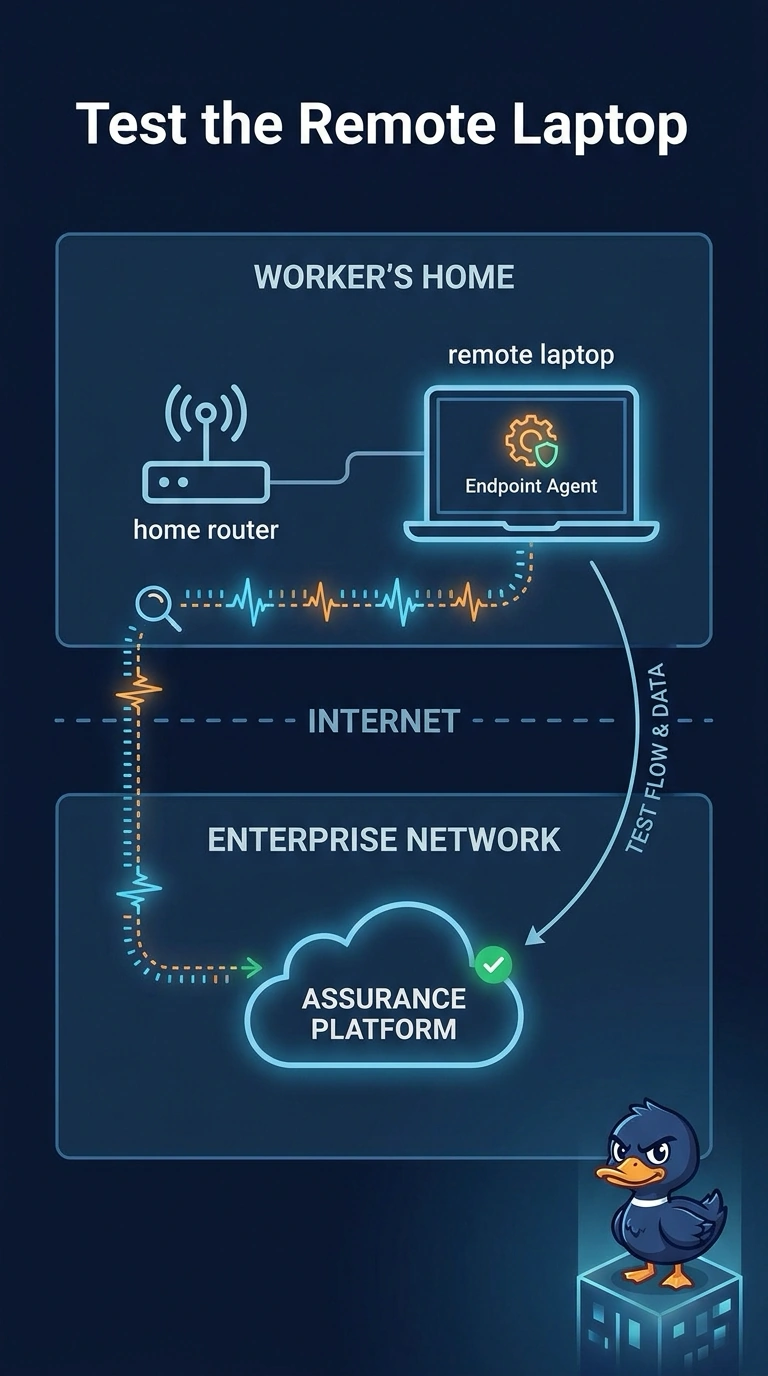
A leak under the kitchen sink does not show up when you only pressure-test the city water main. You run an Endpoint Agent test on the laptop behind that home router. A data-center Enterprise Agent, a cloud DNS probe, or a server page-load stays on the far side of the worker's home network.
Full Explanation
The failing laptop sits behind a home router that data-center probes never cross, so a test that starts in the data center cannot observe the local network in front of that worker. An Endpoint Agent test on the laptop behind that home router runs on the user device and includes the home gateway on the path the worker actually uses. An Enterprise Agent in the data center that does not cross the worker's home router measures a different path and will keep succeeding, or failing, for reasons that are not the home router. A DNS test from a cloud probe that does not sit behind the worker's home router uses a resolver and a network the laptop does not use at home, so it cannot show a lookup or a gateway problem on that home network. A page-load test that runs on a server and does not run on the remote laptop at all loads the page from a host that is not behind the home router. Exam caveat: remote-worker failures that depend on the home network have to be measured from the endpoint behind that network. Operational check: from the affected laptop, confirm the endpoint path includes the home gateway, and confirm the data-center probe path does not.